
 English
  French
  Spanish
  Russian
  Arabic
  Portuguese
  Indonesian
  German
  Turkish
  Persian
  Vietnamese
  中文
中文 Filter presses are widely used in chemical processing, metallurgy, mining, and environmental treatment for solid–liquid separation. As industries continue to pursue higher production efficiency, lower operating costs, and greater automation, traditional filtration technologies are increasingly compared with advanced solutions.
Two commonly evaluated options are the Plate and Frame Filter Press and the Vertical Filter Press. While plate and frame presses remain popular due to their simple structure and lower initial cost, vertical filter presses —such as those developed by New Hongda (NHD)—are designed to meet modern industrial demands for high throughput, automation, and long-term operational stability.
This article compares these two technologies in terms of productivity, footprint, equipment materials, cake moisture, and automation, helping engineers and plant operators select the right filtration system.
What Is a Plate-and-Frame Filter Press?
The plate and frame filter press is a traditional batch filtration device consisting of alternating flat plates and hollow frames. When clamped together, these components form filtration chambers where solids accumulate during operation.
Slurry is pumped into the press through corner feed ports. Solid particles collect on the filter cloth surfaces, forming filter cakes within the frames, while the filtrate flows through drainage channels and exits the system. Once filtration is complete, the press is opened, and the filter cakes are removed manually or semi-manually.
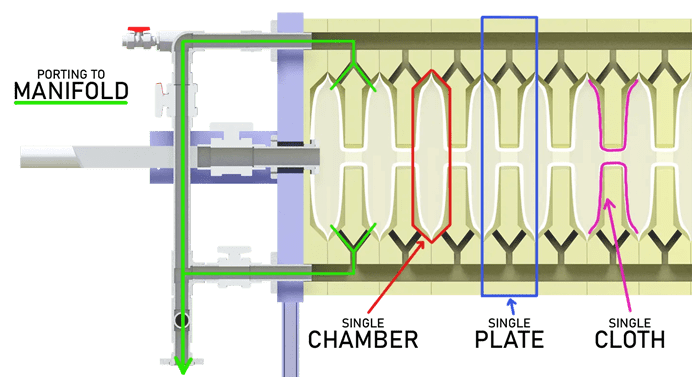
Diagram of a plate and frame filter press, source: M.W Watermark
Advantages of Plate and Frame Filter Presses
Plate and frame presses offer strong flexibility in filtration media. In addition to filter cloth, they can utilize filter paper or other fine filtration materials, making them suitable for polishing filtration applications that require high filtrate clarity.
The design also allows relatively easy filter cloth replacement and adjustable cake thickness by changing frame dimensions. These characteristics make plate and frame presses suitable for low-solids concentration slurries and small to medium production capacity.
Limitations of Plate and Frame Filter Presses
Despite their long industrial history, plate and frame presses face several limitations in modern large-scale operations.
Production efficiency is relatively low due to batch operation and extended auxiliary steps such as plate opening, cake removal, and cloth cleaning. The equipment typically requires a large installation area, increasing plant construction costs.
Filter cake moisture usually ranges between 20% and 40%, which often requires additional drying processes and increases energy consumption. In addition, many plate and frame presses rely heavily on manual or semi-automatic operation, resulting in higher labor intensity and less consistent performance.
What Is a Vertical Filter Press?
A vertical filter press is a high-efficiency filtration system designed for automated and large-scale industrial production. The filtration plates are arranged vertically, allowing gravity-assisted cake discharge and compact equipment installation.
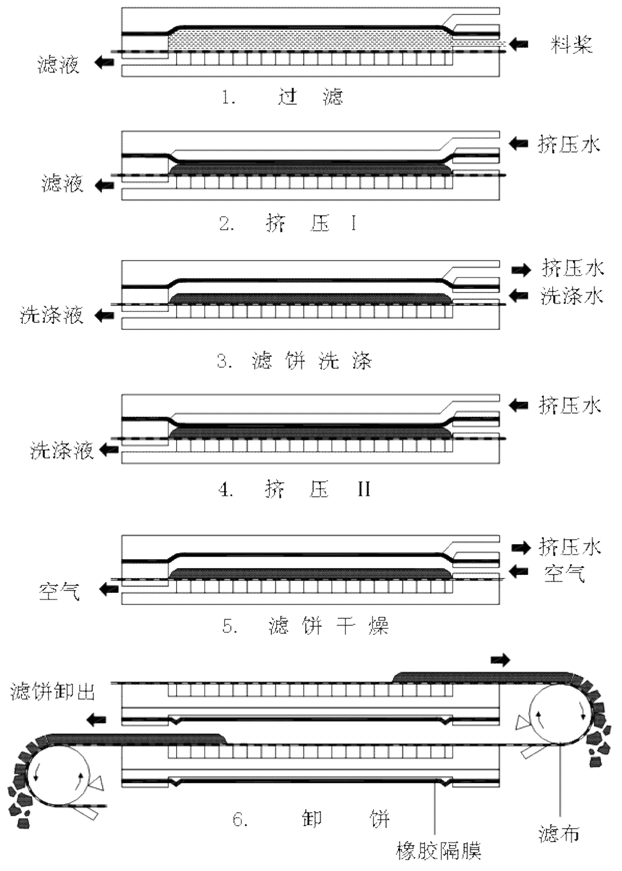
Diagram of a Vertical Filter Press in Filtration and Cake Discharge Process
NHD vertical filter presses are engineered to handle complex chemical and metallurgical processes where reliability, capacity, and operational stability are essential.
Design and Structural Advantages of Vertical Filter Presses
One major difference between vertical filter presses and plate and frame presses lies in equipment construction.
NHD vertical filter presses utilize all-metal filter plates, typically made from stainless steel. Compared with polymer plates used in traditional presses, metal plates provide higher structural strength, improved corrosion resistance, better temperature tolerance, and longer service life.
The vertical arrangement also allows significantly reduced equipment footprint. In many applications, vertical filter presses require only one-quarter to one-tenth of the installation area of plate and frame presses with similar capacity, which can substantially reduce plant infrastructure investment.
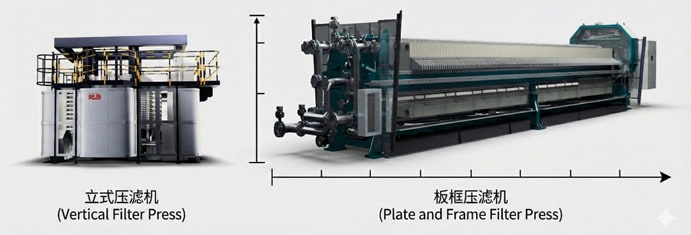
Comparison of Footprint: Vertical Filter Press vs. Plate and Frame Filter Press
Productivity and Filtration Performance
Vertical filter presses are designed to maximize production efficiency and operational consistency.
The filtration capacity per unit area can reach up to six times that of plate and frame presses, and total system capacity can increase by as much as thirty times under optimized conditions. Filtration cycles are significantly shorter. Under optimal conditions, the rapid filtration cycle can be completed in as little as 5-6 minute, allowing continuous high-throughput production.
Another major advantage is superior dewatering capability. Through high-pressure pressing, vertical filter presses can achieve filter cake moisture levels below 10%. Lower moisture reduces downstream drying requirements, saving both energy consumption and transportation costs.
Automation and Operational Reliability
Automation is a key advantage of vertical filter presses. NHD systems integrate automated filtration, washing, cake discharge, and dual-sided filter cloth cleaning. Intelligent control systems allow real-time monitoring and fault diagnosis.
In practical operation, one operator can supervise multiple machines simultaneously, significantly reducing labor costs and improving operational consistency. Fully automated cycles also minimize human error and enhance overall process stability.
Key Differences Between Plate and Frame and Vertical Filter Presses
Plate and frame filter presses are traditionally used in applications that emphasize filtration flexibility and lower initial investment. They perform well in polishing filtration and low-solids processing.
Vertical filter presses are designed for modern industrial production that requires high capacity, high automation, and low operating cost. Their advantages become especially significant in chemical, metallurgical, and mining industries where continuous operation and high product dryness are critical.
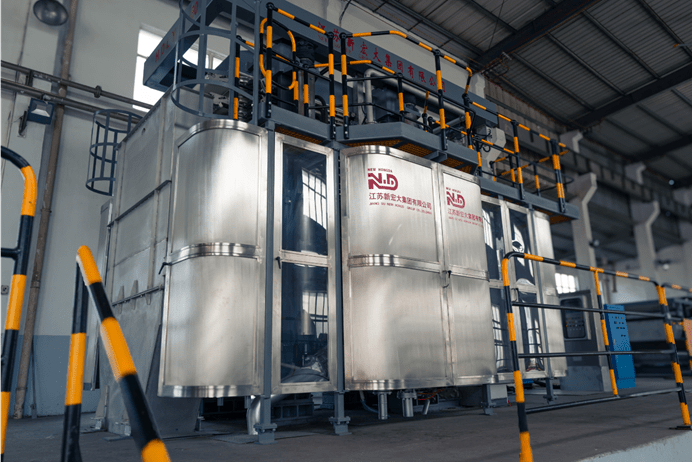
NHD Vertical Filter Press
Which Filter Press Is Right for Your Application?
A plate and frame filter press is typically suitable for:
- Polishing filtration or fine clarification
- Low solids concentration slurries
- Small or medium-scale production
- Applications requiring flexible filtration media
A vertical filter press is generally recommended for:
- High-solids concentration slurries
- Large-scale continuous production
- Applications requiring low cake moisture
- Fully automated filtration processes
- Corrosive or high-temperature operating environments
Conclusion
Both plate and frame and vertical filter presses remain important technologies in industrial filtration. Plate and frame presses provide flexibility and remain suitable for polishing applications and smaller-scale operations.
However, as industrial production increasingly demands higher efficiency, lower energy consumption, and greater automation, vertical filter presses offer clear advantages. NHD vertical filter presses deliver higher throughput, reduced installation footprint, lower cake moisture, and fully automated operation, helping industrial facilities improve long-term productivity and cost control.
Selecting the right filtration technology is not only a process decision but also a strategic investment in operational performance and competitiveness.
FAQ
Q: What is the main difference between a plate and frame filter press and a vertical filter press?
A: A plate and frame filter press operates horizontally and is usually manual or semi-automatic. A vertical filter press uses vertically arranged plates with fully automated cycles, offering higher capacity, faster filtration, lower cake moisture, and reduced labor demand, making it more suitable for large-scale production.
Q: Which filter press produces lower filter cake moisture?
A: Vertical filter presses generally achieve moisture levels below 10% through high-pressure dewatering. Plate and frame filter presses typically produce 20–40% moisture, often requiring additional drying.
Q: Is a vertical filter press suitable for large-scale industrial applications?
A: Yes. Vertical filter presses support high throughput, shorter cycle times, and automated operation, allowing efficient use in industries such as mining, chemical processing, metallurgy, and environmental treatment.
Q: When should a plate and frame filter press be selected?
A: Plate and frame filter presses are suitable for applications requiring high filtration precision, flexible filter media, and smaller production capacity, such as polishing filtration and laboratory-scale processes.