
 English
  French
  Spanish
  Russian
  Arabic
  Portuguese
  Indonesian
  German
  Turkish
  Persian
  Vietnamese
  中文
中文 
Electric vehicles now roll off assembly lines by the millions, and grid-scale storage projects pop up almost weekly. At the heart of many of these systems sits the LFP battery — stable, safe, and increasingly affordable. Yet the performance of every LFP cell begins far upstream, in the careful production of battery-grade iron phosphate (FePO₄). One weak link in that chain can ruin cycle life or safety margins. The critical gatekeeper step is phosphate filtration combined with thorough filter cake washing. Without it, soluble impurities stay trapped and later damage the cathode. That is exactly why more plants are turning to advanced vertical filter press technology to hit strict battery grade purity targets at industrial scale.
Why Battery-Grade FePO₄ Purity Is Hard
Battery makers set tough targets that go well beyond a simple purity number. They demand iron phosphate that will deliver consistent voltage and long life in the finished cell. Reaching those targets starts with knowing exactly what the material must leave behind.
What “Purity” Really Means in FePO₄
Purity in this context means more than 99.5 % FePO₄ content. It also requires extremely low levels of soluble ions such as sodium, sulfate, and chloride — often below 0.05 %. Fine particle contamination must stay under control because oversized or undersized grains affect slurry viscosity later in cathode coating. Even trace heavy metals can trigger side reactions that shorten battery life by 15–20 % after 1,000 cycles. In short, every kilogram of iron phosphate slurry carries mother liquor rich in unreacted phosphates and acids. If those residuals are not removed before drying and calcination, the final powder fails battery grade purity tests.
Getting the targets clear is only the first step. Many older filtration methods simply cannot keep up when daily output climbs from hundreds of kilograms to dozens of tons.
Why Traditional Filtration Often Fails at Scale
Take belt filters as a typical example. They form a thin cake that cracks very easily. Wash water then channels through the cracks instead of pushing the old liquor out evenly. The discharged cake often carries more than 30 % moisture. That forces extra energy use in downstream dryers. Plate-and-frame presses rely on manual plate opening and cloth changing. Every human step brings the risk of error and contamination. At high throughput, cake thickness changes across each plate. Impurity removal therefore differs from batch to batch. As plants grow larger these problems only get worse. The result is frequent off-spec material, higher waste, and lost production time.
The Deciding Step for Purity: Filter Cake Washing
Forming the cake is important, yet the real purification happens in the next few minutes. Filter cake washing turns a simple solid-liquid separation into a true purification process that protects downstream cathode performance.
Displacement Washing: How Purity Is Actually Achieved
In displacement washing, clean water enters the chamber after the initial filtration. It pushes the trapped mother liquor out through the cake in a steady piston-like flow. A properly designed chamber makes sure the wash front moves evenly across the whole cake. Short-circuit paths disappear. With a wash ratio of 1.5 to 2.0 times the cake void volume, soluble impurities drop by 90–95 %. The process works best when the cake itself is dense and free of cracks. High-pressure systems create that kind of cake far more reliably than older equipment.
Single-stage washing already lifts quality noticeably. Still, the strictest LFP specifications often demand even tighter control and rock-solid batch-to-batch repeatability.
Why Multi-Stage Washing Improves Consistency
A second squeeze after the first wash removes leftover liquid before a second wash cycle begins. This staged approach refreshes the driving force for diffusion and reduces the final impurity level another 5–8 %. Plants that run multi-stage washing report lower standard deviation in soluble ion content across 100 consecutive batches. The extra step also raises phosphate recovery rates above 98 %, cutting raw-material costs without extra equipment.
Why Vertical Pressure Filters Are Replacing Traditional Methods?
Older filters have served the industry for decades, yet their limitations become obvious at modern LFP volumes. Vertical pressure filters solve those pain points through higher pressure, better cake structure, and full automation.
High-Pressure Filtration That Builds a More Uniform Cake
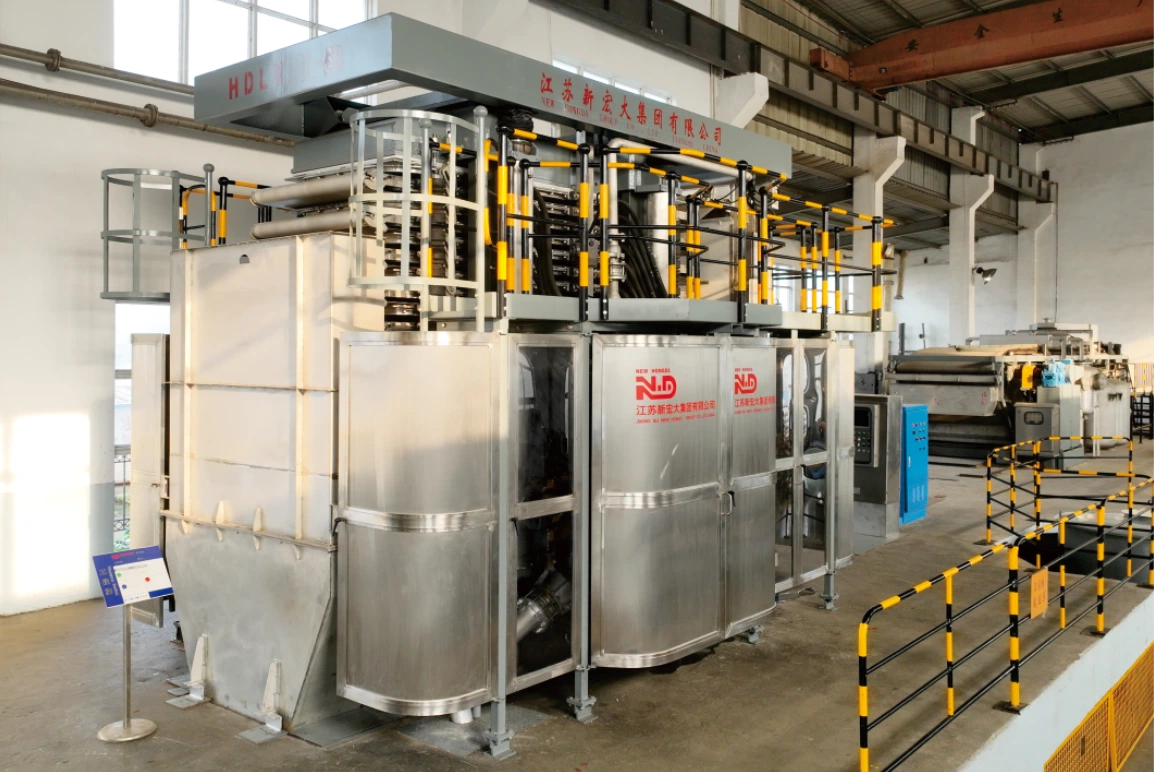
The vertical design stacks filter chambers in a compact four-column frame. Hydraulic pressure reaches 1.6 MPa — roughly three times higher than typical plate-and-frame units. This force creates a cake up to 45 mm thick that is dense and uniform from top to bottom. Uniformity prevents channeling during washing and keeps filtrate clarity high. As a result, the iron phosphate filter retains fine particles that would otherwise escape in traditional setups.
Cake Washing Performance That Improves Impurity Removal
Once the cake forms, the chamber fills completely with wash liquid thanks to the flexible diaphragm. Every part of the cake sees the same wash conditions. This thorough contact removes more residual liquor than gravity or low-pressure systems can manage. Plants using vertical filter press technology routinely achieve final cake moisture below 10 % after the full cycle, eliminating the need for separate thermal drying in many cases.
Process Stability That Scales With Automation
Every step — feeding, squeezing, washing, air drying, and discharge — runs under PLC control. Operators monitor the entire cycle from a single panel that includes self-diagnostics and alarms. The system repeats the same program thousands of times without variation. Capacity scales linearly with filter area, reaching outputs six times higher than equivalent frame presses. That combination of stability and scale makes the vertical filter press the choice for new LFP lines and upgrades alike.
Integrating NHD Automatic Filter Press into Your LFP Line
Knowing the advantages is useful. Seeing exactly where the equipment fits and how to size it turns theory into a practical project plan. NHD’s automatic filter press slots neatly into existing iron phosphate flowsheets and delivers measurable gains in battery grade purity and throughput.
Where It Fits in the Process
The vertical automatic pressure filter sits immediately downstream of the FePO₄ precipitation reactor. Slurry at 20–30 % solids enters the chambers. Filtrate exits while solids build the cake. High-pressure water then squeezes the cake, followed by filter cake washing, a second squeeze, compressed-air drying, and automatic discharge. The dried cake drops onto a conveyor headed for calcination.
Here is the six-step cycle in sequence:
- Slurry feeding and filtration
- First diaphragm squeeze
- Cake washing (optional multi-stage)
- Second squeeze
- Air drying
- Cake discharge
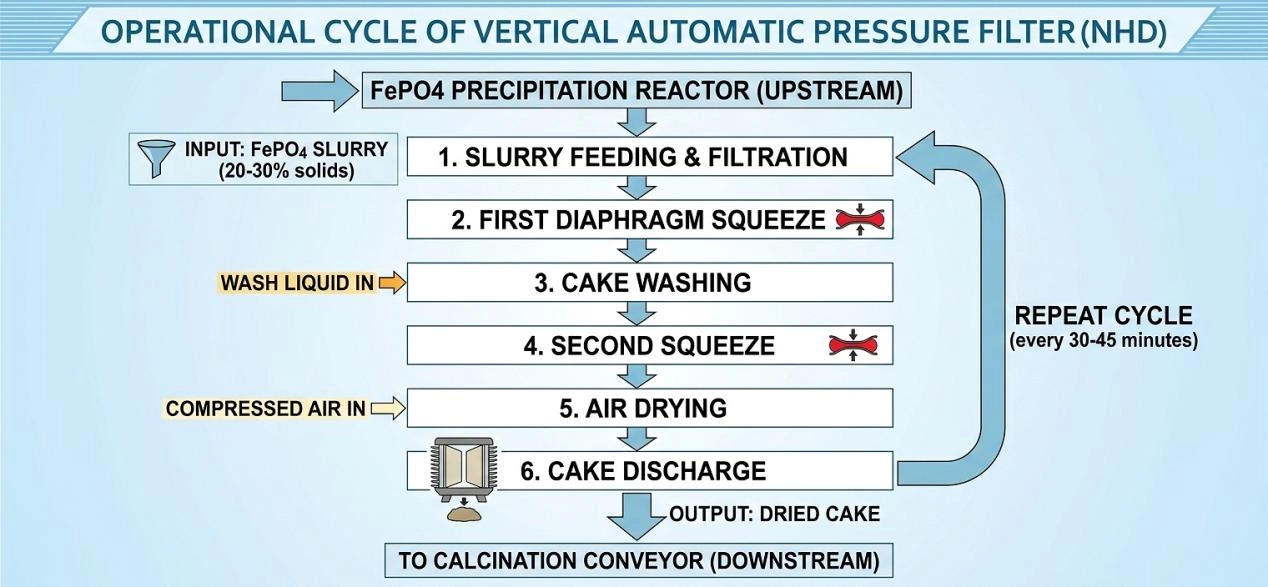
The entire sequence repeats automatically, producing consistent cake every 30–45 minutes depending on model size.
Automation as a Purity and Consistency Tool
Full automation removes operator variability. The control panel handles timing, pressure setpoints, and wash volumes with precision. Built-in sensors detect cloth condition and trigger alarms before problems arise. Because the process never pauses for manual intervention, purity stays within tight limits across shifts and weeks.
Practical Sizing / Selection Inputs
Selection starts with daily dry solids tonnage and required cycle time. Filter area ranges from 6 m² for pilot lines to 180 m² for large plants. For a typical 20-ton-per-day iron phosphate operation, a 30–60 m² unit usually suffices. Key inputs include slurry solids content, target cake moisture (<10 %), and wash water quality. NHD offers models with 1.6 MPa maximum pressure and cake thickness up to 45 mm. The compact footprint fits existing buildings without major civil works.
Conclusion
Rising LFP demand continues to push FePO₄ producers toward higher capacity and tighter purity. Vertical pressure filters deliver uniform cakes, superior filter cake washing, and drier discharge compared with legacy equipment. The result is reliable battery grade purity, higher raw-material recovery, and lower operating costs. NHD’s automatic filter press has proven itself in phosphate filtration lines worldwide. To explore how this LFP filtration equipment can fit your plant, please contact our team at sales@chinanhd.com for a customized solution.
FAQs
Q1: Why is a vertical pressure filter better than a belt filter for LFP production?
A: It creates a thicker, more uniform cake and supports deeper filter cake washing at higher pressure.
Q2: How does filter cake washing improve battery grade purity?
A: It displaces residual mother liquor and soluble impurities from the cake pores.
Q3: How NHD filter press helps scale FePO₄ production?
A: Full automation and 6× higher capacity deliver consistent battery grade purity at larger volumes.