
 Vietnamese
  English
  French
  Spanish
  Russian
  Arabic
  Portuguese
  Indonesian
  German
  Turkish
  Persian
  中文
中文 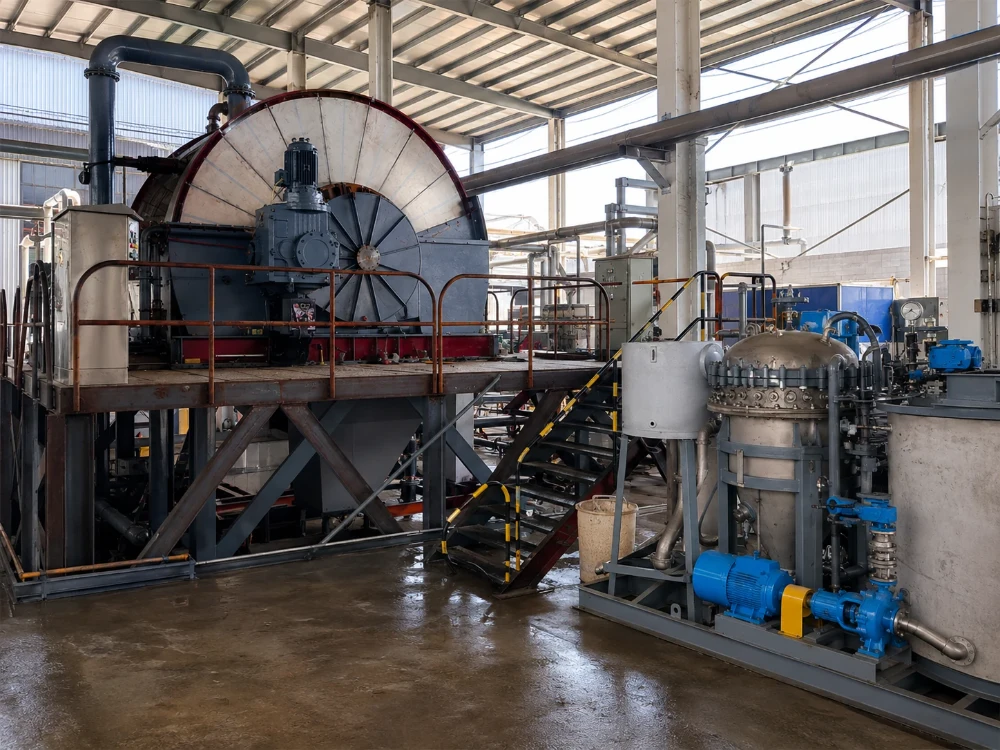
In a Bayer process alumina plant, filtration requirements change significantly throughout the production flow.
Different process stages involve different materials, from high-solid slurry separation to fine particle removal and liquor clarification. As a result, no single filtration technology can provide the best performance for every process condition.
Một Bộ lọc đĩa is designed for continuous vacuum filtration duties where large volumes of slurry require solid-liquid separation, cake formation, drying, and discharge.An Bộ lọc lá tự động serves a different purpose: enclosed pressure filtration for applications requiring high filtrate quality, fine particle removal, and efficient liquid recovery.
Instead of viewing Disc Filters and Automatic Leaf Filters as competing technologies, alumina producers should understand where each filter fits in the Bayer process and how they can work together to improve filtration efficiency, product recovery, and operational stability.
Why Does an Alumina Refinery Need More Than One Filtration Duty?
Different Bayer Process Stages Require Different Separation Targets
A Bayer circuit does not handle one constant slurry from feed preparation to alumina product. Grinding and digestion create a caustic slurry; clarification separates mud from liquor; precipitation produces aluminum hydrate; classification and downstream handling then change the solids and liquid requirements again. Each stage presents a different separation target, which means equipment selected for one position in the circuit will not necessarily perform the same role in another.
High-Throughput Filtration and Fine Filtration Solve Different Problems
A high-solid hydrate stream needs enough active area, vacuum contact, cake formation, drainage, and discharge capacity to keep a continuous line moving. A clarified liquor with fine suspended particles presents a different problem: filtrate quality, enclosed operation, and controlled recovery can matter more than cake throughput. Treating these as the same separation task can create an avoidable mismatch between equipment and process target.
Choosing a Filter Based on Process Duty, Not Equipment Type
The useful question is not whether a Disc Filter or an Automatic Leaf Filter is the better machine in general. It is whether the incoming material, required output, pressure or vacuum conditions, and downstream destination match the operating principle of the proposed unit. This distinction allows the refinery team to assign each filter a defined role — and to evaluate how the two stages interact rather than treating them as independent equipment choices.
Disc Filter in Alumina Plants: Continuous High-Capacity Solid-Liquid Separation
How Disc Filters Work in Alumina Filtration
A Disc Filter uses a series of rotating filter discs to maintain continuous vacuum filtration. The vacuum draws liquid through the filter cloth into the internal filtrate collection system while solids remain on the disc surface and form a cake. As the discs rotate through the operating zones, filtration, drainage, discharge, and cloth regeneration can be repeated without stopping the main separation cycle.
In the Bayer process, Disc Filters are mainly used for alumina hydrate filtration after precipitation.
At this stage, the equipment separates alumina hydrate solids from mother liquor and prepares the filtered hydrate for downstream calcination.
Key requirements include:
- High processing capacity for continuous production
- Stable cake formation and discharge
- Controlled cake moisture for calcination
- Reliable long-term operation
Compared with batch filtration systems, Disc Filters provide a larger filtration area and continuous operation capability, making them suitable for large-scale alumina refineries.
NHD Disc Filter for Continuous Alumina Filtration
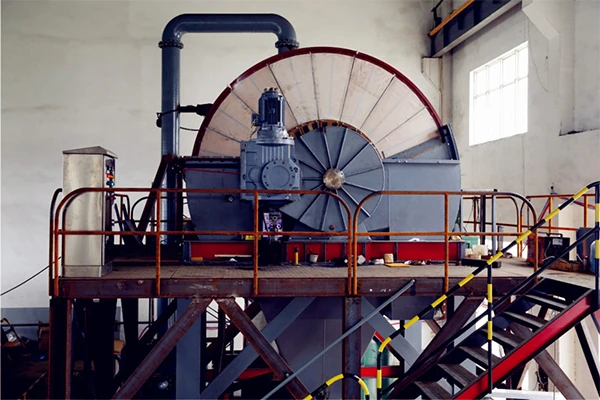
Các NHD Disc Filter is designed for continuous vacuum filtration duties in alumina and other chemical industries.
Its multi-disc structur provides a large filtration and drying surface within a compact footprint. The center spindle and distribution valve coordinate feed, vacuum, filtrate withdrawal, and discharge in a continuous sequence — suited to alumina duties where stable throughput across repeated cycles matters more than batch capacity.
When a disc reaches the discharge zone, back-blowing can release the formed cake into the receiving hopper. After discharge, the cloth can be washed and regenerated before returning to filtration. This sequence keeps the filtration surface active and limits cloth blinding between cycles.
Feed distribution matters when solids can settle or crystallize in the tank. Tangential and bottom feeding arrangements can help keep material moving through the vessel, while rapid pneumatic discharge limits the time that separated solids remain near the equipment bottom during an interruption. These details connect the mechanical layout with continuous operation and maintenance stability.
Automatic Leaf Filter in Alumina Plants: Fine Filtration and Liquor Clarification
Why Some Alumina Processes Require Fine Filtration
Not every stream in an alumina plant is a high-solid cake-dewatering duty. After coarse separation, the remaining liquid may still contain fine particles or may be difficult to filter because of low solids, high viscosity, or a demanding clarity target. In this situation, an enclosed pressure filter can provide a more suitable filtration logic than increasing the area of a continuous vacuum machine.
Typical Alumina Applications for Automatic Leaf Filters
In a Bayer flow route, a leaf-filter duty can follow clarification, where the unit polishes pregnant liquor before the process moves toward precipitation. The exact application still depends on liquor chemistry, suspended-solid loading, required filtrate quality, pressure basis, and recovery target. These conditions should be verified in the project design rather than assumed from the product name alone.
NHD Automatic Leaf Filter for Enclosed Fine-Filtration Duties
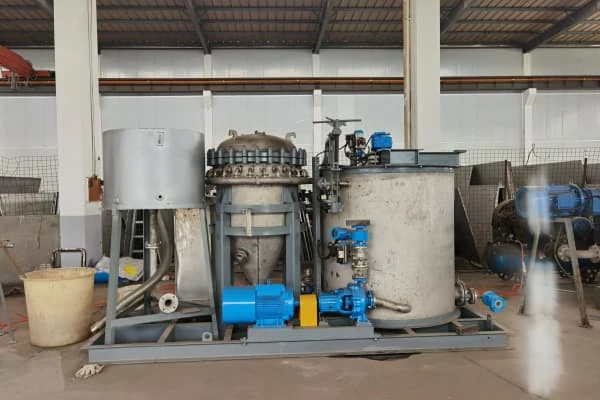
Các NHD Automatic Leaf Filter is designed for fine-filtration applications in alumina and other chemical industries where controlled filtration performance is required. Its product configuration can be customized according to the required pressure, filtrate quality, element material, cake discharge method, and control scope after the process conditions are defined. Its maximum design pressure of 1.0 MPa can meet demanding industrial filtration requirements.
The vessel, head, filter elements, liquid collecting manifold, high-level tank, pressure relief pot, and hydraulic fast-open device form one enclosed filtration system. Fine filtrate passes through the cloth and collecting tubes into the manifold and high-level tank, then flows onward. This arrangement keeps the liquid path controlled while the solids accumulate on the filter surface.
At the end of a filtration cycle, pressure is released and liquid stored in the high-level tank flows back through the system. The back-flush strips the cake from the filter elements, allowing the solids to settle in the vessel cone before discharge. The product design also supports cloth recovery without water consumption, which can reduce the washing and evaporation load in the surrounding process.
Automatic operation, PLC touchscreen control, isolation valves, and triple pressure-overload protection help keep the filtration cycle controlled. If one element becomes abnormal, isolation can limit the effect on the rest of the unit. Full enclosure, long cloth life, and easy maintenance are valuable where liquor containment and stable fine-filtration performance matter.
How Do Disc and Leaf Filters Work Together in a Bayer Process?
Different Filters, Different Roles
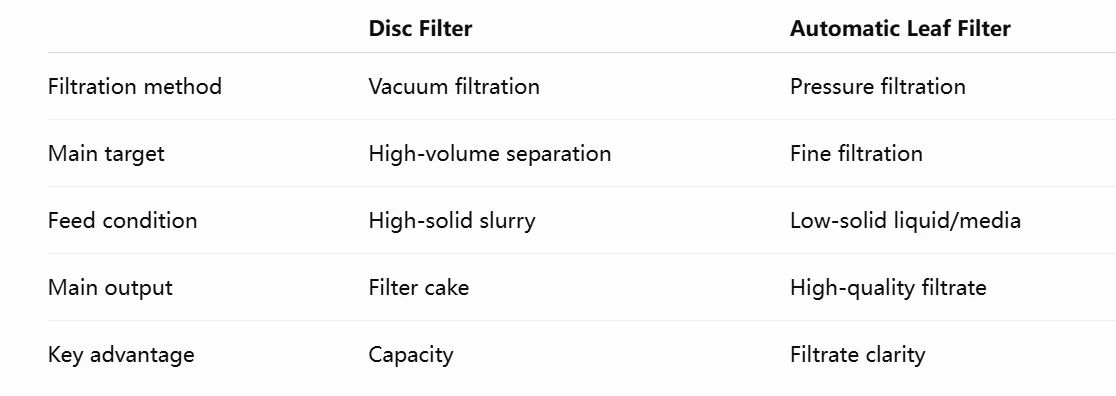
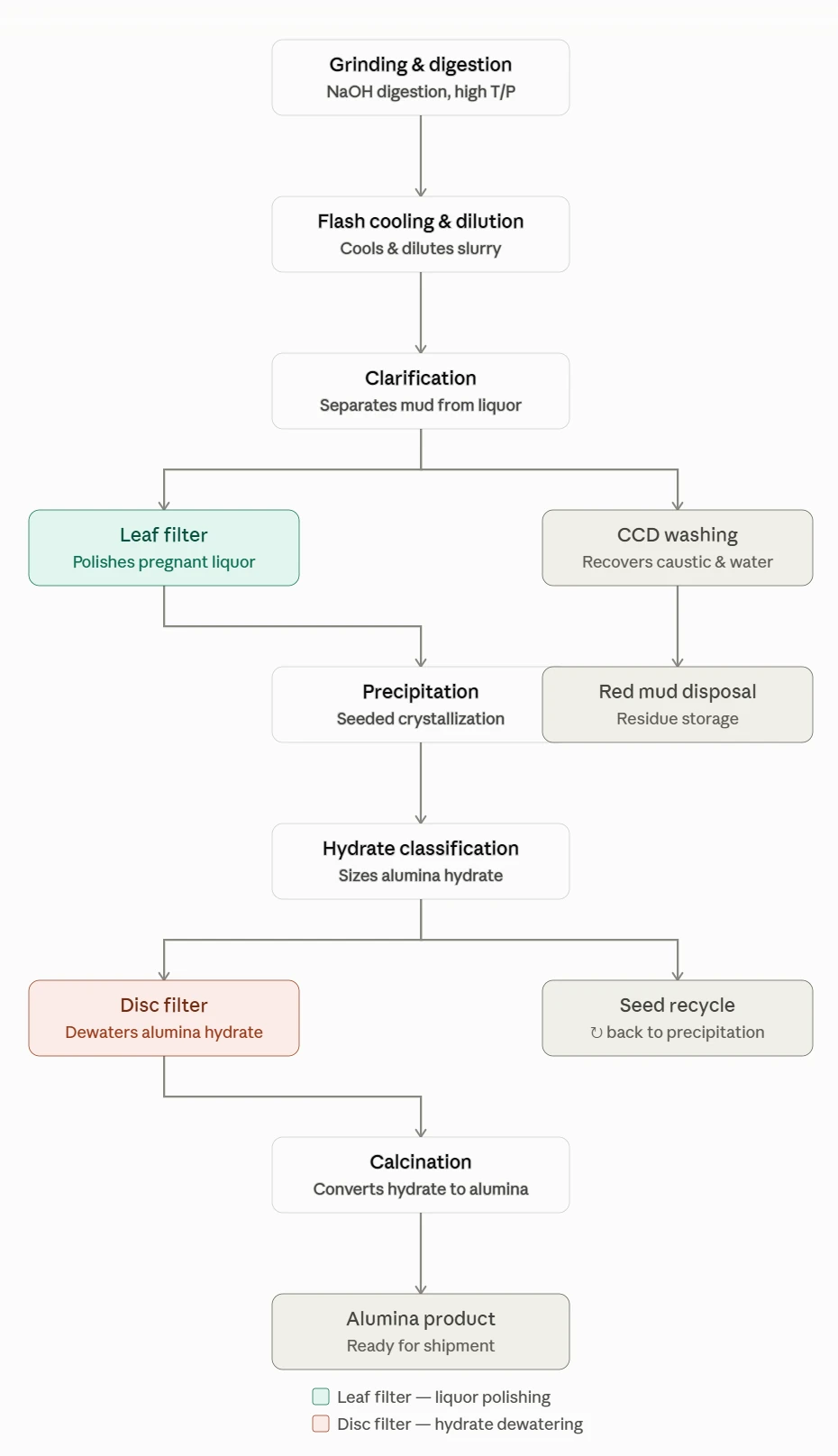
The comparison below summarizes the boundary between the two duties. It is not a ranking. Disc filtration is associated with continuous vacuum separation of a higher-solid feed, while leaf filtration is associated with enclosed pressure filtration where fine filtrate quality and liquid recovery are central.
Building an Efficient Alumina Filtration Route
The Bayer process flow can connect the two filters without making them direct alternatives. In this route, clarification separates mud from liquor and the leaf-filter duty polishes pregnant liquor. After precipitation and hydrate classification, the Disc Filter dewaters alumina hydrate before calcination. Each unit handles a different material condition, while the process as a whole benefits from clearer liquor, controlled solids recovery, and a stable hydrate cake. The result is a filtration route where each unit operates within its intended duty range — and where the overall separation performance reflects the process design rather than a compromise between incompatible equipment roles.
Why Using Only One Filtration Technology May Limit Performance
Using one filtration principle at every node can force the equipment to operate outside its useful range. A continuous vacuum machine may be unnecessarily large for a fine-liquor duty, while a pressure leaf unit is not a substitute for the area and cake-handling capacity required by a high-solid hydrate stream. Separating the roles allows the plant team to review vacuum, pressure, cake, filtrate, wash, control, and recovery requirements together.
How to Select the Right Filtration Solution for an Alumina Project?
Understand Material Characteristics Before Equipment Selection
Start with the process location and the material entering the unit. Record solid content, particle size, settling behavior, viscosity, temperature, liquor chemistry, and whether the target is a dewatered cake or a clarified liquid. These conditions determine whether continuous vacuum filtration, enclosed pressure filtration, or a coordinated combination provides the more defensible design basis.
Define Performance Targets
Capacity alone is not enough. The project team should define throughput, cake moisture, filtrate clarity, residual solids, liquid recovery, washing requirement, and acceptable operating continuity. The target should also identify where the separated cake or filtrate goes next, because a filter that meets one local number may still create a recovery or handling problem downstream.
Consider Plant Integration and Long-Term Operation
The review should include available vacuum or pressure, filtrate routing, discharge equipment, control signals, maintenance access, cloth service, utilities, and space around the unit. For a two-filter route, the interfaces between clarification, liquor polishing, precipitation, hydrate classification, dewatering, and calcination deserve the same attention as either machine by itself.
Kết luận
In an alumina Bayer process, a Disc Filter and an Automatic Leaf Filter should be judged by the duties they perform in the flow sheet, not by asking which machine is universally better. Continuous vacuum filtration, large-area cake formation, and cloth regeneration suit one process node, while enclosed pressure filtration of low-solid, high-viscosity, or difficult-to-filter media suits another. When feed conditions, recovery targets, filtrate routing, and control requirements are reviewed together, the two filtration duties can reduce process losses and support steadier resource recovery.
With its Disc Filter and Automatic Leaf Filter range, NHD helps alumina producers select the right filtration technology for each process stage — from high-capacity solid-liquid separation to fine filtration and liquor clarification. For a tailored filtration solution, NHD can evaluateBayer-process filtration data, process-node duties, slurry or liquor properties, capacity, and cake or filtrate targets. Contact us through Email: sales@chinanhd.com / WhatsApp: +86 136 6732 4277 for a more specific filtration system design.
Câu hỏi thường gặp
Q1: Are a Disc Filter and an Automatic Leaf Filter direct alternatives in an alumina plant?
A1: No. A Disc Filter is suited to continuous vacuum filtration and high-solid cake dewatering, while an Automatic Leaf Filter is suited to enclosed pressure filtration of low-solid, high-viscosity, or difficult-to-filter media. Their roles can occur at different Bayer process nodes.
Q2: What alumina filtration duty is suited to a Disc Filter?
A2: A Disc Filter is suited to a continuous alumina solid-liquid separation duty where the plant needs large filtration area, repeated cake formation, filtrate collection, drying, back-blowing discharge, and filter cloth regeneration.
Q3: When can an Automatic Leaf Filter be considered within a Bayer process filtration circuit?
A3: It can be considered where the process requires enclosed pressure filtration, fine particle removal, high filtrate quality, or liquid recovery from low-solid, high-viscosity, or difficult-to-filter media. The final fit depends on liquor chemistry, pressure, solids loading, and the required filtration result.