
 English
  French
  Spanish
  Russian
  Arabic
  Portuguese
  Indonesian
  German
  Turkish
  Persian
  Vietnamese
  中文
中文 
In industrial wastewater systems, filtration is rarely a peripheral operation. It is the point where chemical reactions, particle physics, hydraulic control, and mechanical reliability intersect. If separation fails, every upstream process loses its value because reagents are wasted, clarifiers overload, water reuse collapses, and regulatory margins disappear.
When wastewater originates from phosphoric acid plants, alumina refineries, smelters, pigment production, or hydrometallurgical circuits, solids are not passive contaminants, but are chemically active, abrasive, and structurally unstable. This is why filter presses and continuous vacuum filtration systems are not selected by catalogue capacity alone, but by their ability to sustain separation performance under hostile and variable operating conditions.
This article examines how filtration actually works in industrial wastewater systems, why performance often collapses after commissioning, and how proven engineering logic changes the outcome.
Why does filtration become the decisive bottleneck in many industrial wastewater systems?
In industrial circuits, wastewater is not a uniform fluid, and gypsum crystals, red-mud residues, metal hydroxides, silica gels, or fine phosphate slurries have to be dealt with. These solids deform under pressure, blind filter media, and change permeability during operation.
If the filtration design does not reflect this behavior, you encounter the following possible consequences:
- rising pressure drop with declining throughput
- unstable cake moisture that disrupts disposal or reuse
- short filter cloth lifetime
- frequent chemical cleaning cycles
- mechanical distortion of plates or frames
Once these effects appear, the filtration becomes the slowest stage in the entire treatment chain—clarifiers accumulate sludge, pumps operate outside their efficiency range, and downstream polishing steps receive fluctuating loads. In practice, filtration capacity determines whether wastewater treatment is a continuous process or a recurring operational crisis.
How does a filter press actually work when applied to industrial wastewater rather than laboratory conditions?
A filter press in an industrial plant does not behave like a textbook separator. Its performance depends on how solids rearrange under compression, how liquid pathways evolve inside the cake, and how evenly mechanical forces distribute across large filtration surfaces.
Why does the feeding phase already determine whether your entire filtration cycle will remain stable over hundreds of operating hours
During filling, slurry velocity, inlet geometry, and chamber balance control were solids settled first. If solids accumulate asymmetrically, later compression forms rigid zones that block liquid flow. These zones become permanent resistance layers that cannot be corrected by higher pressure.
Industrial systems, therefore, require carefully designed feed channels, controlled ramp-up profiles, and chamber layouts that distribute slurry evenly before any meaningful compression begins.
Why cake consolidation and secondary compression define your achievable moisture content more than pump pressure alone
Once solids form a structural skeleton, permeability becomes a material property rather than a mechanical setting. Increasing pressure beyond this point only collapses pores and traps liquid.
Stable filter presses rely on staged compression logic, predictable deformation of cake layers, and consistent drainage geometry. Moisture reduction is achieved through controlled consolidation, not brute force.
Why washing and air-purge phases decide whether you truly remove contaminants or simply relocate them into solid waste
In chemical wastewater, dissolved salts and acids migrate with the filtrate unless internal channels guide wash water through the entire cake thickness. Poor distribution leaves chemically active zones that later leach during storage. Industrial presses, therefore, integrate internal flow paths, timed purge cycles, and drainage segmentation to ensure washing reaches every layer.
Where does NHD fit when filtration must operate reliably in chemically aggressive and mechanically demanding environments?
NHD is a Chinese separation-equipment group founded in 1992, now integrating design, R&D, manufacturing, installation, and EPC delivery across filtration, filter presses, agitators, thickeners, sulfuric-acid equipment, desulfurization systems, and pressure vessels. Our company operates large production facilities in Dainan, Jiangsu, and employs more than 800 staff, including over 260 engineering specialists.
Our filtration systems are deployed in phosphoric chemical plants, alumina refineries, non-ferrous smelting, titanium dioxide production, coal chemicals, environmental protection facilities, and wet-process metallurgy projects, serving more than 1,000 industrial clients across over 50 countries.
After decades of field application, its rotary table vacuum filtration technology has reached roughly 98% domestic market share in phosphoric-acid processing, while automatic vertical filter presses, agitators, and thickeners exceed 50% market penetration in their respective categories.
This position was established not through branding, but through long-term performance in high-corrosion systems, large-scale continuous operation, and projects where filtration stability directly affects national fertilizer supply, alumina capacity expansion, or hydrometallurgical recovery chains.
How does vacuum filtration differ from traditional filter press logic when wastewater volumes become too large for batch operation?
Batch presses scale poorly once wastewater flow becomes continuous and high-volume. Plate shifting time, labor intensity, hydraulic fatigue, and cycle scheduling begin to increase the total cost. However, continuous vacuum filtration changes this structure.
In phosphoric wastewater circuits, gypsum crystals form abrasive cakes with strong scaling tendencies. The Rotary Table Vacuum Filter (for Phosphoric Acid) addresses those risks through:
- segmented filter discs that maintain surface flatness under load
- large-angle distribution valves that resist crystallization blockage
- adjustable overflow-type slurry distributors for uniform cake growth
- high-impact, low-consumption spray systems for cloth regeneration
- stable mechanical support that limits vibration and seal fatigue
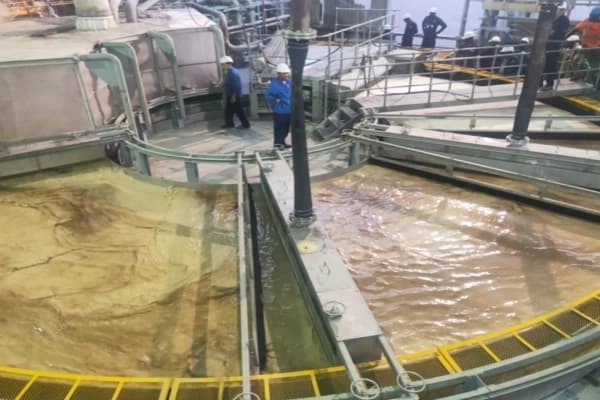
In Senegal’s 300,000-ton/year phosphoric acid project, a unit of this class covering 100 square meters replaced a smaller system and achieved 562 tons per day throughput in continuous testing, exceeding contractual targets while maintaining low soluble-phosphorus content in the cake. From a wastewater-treatment perspective, this translates into predictable solids discharge, stable filtrate quality, and reduced chemical carry-over.
How should you approach alumina-based wastewater where alkaline slurries dominate the separation behavior?
Alumina wastewater behaves differently. Instead of acidic gypsum, you face alkaline liquor with aluminum hydroxide particles that compress easily and resist drainage. This is where flat-pan vacuum filtration becomes relevant.
The Pan Vacuum Filter (for Alumina) evolved from early limitations in global alumina production, where filter size constrained line capacity. Large-diameter disc machining and reinforced pan structures allowed single-unit areas to exceed 200 m², supporting multi-million-ton refinery lines.
For wastewater treatment, this architecture provides constant hydraulic resistance, predictable alkaline filtrate recovery, low structural stress despite a large surface area, and compatibility with thickener-filter integrated circuits.
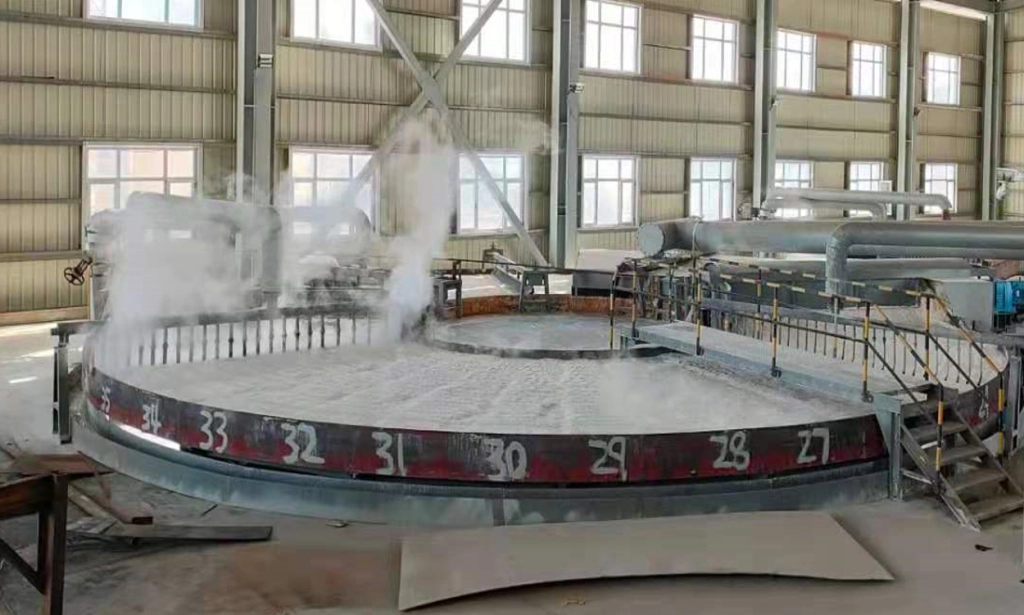
In Vietnamese alumina projects, 100 m² pan filters were integrated into 650,000-ton annual capacity lines, operating continuously with stable cake thickness and controlled liquor recovery.
What operational risks should you evaluate before selecting filtration equipment for wastewater projects?
Why structural rigidity matters more than filter area once equipment reaches industrial scale
Large filtration surfaces amplify mechanical distortion. Even millimeter-level deformation alters seal compression and internal flow balance. Designs that segment load paths and support rotating structures uniformly avoid long-term fatigue.
Why filter media compatibility with chemistry often limits service life more than mechanical wear
Acids, alkalis, fluorides, and organic solvents degrade polymer fibers at different rates. Tailored filter cloth selection extends operating cycles and reduces unscheduled shutdowns.
Why maintenance philosophy must be engineered into the equipment rather than delegated to operators
Systems built for fast inspection access, modular component replacement, and predictable wear patterns reduce dependency on emergency interventions and maintain steady treatment efficiency.
How should you judge whether a filtration solution will remain effective beyond commissioning?
Short-term performance only confirms mechanical assembly. Long-term reliability is demonstrated through:
- multi-year operation in comparable chemical systems
- stable throughput after scale-up
- availability of local installation and commissioning support
- repeat adoption by capacity-expansion projects
In phosphate, alumina, and rare-earth hydrometallurgy projects across Africa, Southeast Asia, and Australia, filtration systems based on these principles were deployed under tight standards and modular construction constraints, achieving on-time delivery and sustained performance.
Conclusion
A filter press in industrial wastewater treatment is not merely a mechanical separator. It defines whether solids become a controlled by-product or a recurring process failure.
When design reflects slurry behavior, structural stress, chemical compatibility, and operational continuity, filtration becomes a stabilizing element in the entire treatment system. When it does not, every downstream metric deteriorates. For high-solid, chemically aggressive wastewater, separation technology is not a supporting choice but a strategic process decision.
FAQs
Q: Can a filter press handle wastewater with highly variable solids concentration?
A: Yes, if chamber geometry, feed distribution, and compression sequencing are designed for permeability variation. Systems built only around nominal capacity struggle once particle size or chemistry shifts.
Q: Is vacuum filtration always preferable to pressure filtration for large wastewater volumes?
A: Not always, but continuous vacuum systems often provide better stability when flow rates are constant, and solids loading is high, especially in phosphate and alumina circuits.
Q: What causes most long-term filtration failures in industrial plants?
A: The dominant causes are uneven mechanical loading, chemically incompatible filter media, and inadequate internal washing paths, not insufficient pressure or motor power.