
 English
  French
  Spanish
  Russian
  Arabic
  Portuguese
  Indonesian
  German
  Turkish
  Persian
  Vietnamese
  中文
中文 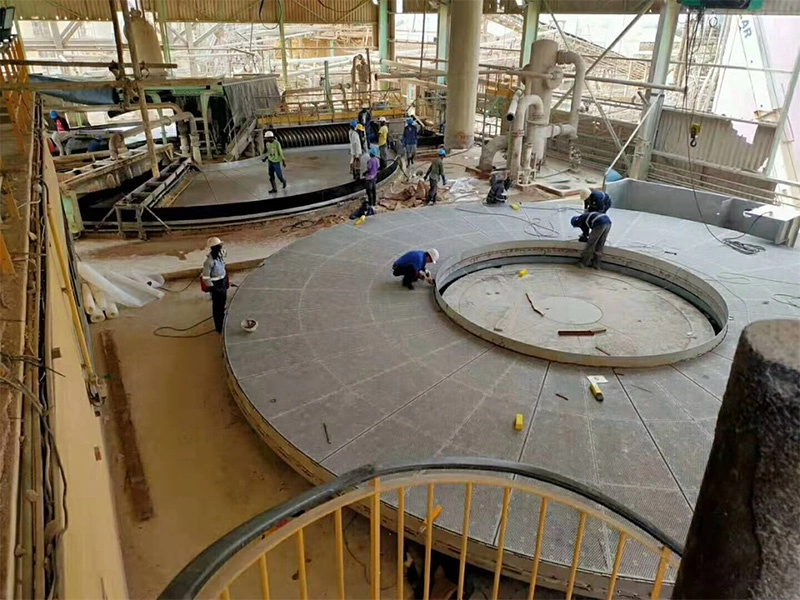
Wet process phosphoric acid plants often lose filtration stability before the problem becomes a visible equipment failure. Gypsum scaling, unstable cake washing, higher moisture, filter cloth blockage, and limited filter area can all reduce acid recovery, raise cleaning frequency, and weaken downstream production.
Phosphoric acid filtration requires more than a single-machine decision. They need to connect process conditions with cake washing, moisture target, material selection, capacity expansion, automation level, and supplier engineering support. For phosphate chemical projects, NHD Rotary Table Vacuum Filter can be discussed as a core solid-liquid separation option because it is designed for phosphoric acid plant filtration duties and has been used in large PA projects.
What Makes Wet Process Phosphoric Acid Filtration Difficult?
Phosphoric acid filtration is difficult because the filter has to deal with corrosive liquid, gypsum cake, changing slurry behavior, and continuous production pressure at the same time. A plant may call the issue “poor filtration,” but the real cause often sits in scaling, washing, cloth load, capacity, or material matching.
Gypsum Scaling and Blocking
Gypsum scaling usually starts as a cleaning issue, then becomes a production issue. Buildup around flow channels, cloth areas, or discharge sections can slow drainage, reduce suction stability, and raise cleaning frequency. In wet process phosphoric acid filtration, more manual cleaning is not a real solution if the equipment design still leaves places where gypsum can settle and block.
Cake Washing Instability
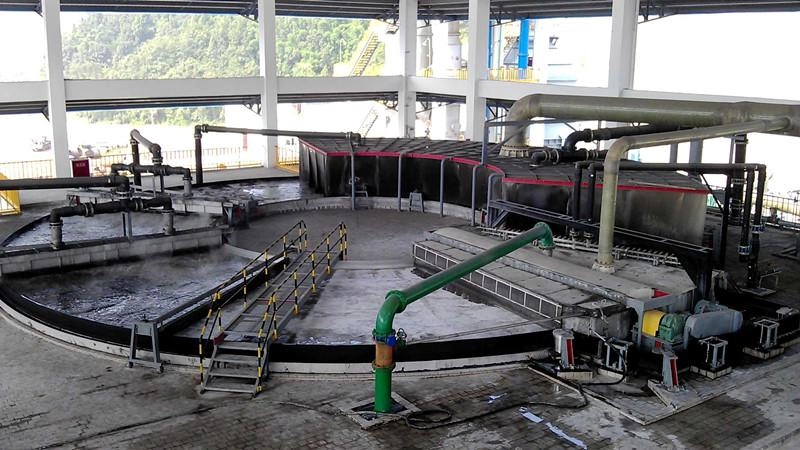
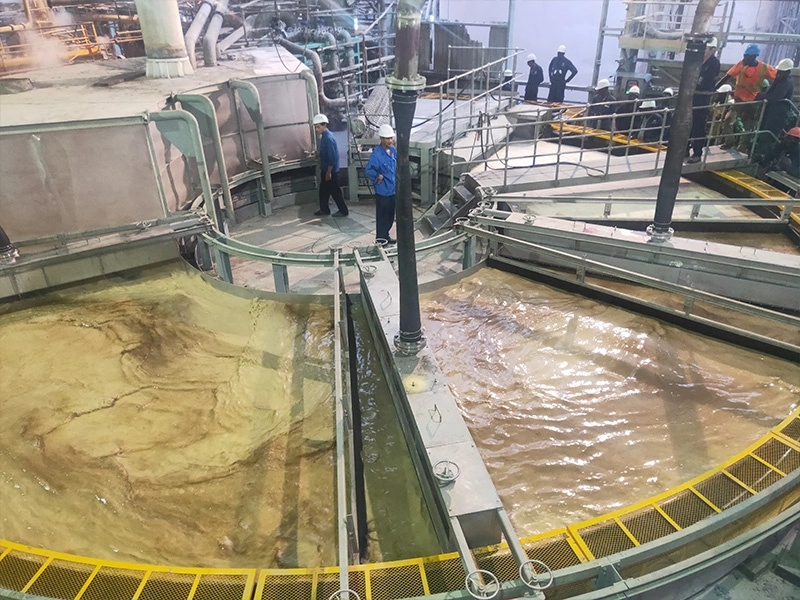
Cake washing directly affects acid recovery and phosphogypsum quality. If wash water does not pass evenly through the cake, part of the cake may carry higher soluble phosphorus while another part is over-washed. The filter design should clearly separate filtration, washing, suction, cake discharge, and cloth regeneration zones.
Filter Cloth Load
Filter cloth condition changes filtration speed, cake release, and cleaning frequency. In phosphoric acid filtration, the cloth faces gypsum particles, acid exposure, repeated washing, and mechanical movement. Once the cloth carries too much load, the plant may see higher moisture, leftover cake, or unstable discharge after each cycle.
Capacity Bottlenecks
A capacity bottleneck often appears after production expansion. Operators may shorten washing time or delay cleaning to keep output moving, but that can weaken cake washing and moisture control. For large phosphoric acid plant filtration projects, buyers should check whether the available filtration area can still support washing, drying, discharge, and cloth cleaning at the new production target.
Corrosion and Material Matching
Phosphoric acid service is not only a filtration question. Contact parts may face acid, gypsum abrasion, wash water, and cleaning routines. Acid concentration, temperature range, solids behavior, cleaning method, and contact-part material all need to be confirmed with the supplier before finalizing the selection. A poor material match can turn into leakage, local wear, or repeated repair even when the filter area is large enough.
How Do These Challenges Affect Equipment Selection?
Once the filtration problem is clear, equipment selection should not start from a catalog name. Buyers need to check how each design handles filtration area, cake washing, drying, maintenance, material exposure, and future expansion. If these points do not match the PA line, a larger machine may still fail to remove the real bottleneck.
Filtration Area and Active Area
Filtration area should be checked against target throughput, not only current production. If capacity rises, the active area still needs to leave enough time for washing, drying, cake discharge, and cloth regeneration. Too little area forces each step into a tighter window and makes stable phosphoric acid filtration harder to maintain.
Cake Washing and Drying Zones
PA filters require sufficient separation between zones (filtration, washing, drying, discharge, cleaning) to avoid unstable cake moisture and incomplete washing. This is why the review should include the rotary table structure itself, not only the total filter area.
Maintenance and Operability
Maintenance and operability decide whether the filter keeps its performance after months of real production. Easy cloth access, cleanable zones, visible wear points, spare part planning, and safe platform access all affect uptime. The project team should share any retrofit space limits before fixing the final layout of an existing plant.
Flow Parts and Material Selection
Flow parts need to match acid slurry movement and corrosion exposure. Wear often appears near channels, nozzles, bends, discharge areas, and cloth support points. When evaluating equipment, buyers should clearly identify which areas require corrosion-resistant or wear-resistant materials. Proper material selection helps extend service life, reduce maintenance frequency, and improve operating stability. For example, 316L stainless steel may be suitable for relatively mild phosphoric acid service or wash water areas, while more corrosive acid slurry conditions may require higher-alloy materials such as 904L, duplex 2205. This is also where manufacturing quality, welding, machining, and inspection become part of the equipment decision.
When Should Buyers Consider a Rotary Table Vacuum Filter Upgrade?
A rotary table vacuum filter upgrade becomes worth discussing when cleaning, washing, moisture, capacity, or site constraints start affecting the whole PA line. The warning sign is not always a full breakdown. More often, the plant loses tolerance for ore variation, higher output, or stricter washing targets.
Existing Filter Area Bottleneck
If the existing filter cannot meet target output without reducing washing or drying time, repair alone may not solve the problem. The plant should compare current filtration area, target throughput, cake washing requirement, and moisture target before deciding whether upgrade work is needed.
Larger Unit Replacement
A larger unit replacement should be based on process review and site checking. A new rotary table vacuum filter may need pump changes, piping adjustment, separator matching, civil structure review, and installation planning. Treating it as a simple size change can create new retrofit problems after the order is placed.
Retrofit Space and Civil Structure
Many phosphoric acid plants are not greenfield projects. New equipment has to fit around existing steel structures, platforms, pipes, pumps, and maintenance routes. Site drawings, current equipment dimensions, foundation limits, crane access, and available shutdown windows should be prepared before supplier discussions begin. Civil structure checks can be just as important as filter size.
Continuous Operation Test
A continuous operation test gives better evidence than a short startup observation. Buyers should define throughput, gypsum quality, washing result, moisture target, and stable running time before acceptance. Without those targets, a filter can appear to start normally while still leaving process risk unresolved.
300kt/a PA Project for INDORAMA ICS in Senegal
The INDORAMA ICS 300kt/a PA project in Senegal illustrates how capacity bottleneck and filtration area constraints translate into a concrete upgrade decision. NHD supplied a 100m² rotary table vacuum filter to replace an existing 77m² unit, addressing the throughput gap while keeping the site retrofit scope manageable. The project involved on-site assessment, civil structure reinforcement, installation planning, and a 72-hour continuous operation test. The test reached 562 tons/day, above the required 558 tons/24h, and gypsum water-soluble phosphorus content reached 0.47 against a 0.5 target.
How Should Buyers Evaluate Suppliers and Build a Procurement Checklist?
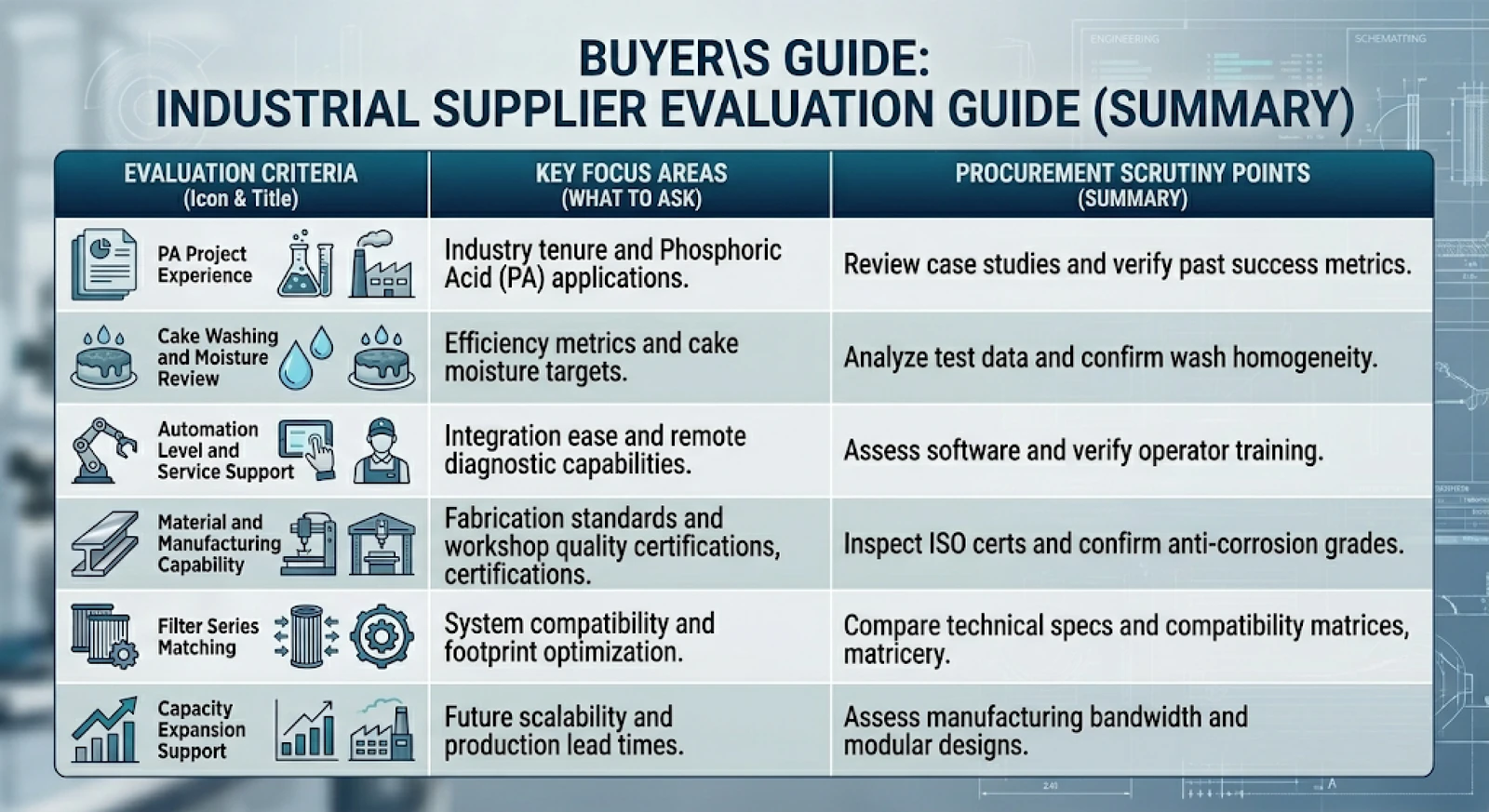
Supplier evaluation should combine process experience, project evidence, manufacturing capability, material review, and service support. A PA filtration supplier should understand the process and the site realities around replacement, installation, commissioning, and long-term maintenance. The guide below turns that review into practical procurement checkpoints.
Final Procurement Checklist for Contact Us Review
Before sending an RFQ for a phosphoric acid rotary table filter, buyers should prepare the following information:
- Current production capacity
- Target capacity expansion
- Acid slurry condition, including solid content and temperature
- Required filtration area
- Cake washing requirements
- Target cake moisture
- Material requirements for wetted parts
- Installation space and layout limits
- Automation and control expectations
- Spare parts and maintenance plan
- Factory acceptance test or performance test targets
If the existing operation is affected by scaling, high cake moisture, unstable filtration, or limited installation space, this should be clearly stated in the inquiry.
Conclusion
Wet process phosphoric acid filtration is rarely improved by increasing filter size alone. Cake washing, drying performance, gypsum scaling, filter cloth condition, material selection, and available installation space should be reviewed together before making an equipment decision. A clear understanding of these factors helps buyers avoid repeated bottlenecks and choose a rotary table vacuum filter that better matches real plant conditions.
With 30+ years of experience in solid-liquid separation, NHD has supplied more than 300 installed applications at home and abroad, with a maximum single-unit filtration area of 320㎡. In addition to phosphate chemical applications, NHD rotary table vacuum filters have also been gradually promoted in metallurgy, environmental protection, ore washing, paper making, and other industries. NHD can review PA filtration data, Filter Series matching needs, and rotary table vacuum filter requirements through sales@chinanhd.com or WhatsApp +86 13667324277 for a more specific selection discussion.
FAQs
Q1: What filtration equipment is commonly used in wet process phosphoric acid plants?
A1: Rotary table vacuum filters are widely used for continuous phosphoric acid filtration, cake washing, drying, discharge, and cloth regeneration.
Q2: Why does cake washing matter in phosphoric acid filtration?
A2: Poor cake washing can raise soluble phosphorus loss, waste wash water, and make phosphogypsum quality less stable.
Q3: What should buyers confirm before upgrading a rotary table vacuum filter?
A3: Buyers should confirm capacity target, filtration area, washing demand, moisture target, materials, retrofit space, control needs, and acceptance tests.