新闻

What Is a Mining Agitator? A Guide to Mineral Processing Mixers (2026)

The sedimentation and stratification of the juicePeople who have mixed a dense fruit beverage understand what occurs when bits sink down. The initial taste comes out light; the final one turns thick.

A processing facility in minerals deals with a harder form of that issue, but it involves rock bits, chemicals, liquid, warmth, and big containers. A mining agitator maintains the rock mixture flowing, so heavy parts do not drop, chemical actions do not lag, and the following step gets a consistent supply.

Reliable blending influences separation, extraction, settling, straining, and operation time. For technical staff and buying groups, a mineral processing mixer is a core part of the system. This is vital as operations handle lower rock quality and tighter liquid loops.

What Is a Mining Agitator?

This equipment is an industrial mixing device used to suspend solid particles, blend liquids, support reactions, and keep slurry stable inside a process tank.

In mining, the medium may contain ore particles, water, acid, alkali, flocculant, air, or dissolved metals, so the mixer must handle flow behavior, abrasion, and corrosion.

The Basic Working Principle

An agitator turns motor power into controlled fluid movement. The motor provides speed, the gearbox reduces it to a useful range, and the shaft transfers torque to the impeller.

In many mineral tanks, useful agitation is not “as fast as possible.” Too much speed can break crystals or increase wear. Inadequate speed leads to the precipitation of solid matter.

Key Components and Collaboration

A complete agitator system includes the motor, gearbox, shaft, seal, impeller, baffles, and tank body. Axial-flow impellers move slurry up and down, while radial-flow impellers push liquid outward. For a slurry agitator, the best design depends on particle size and solids content. It also depends on tank diameter, liquid density, and process duty.

Levels of Solids Suspension

Plant teams often need to separate two goals: on-bottom motion and homogeneous suspension. On-bottom motion signifies the transition from a stationary bed to a mobile state. Homogeneous suspension means particles are spread more evenly through the tank. Flotation feed and leaching may need strong, even mixing. Holding duties may only need enough motion to stop hard settling.

Why Mining Plants Need Dedicated Mixers

Mining slurry may be abrasive, corrosive, dense, hot, or chemically active. A general mixer may rotate, but it may not create the right circulation path or shear level.

Dedicated agitators help plants keep the process steady, protect downstream equipment, and reduce the hidden cost of unstable slurry flow.

  • Keeping Solids Suspended: Properly sized slurry agitators maintain active tank volume and prevent line blockages by keeping solids in suspension without causing excessive turbulence.
  • Supporting Chemical Reaction: A reliable mineral processing mixer optimizes leaching and neutralization by ensuring uniform reagent distribution while protecting delicate crystals from shear damage to maintain filtration efficiency.
  • Concentration and Flow Control: Stable mixing maintains uniform slurry concentration to ensure downstream equipment operates at peak design efficiency. It also minimizes feed fluctuations, preventing inconsistent filter cake moisture and excessive washing demands.

Main Types of Agitators Used in Mining

No single agitator type fits every plant. A reagent tank, high-solids leaching reactor, and large storage tank need different mixer geometry. The best choice depends on tank size, installation space, access, torque demand, and required circulation.

  • Top-Entry Agitators

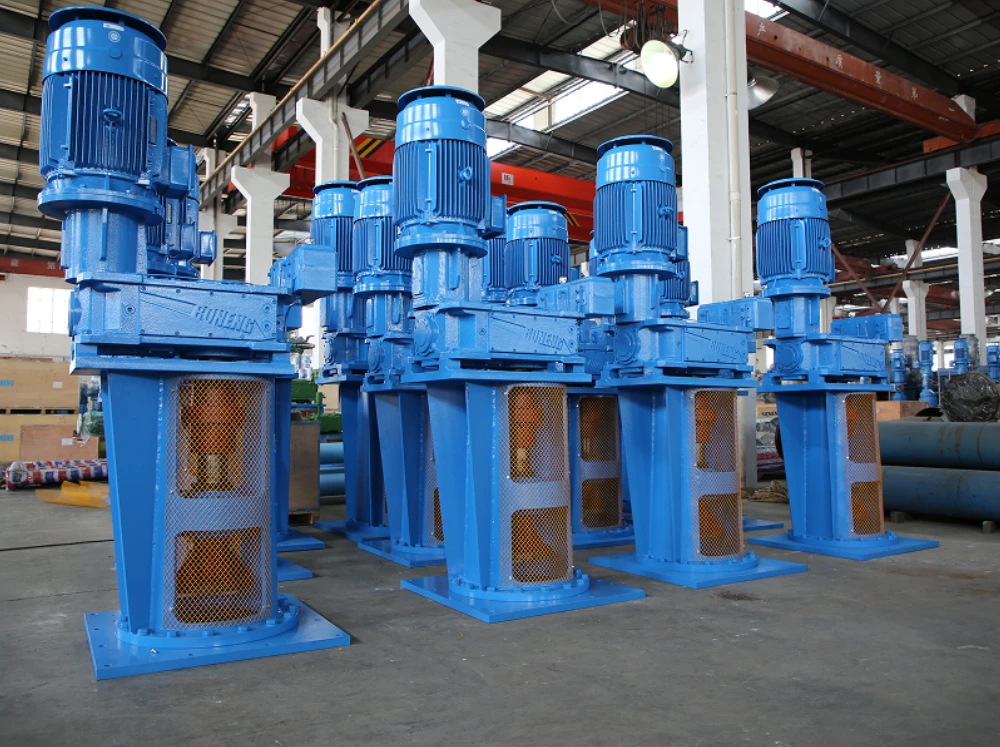
Top-entry agitators are common in reaction tanks, flotation feed tanks, leaching reactors, and process vessels. Technicians install them from the tank roof or bridge, and they can use long shafts and multiple impellers. They suit duties where vertical circulation, solids lift, and full-tank blending are important.

Top-Entry Agitators

  • 侧入式搅拌器

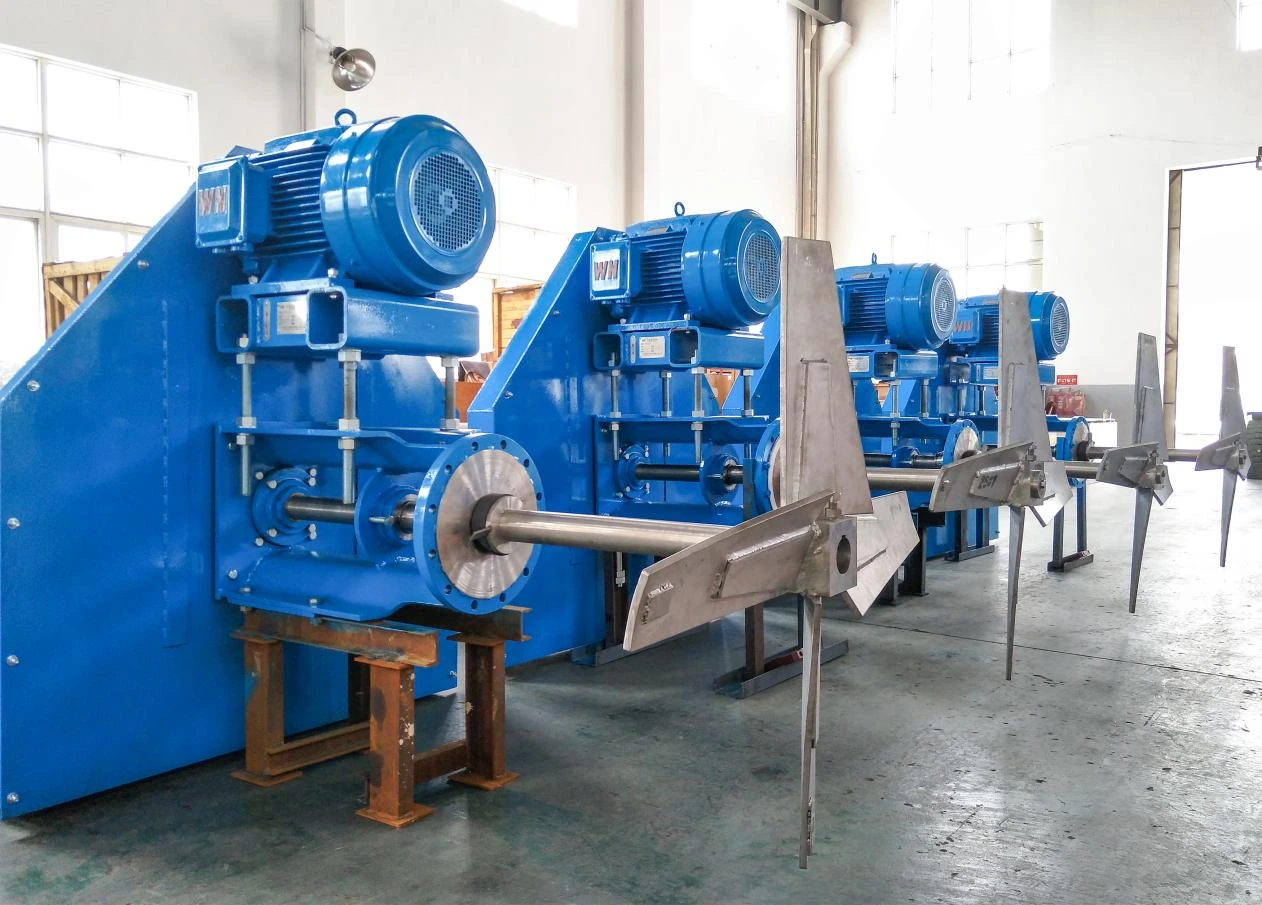
Side-entry agitators are often used in large liquid storage tanks and other large-volume vessels. For tanks above 1000 m³, NHD side-entry designs can use only 1/3 to 2/3 of the power required by a center-mounted agitator.

Additionally, these units offer a more economical setup by reducing both manufacturing costs and the structural demands on the tank foundation.

侧入式搅拌器

  • Specialized Agitators for Harsh Slurry

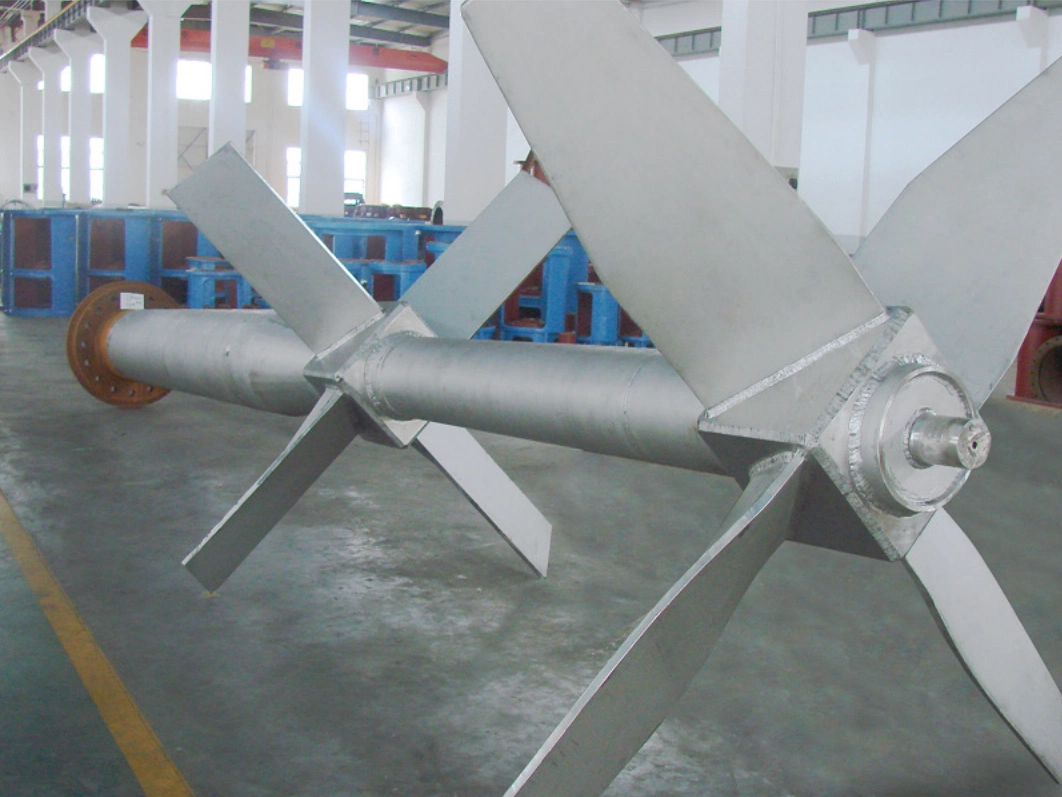
Some mining and chemical duties need low shear, high circulation, or special anti-corrosion materials. Variable cross-section and obliquity agitators can provide strong axial circulation with lower shear. In suitable services, NHD designs of this type may reduce power use by 40–50% compared with traditional 45° PBT agitators while keeping the required mixing effect.

Specialized Agitators for Harsh Slurry

How to Choose a High-Efficiency Agitator for Mining Slurry

Good selection starts before a price request. A buyer should not only ask for motor power or tank size. The right specification should connect process data, slurry properties, corrosion conditions, installation limits, and maintenance needs. Early technical communication can prevent undersized equipment, wasted power, and site changes after installation.

Comprehensive Data Collection

A supplier needs tank dimensions, working volume, slurry density, solids percentage, particle size, viscosity, temperature, pH, reagent type, and required mixing result. It also helps to know whether the process needs suspension, blending, heat transfer, gas dispersion, or reaction control. For a mining slurry mixer, small data gaps can change the choice.

Impeller, Speed, and Power Matching

Impeller type and speed should be chosen together. A larger impeller at lower speed may move more slurry with less shear, while a smaller high-speed impeller may waste power or increase wear.

An experienced industrial agitator manufacturer will check pumping flow, torque, shaft strength, and tank flow pattern instead of motor power alone.

Material Selection and Wear Resistance

Abrasive ore slurry and acidic or alkaline media require careful material choice. Common options include 304L, 316L, 317L, 904L, 2205, 2507, and titanium, with special materials used for tougher corrosion-wear conditions. The wetted parts of a mud agitator should match the real chemistry, not only the ore name.

Design for Maintenance

Seals, bearings, couplings, and gearbox access matter after start-up. Choose seals based on leakage limits, pressure, temperature, and safety needs. For remote mines, service access can be as valuable as mixing efficiency.

How NHD Ensures High Performance for Your Agitator

NHD designs agitators for liquid-liquid, solid-liquid, gas-liquid, and multi-phase duties, with power from 1.5 to 1000 kW and speeds from 0.01 to 3000 rpm. For mining and chemical buyers, its value lies in matching test data, flow simulation, material selection, and site support.

CFD for Precision Design

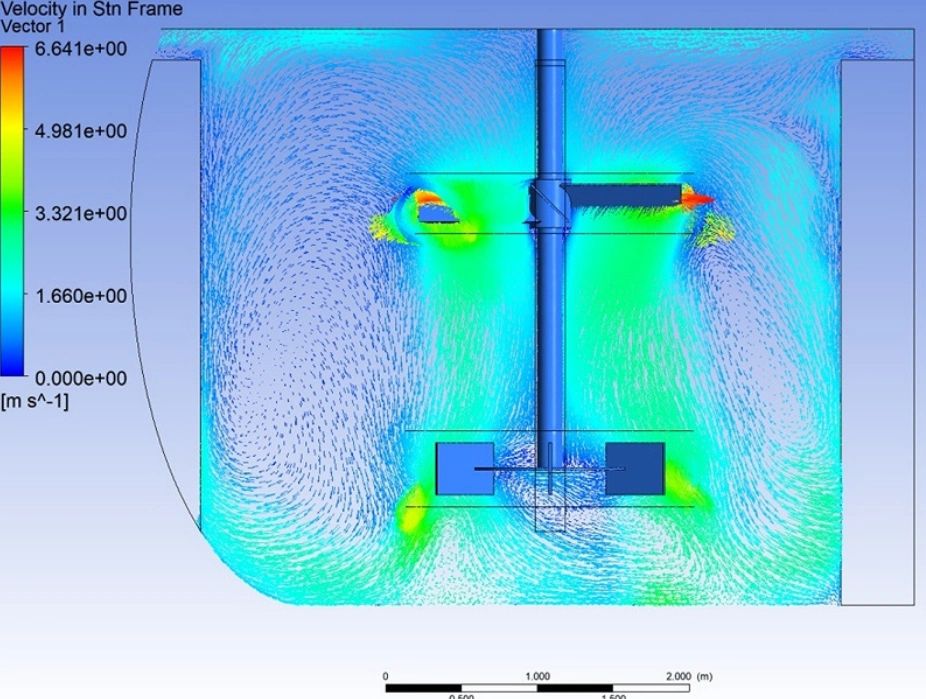
NHD uses flow simulation tools like Fluent, Gambit, and Mixsim. It studies circulation, dead zones, velocity distribution, and power demand. CFD helps engineers compare blade forms, shaft positions, tank bottoms, and baffle effects before production. This is useful for a large mixing tank agitator where small design mistakes become expensive.

Pilot Testing and Scalability

NHD operates an Acoustic Doppler Velocimeter testing bench for agitator models, with 600 mm, 1200 mm, and 1800 mm tank diameters. It can test model flow, prototype units below 1800 mm, baffles, tank-bottom effects, and different impeller designs. This route helps scale lab findings into plant equipment with fewer surprises.

Acoustic Doppler Velocimeter testing bench

Life-Cycle Technical Support 

As an industrial agitator manufacturer with mining, metallurgy, phosphate, alumina, petrochemical, and wastewater experience, NHD can support selection, testing, manufacturing, commissioning, and later service.

结论

A. mining agitator supports slurry stability, particle suspension, reaction control, and process flow. The best choice depends on slurry data, tank design, duty, materials, impeller form, power demand, and maintenance access.

NHD can help mining and chemical plants review agitator selection, including side-entry solutions for large-scale blending and slurry handling. Contact us now at sales@chinanhd.com 或通过 WhatsApp 86 1366732427 to receive a customized solution just for you.

常见问题

Q: What is a mining agitator used for?
A: It keeps ore particles suspended, mixes reagents, supports leaching or neutralization, prevents tank-bottom settling, and delivers steadier slurry to pumps, thickeners, and filters.

Q: Is a slurry agitator different from a mixer?
A: A mixer is a broad term. This type is built for liquid-solid service, where suspension, abrasion, torque, impeller shape, and wear-resistant materials are more important.

Q: When should I choose a side-entry mixing tank agitator?
A: Consider it for large storage or process tanks, especially when top-entry installation is difficult or when the plant needs broad circulation with lower installed power.


分享给:

目录

    搜索

    最新消息

    金属丝网除雾器是如何工作的,哪一个适合你的塔?
    了解金属丝网的核心力学。..
    2026年地球日:工业水回收用高速增稠剂选择指南
    击败即将到来的2026年工业水回收。..
    为什么垂直结构设计在2026年压滤机市场占据主导地位
    立式压滤机在2026年占据主导地位。。。

    感谢您的留言!

    我们已收到您的信息,并将很快与您联系。