 German
  English
  French
  Spanish
  Russian
  Arabic
  Portuguese
  Indonesian
  Turkish
  Persian
  Vietnamese
  中文
中文 
High-solid slurries place enormous mechanical stress on a thickener. As solids accumulate on the tank bottom, rake torque rises continuously. If the underflow system cannot remove settled material fast enough, excessive resistance can overload the drive, damage the rake mechanism, and even shut down the entire thickening process.
Choosing a thickener drive mechanism is about far more than picking a motor — it means a system that monitors conditions, reacts to abnormal loads automatically, and works with the process to protect equipment and keep production stable.
This guide explains the six engineering features that matter most when evaluating a thickener drive mechanism for mineral processing, alumina refining, non-ferrous metallurgy, phosphoric acid production, and other high-solid applications.
Why High-Solid Slurries Challenge Thickener Drive Systems
How Slurry Properties Increase Drive Load
Drive load starts with the material entering the tank. How fast a bed forms and how hard it fights the rake comes down to a combination of factors — how concentrated the solids are, their size and density, how the slurry behaves under shear, how quickly it settles, and how well it responds to flocculant. Fine particles may produce a compact bed, while coarse or fast-settling solids can build unevenly if feed distribution is poor.
The normal feed value is only part of the design basis. Startup material, short-term feed surges, changes in ore or process chemistry, and an interruption in underflow pumping can create a much heavier duty. The drive, gearbox, shaft, rake arms, bearings, and lifting arrangement must be considered against that operating range rather than one average solids figure.
Why Torque Continues to Rise During Operation
Torque rises when settled solids enter the tank faster than the underflow system removes them. The bed becomes deeper and denser, so more force is required to keep the rake moving. A low underflow rate, blocked discharge line, pump limitation, incorrect flocculant condition, or temporary process upset can all disturb this balance. Because the increase is often gradual, a thickener drive needs a live torque signal for early warning — protection based on motor nameplate power alone isn’t enough.
Restarting after an extended stop can place the arms into a consolidated bed. Continuing to run without correcting the solids inventory pushes the drive closer to its mechanical limit and can make recovery more difficult.
Common Problems Caused by Inadequate Drive Protection
Weak protection often appears first as repeated overload alarms or motor trips. If the thickener is restarted without reducing rake resistance, the same condition returns. More severe cases can twist or damage rake arms, overload bearings or gearing, interrupt underflow discharge, and force the plant team to clear accumulated solids from the tank. Unstable discharge then affects downstream pumping, washing, filtration, or water recovery. Protection therefore has to identify rising load early and provide a controlled response before a routine process variation becomes a mechanical failure.
Six Features of a Reliable Thickener Drive Mechanism
Sustained Load Capacity for Heavy-Duty Operation
A drive should be rated for the torque required during continuous operation and for the higher load that can occur during a process upset. The proposal should document the basis behind each figure — rated operating torque, maximum allowable torque, gearbox service factor — along with the bearing arrangement, lubrication, shaft design, and rake structure. A high motor rating does not by itself prove that the complete load path can operate steadily under a dense solids bed.
Real-Time Torque Monitoring
Real-time torque monitoring gives the control room a direct view of changing rake resistance. What matters is a stable signal across the full working range — one clean enough that the process team can tell a brief spike apart from solids that are steadily building up. Alarm setpoints can then be related to normal operating torque, corrective action, and the mechanical protection limit. The signal is most useful when it is reviewed together with feed, underflow, and slurry measurements.
Overload Protection System
An overload system needs defined stages. An early alarm gives operators time to check discharge and feed conditions. A higher threshold can initiate rake lifting, reduce feed, or stop the drive according to the agreed control philosophy. Mechanical and electrical limits should be coordinated so the system protects the gearbox and rake assembly before damaging stress develops. Reset conditions also matter; an automatic restart should not send the rake back into the same overloaded bed.
Automatic Rake Lifting
Rake lifting reduces resistance by raising the arms when the lower bed becomes too dense. The lifting stroke, speed, position feedback, and return sequence should match the tank and rake design. A useful automatic thickener does more than react to a trip. It uses the torque signal to lift in a controlled way, confirms that load has fallen, and lowers the rake only when operating conditions allow. This can prevent a developing jam from turning into a tank-cleaning shutdown.
DCS Integration and Intelligent Control
DCS integration ties drive protection directly to the process conditions driving the load in the first place. Torque, motor status, rake height, slurry level, feed rate, underflow rate, and relevant solids data can be viewed on one operating screen. The control logic can then coordinate alarms, feed changes, discharge response, and rake lifting. The project team should still define which actions are automatic, which require operator confirmation, and how the system returns to normal service after an upset.
Ultrasonic Slurry-Level and Solidst Monitoring
Ultrasonic slurry-level and solids monitoring adds process context to the mechanical torque signal. A rising bed or changing concentration can show why rake resistance is increasing before the drive reaches an alarm point. Measurement location, calibration, signal quality, and the effect of foam or changing slurry properties should be reviewed for the actual tank. The value comes from using the data in feed, settling, and underflow control, not from installing another isolated instrument.
How the Six Features Improve Different Thickening Applications
Mineral Processing and Non-Ferrous Metallurgy
Mineral-processing and hydrometallurgical circuits can see wide changes in ore, particle size, leach residue, and feed solids. CCD washing also connects the performance of one thickener with the next stage. Torque monitoring and underflow control keep the rake moving through those swings. When solids inventory does build up, overload protection and lifting give the system a way back — instead of a shutdown. Large tanks make early detection especially important because clearing a compacted bed is a major interruption.
Alumina Red Mud Separation and Washing
Red mud separation and washing require dense underflow without losing control of rake load or overflow quality. Flocculant response, feed dilution, bed depth, underflow concentration, and discharge stability interact throughout the washing train. A reliable drive keeps the rake moving under sustained compression, while torque and ultrasonic material signals help the control system respond to the actual solids condition instead of relying on a fixed operating schedule.
Wet-Process Phosphoric Acid and Wastewater Treatment
Wet-process phosphoric acid and industrial wastewater duties may combine fine particles, variable feed, corrosive liquid, and changing settling behavior. A sudden solids surge — or a drop in underflow capacity — can quickly raise bed load. The drive protection philosophy should be coordinated with material selection, feed control, discharge equipment, and maintenance access. Torque trends and slurry measurements give the plant team a clearer basis for adjusting the process before the rake reaches a damaging condition.
Applying the Same Checks to a Center Drive Thickener and a Peripheral Drive Thickener
A center drive thickener and a peripheral drive thickener use different mechanical arrangements, but neither should be selected from its name alone. The same six checks still apply: sustained load capability, live torque monitoring, overload response, rake lifting, control integration, and slurry monitoring. Tank diameter, process duty, actual torque basis, structural arrangement, maintenance access, and supplier experience must support the proposed configuration. Where the available product information does not define separate application limits, the project team should request a duty-specific engineering basis rather than assume one arrangement is automatically better.
10 Questions to Ask Before Buying a Thickener Drive Mechanism
Before selecting a supplier, verify the following engineering capabilities.
| What to Verify | Why It Matters |
| Rated operating torque | Matches process load |
| Maximum overload capacity | Prevents mechanical failure |
| Torque monitoring method | Detects abnormal conditions early |
| Automatic rake lifting | Protects the rake mechanism |
| Gearbox safety factor | Extends service life |
| DCS compatibility | Enables intelligent control |
| Slurry monitoring capability | Optimizes process stability |
| Large-diameter project experience | Reduces engineering risk |
| Maintenance requirements | Lowers operating cost |
| Spare parts and service support | Improves long-term reliability |
How the NHD Thickener Integrates Drive Protection with Intelligent Process Control
Die NHD-Verdickungsmittel connects the mechanical drive with the material condition inside the tank. Its documented design uses heavy-load drive arrangements, torque detection, automatic protection, DCS coordination, and ultrasonic monitoring so the response can follow changing solids load and discharge conditions.
Automatic Rake Lifting and DCS Integration
NHD’s torque indicator detects operating changes in real time and sends the signal to the plant control center. When torque rises because solids are not being discharged at the required rate, the control logic can support alarm, motor protection, and rake-lifting action. The lifting function reduces resistance before the arms become trapped in a dense bed. DCS integration then links the drive response with related equipment and process data instead of treating overload as an isolated motor fault.
Ultrasonic Slurry Monitoring
NHD uses ultrasonic measurement for slurry level and solids content, providing the control system with additional information about the material inside the thickener. When torque, rake position, slurry level, and concentration are reviewed together, the plant team can see whether a load increase is associated with bed accumulation, feed variation, or insufficient discharge. For an automatic thickener, the final instrument arrangement and control thresholds should be matched to the actual slurry and tank geometry.
Proven Performance in Large Industrial Thickeners
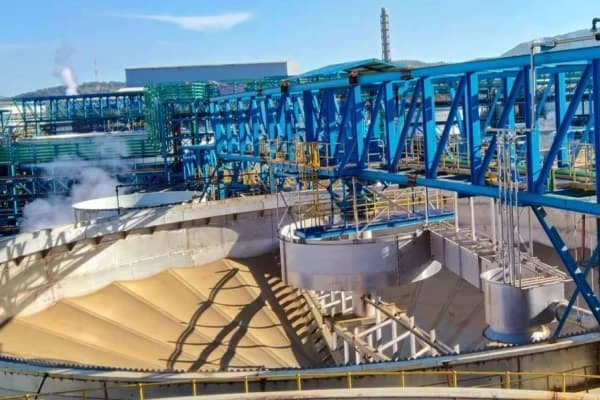
NHD project records include a φ30m leaching thickener for a copper-smelting project in Russia, a φ36m CCD thickener for a cobalt-nickel operation in Papua New Guinea, a φ45m thickener for copper and cobalt smelting in the Demokratische Republik des Kongo, and φ32m, φ36m, and φ42 m units for a nickel-cobalt project in Indonesia. These references cover equipment supply, site installation, tank assembly, and large industrial settling duties. They provide a more relevant engineering basis than comparing drive motor power alone.
Schlussfolgerung
High-solid slurry can turn gradual sediment accumulation into rising torque, motor overload, unstable discharge, and rake damage. A thickener drive mechanism should therefore be evaluated as one protection-and-control system, not by motor rating alone. NHD Thickener combines real-time torque detection, overload protection, automatic rake lifting, DCS integration, and ultrasonic material monitoring to match the drive response with actual solids load and discharge conditions.
Ready to evaluate a high-solid thickener duty? Send the target solids content, underflow concentration, tank dimensions, throughput, and control requirements to NHD for a fast, no-obligation review.
Email: sales@chinanhd.com
WhatsApp: +86 136 6732 4277
Häufig gestellte Fragen
Q1: Why does a high-solid slurry increase load on a thickener drive mechanism?
A1: More solids create a deeper, denser bed at the bottom of the tank. The rake has to push that material toward the discharge point, so resistance and torque rise. If underflow removal falls behind feed and settling, the accumulated bed can overload the drive and trap the rake arms.
Q2: How do torque monitoring and automatic rake lifting protect a thickener drive?
A2: Torque monitoring identifies increasing rake resistance while the unit is still operating. The control system can alarm, adjust the process, or initiate lifting at defined thresholds. Raising the rake reduces contact with the dense lower bed, which lowers resistance and gives the plant a controlled recovery route before mechanical damage occurs.
Q3: What slurry data should be connected to a thickener’s DCS control system?
A3: Useful signals include slurry or bed level, solids concentration, feed and underflow rates, torque, rake position, motor status, and relevant flocculant data. The exact list depends on the process, but each signal should support a defined alarm, control action, or operating decision rather than appear as an isolated display value.