 Persian
  English
  French
  Spanish
  Russian
  Arabic
  Portuguese
  Indonesian
  German
  Turkish
  Vietnamese
  中文
中文 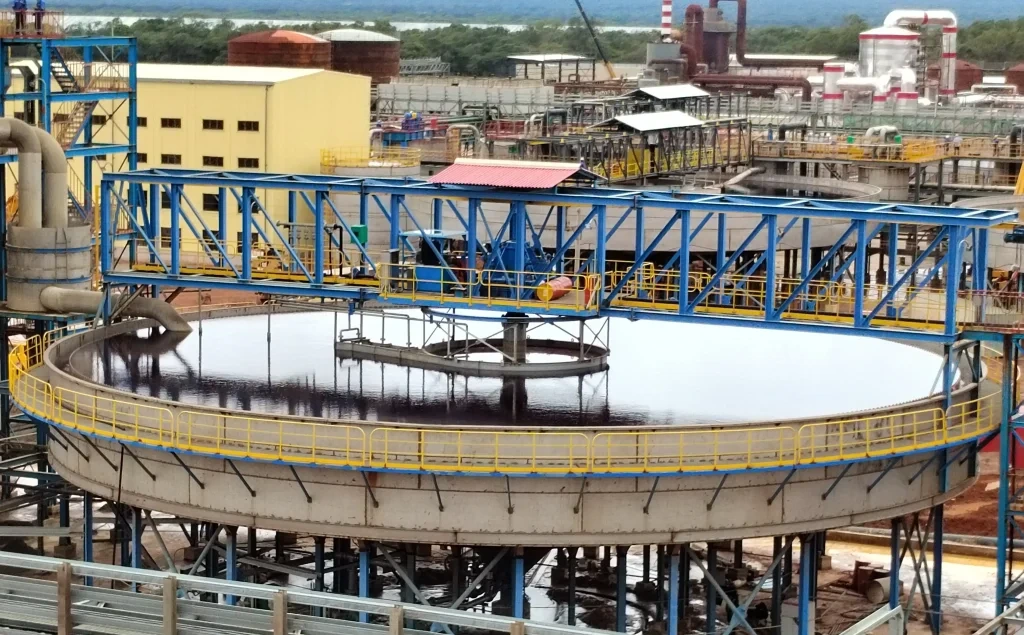
The Democratic Republic of the Congo is pushing more mineral value into domestic processing. A new administrative measure restricting exports of copper and cobalt concentrates, while allowing products such as cathode copper, blister copper, and cobalt hydroxide to continue moving out of the country, changes the question for project developers. The newly introduced 55% valuation coefficient for certain by-products adds another commercial variable.
For copper-cobalt projects, this does not mean every mine will build the same hydrometallurgical line. It does mean local conversion capacity becomes more important. Leaching, solution purification, solvent extraction, electrowinning, precipitation, washing, and residue treatment all create slurry streams that must move without holding up the plant.
Filtration is one place where schedules can slip. A belt filter that cannot maintain cake washing, a cloth that blinds too quickly, or a pressure-filter package delivered after the rest of the plant can leave expensive upstream equipment waiting.
Why Can Local Processing Turn Filtration into a Schedule Risk?
An SX-EW plant is often discussed through extraction chemistry and cathode output. On site, the supporting solid-liquid separation stages can be just as unforgiving.
Where Does Slurry Handling Affect the Main Process?
Leach residue has to leave solution efficiently. Intermediate solids may need washing before disposal or further treatment. Precipitated products can require dewatering to reach a manageable moisture level. Filtrate may have to return to a solution circuit without carrying excessive fine solids.
If one of those stages is undersized, the problem rarely stays inside the filter. Tanks fill faster. Pumps operate outside the expected range. Solution inventory shifts. Operators extend cycles or add washing water to compensate, and the original material balance starts to drift.
That makes filtration capacity a process issue rather than a standalone equipment specification.
Why Does Delivery Timing Matter in a New Local Plant?
Large projects frequently order major reactors and SX-EW equipment early, while filtration is finalized later because the slurry seems easier to define. That can be a costly sequence.
Filter area, belt width, vacuum system, slurry feed arrangement, filtrate receivers, cloth selection, wash-water system, discharge conveyors, structural steel, and maintenance access all affect civil and utility work. When those details arrive late, site teams may have to revise foundations or piping after construction has already started.
A better approach is to freeze the filtration basis while pilot and metallurgical results are still being reviewed.
Where Does a Horizontal Rubber Belt Vacuum Filter Fit?
A horizontal rubber belt vacuum filter is useful where the process favors continuous dewatering and washing rather than repeated batch cycles.
When Does Continuous Vacuum Filtration Make Sense?
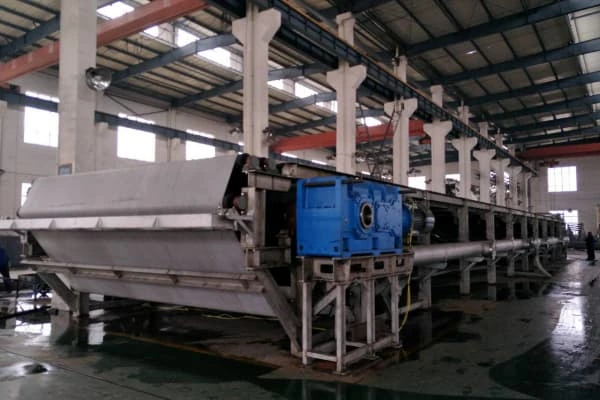
The machine carries filter cloth on a moving rubber belt while vacuum and gravity draw liquid through the cake. Feed, filtration, washing, drying, discharge, and cloth regeneration can therefore run as a continuous sequence.
ان اچ دی continuous horizontal rubber belt vacuum filtration is used in mining and metallurgy as well as other process industries. Its design includes a heat-preservation vacuum box, flow-guide vacuum suction box, multiple vacuum suction sections, multi-stage spraying, cloth washing, and an annular rubber-belt supporting structure. The published size range extends to 162 m² of effective filtration area in the listed configurations.
For copper-cobalt duty, none of those features should be taken as a substitute for testing. The engineering team still needs cake permeability, solids loading, washing objective, filtrate clarity, vacuum requirement, temperature, chemical environment, and expected cloth life.
Why Is Filter Cloth Part of Equipment Selection?
Filter cloth is often ordered as a consumable after the machine has been selected. That is too late for difficult hydrometallurgical slurry.
Pore structure and permeability affect how quickly the initial cake forms. Chemical resistance matters where acidic liquor remains in the slurry. Fabric stability matters on a moving belt because tracking and tension are continuous. Cake release influences how much residue stays on the cloth and how much washing is needed before the next pass.
ان اچ دی industrial filter cloth for continuous separation duties covers cloth for horizontal belt vacuum filters as well as several other filter types. Its continuous-machine cloth is designed around cleaning, dimensional stability, operating life, and repeated filtration.
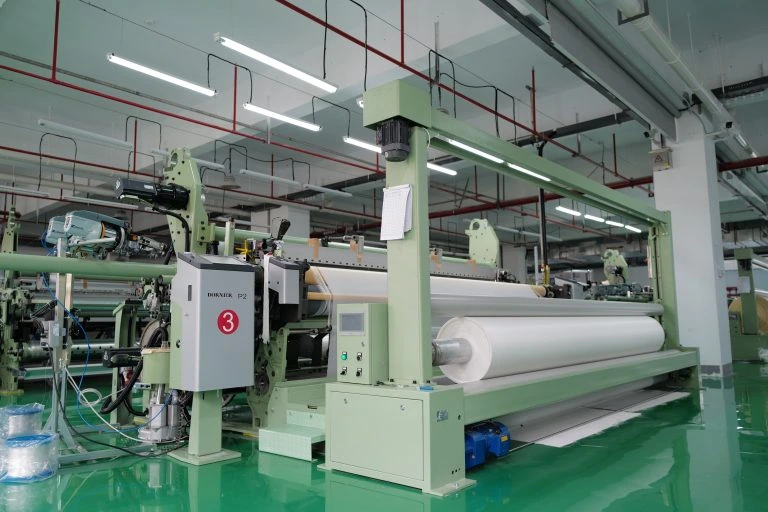
The cloth should be tested with the actual slurry rather than selected from particle size alone. Fine solids, acid chemistry, temperature, wash liquor, and discharge behavior can all change the suitable weave.
Do Belt Filters Use Filter Plates?
No. This distinction matters in RFQs.
A horizontal rubber belt vacuum filter uses a moving filter cloth, rubber belt, vacuum box, and related support and washing components. Filter plates belong to pressure-filter systems, not to the belt-filter filtration zone.
If a copper-cobalt plant has one duty requiring continuous belt filtration and another requiring lower cake moisture through pressure filtration, then both cloth and filter plates may appear in the overall procurement package—but for different equipment.
NHD has copper-cobalt references on both sides of that separation discussion. Its equipment records include two 144 m² Vertical Automatic Pressure Filters for the Deziwa copper-cobalt deposit in the DRC, while other DRC projects use large thickeners and agitators.
What Should Buyers Freeze Before Ordering Filtration Equipment?
The most useful RFQs start from the slurry and the required product, not a preferred machine name.
Which Process Parameters Should Be Fixed First?
Buyers should define normal and maximum solids concentration, particle-size distribution, slurry density, temperature, pH and chemistry, dry-solids throughput, required cake moisture, washing objective, filtrate clarity, operating hours, and feed variability.
For a belt filter, vacuum degree, wash-water availability, cake thickness, belt speed, filtration residence time, and filtrate routing need to be considered together. For a pressure filter, chamber filling, pressing pressure, wash sequence, air demand, cake discharge, cloth cleaning, and plate movement become more important.
This data also makes it possible to compare supplier capacity claims on the same basis.
What Should Be Checked Beyond the Filter Itself?
The equipment has to arrive and fit the plant. Buyers should ask about fabrication lead time, bought-out components, cloth and spare-parts availability, modular transport, field assembly, electrical interfaces, instrumentation, commissioning scope, and the time required to replace high-wear parts.
Local processing projects can lose weeks over something as basic as a cloth shipment or a vacuum receiver that does not match the actual filtrate volume. A strong technical offer should therefore include the supporting system, not only the main frame.
Why Does DRC Project Experience Matter?
Local conditions do not make every DRC plant identical, but existing project experience reduces the amount of basic interface learning that has to happen during execution.
ان اچ دی Sicomines copper-cobalt thickening reference in the DRC includes a Φ45 m thickener for copper-cobalt smelting. Its wider records also include DRC copper-cobalt agitators and pressure-filter installations, while its product portfolio covers filtration, press filtration, thickening, agitation, filter cloth, fabrication, installation, and EPC-related work.
That integrated scope can matter when the project schedule depends on slurry conditioning, thickening, filtration, and consumables arriving in the right sequence.
Owners and EPC teams can request a copper-cobalt filtration review from NHD using the latest process flow, slurry samples or test data, throughput, washing target, utility conditions, site layout, and expected commissioning date.
نتیجه گیری
More local copper-cobalt processing in the DRC will put attention on large hydrometallurgical units, but capacity can still be lost in the supporting separation stages.
Horizontal rubber belt vacuum filters are useful for continuous dewatering and washing when the slurry supports that operating mode. Filter cloth has to be selected as part of the filtration system, not as an afterthought. Pressure filtration is a different duty and brings filter plates, batch-cycle behavior, and different utility requirements into the project.
For procurement teams, the practical way to protect the schedule is to freeze filtration data early, separate belt-filter and pressure-filter duties correctly, and evaluate delivery, consumables, installation, and commissioning as part of the same package.
سوالات متداول
Q1: What data should a DRC copper-cobalt project provide before selecting a vacuum belt filter?
A1: Provide slurry composition, solids concentration, particle distribution, density, temperature, chemistry, dry-solids throughput, washing target, cake moisture requirement, filtrate quality, vacuum conditions, utility data, operating hours, and site layout.
Q2: Should filter cloth and filter plates be ordered for the same horizontal belt filter?
A2: No. A horizontal rubber belt vacuum filter uses filter cloth on a moving belt and does not use chamber-style filter plates. Filter plates are relevant when a separate pressure-filter duty is included in the plant.
Q3: Can NHD support filtration equipment and consumables for copper-cobalt projects?
A3: NHD can review belt filtration, pressure filtration, filter cloth, thickening, installation, and related process interfaces. Final equipment and consumable selection should follow representative slurry tests, production targets, chemical conditions, utilities, and the project’s delivery schedule.