 Persian
  English
  French
  Spanish
  Russian
  Arabic
  Portuguese
  Indonesian
  German
  Turkish
  Vietnamese
  中文
中文 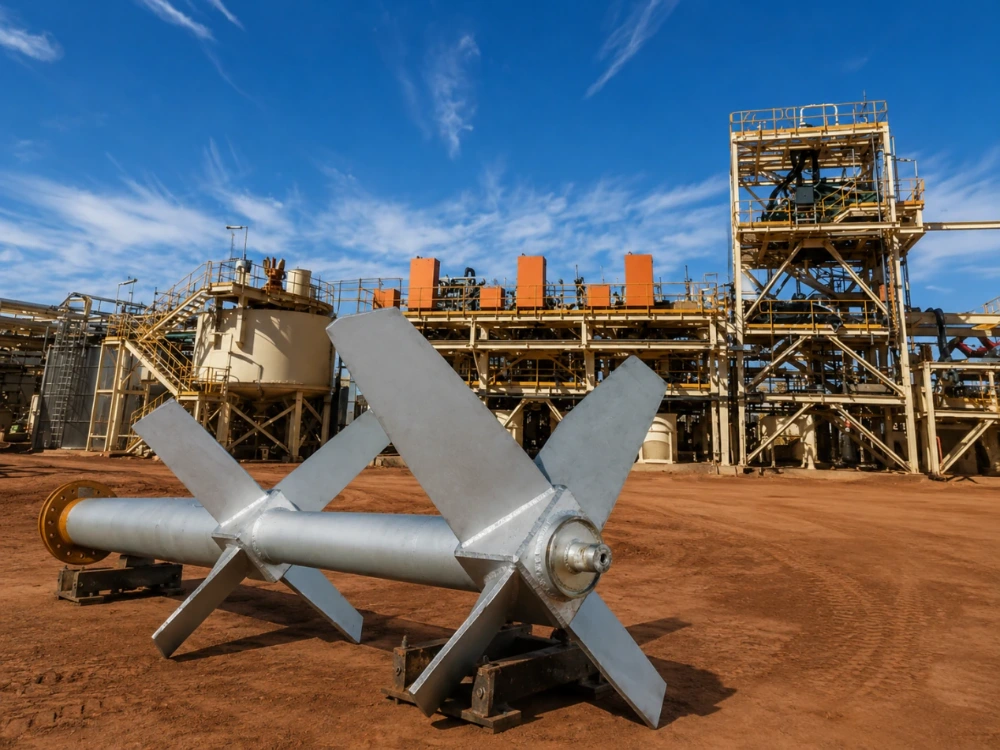
Japan’s latest move into Namibia’s heavy rare earth sector puts another African project into the pre-investment engineering cycle. Toyota Tsusho has established a wholly owned vehicle for the investment, while JOGMEC support for the Lofdal project can reach JPY 5.46 billion. The deposit is particularly relevant for dysprosium and terbium, two heavy rare earths used in permanent-magnet supply chains, and a final investment decision is planned around the 2026–2027 fiscal-year period.
For equipment buyers, the important stage comes before that decision. A rare earth project has to convert laboratory chemistry into a process that can circulate slurry, control residence time, wash solids, recover solution, and run repeatedly at a larger scale.
Pilot equipment is where many of those assumptions get tested. Agitation, thickening, flocculant preparation, filtration, pumps, piping, controls, and materials should therefore be treated as one process package rather than a group of small machines that will be redesigned later.
Why Do Rare Earth Projects Need Pilot Equipment Before FID?
Heavy rare earth processing is particularly sensitive to feed characteristics and chemistry. A flowsheet that works with a small laboratory batch still has to survive continuous operation, feed variability, and equipment scale-up.
What Does a Pilot Plant Need to Prove?
The pilot campaign should establish more than extraction percentage. It needs data that a mechanical supplier can use.
For an agitated leach stage, that includes slurry density, viscosity, solids suspension, particle distribution, residence time, reagent conditions, temperature, corrosion environment, and power demand. Thickening work needs settling rate, flocculant response, overflow clarity, and target underflow concentration. Filtration adds cake permeability, filtrate quality, washing requirement, moisture, cloth behavior, and cycle time.
The better these variables are defined before FID, the less guesswork remains in the full-scale equipment package.
Why Doesn’t Scale-Up Work by Simple Multiplication?
A ten-times-larger tank is not just a laboratory tank multiplied by ten.
The circulation path becomes longer. Shaft loading changes. Power per unit volume does not automatically produce the same flow pattern. Solids may settle in parts of the vessel that did not exist at pilot scale. A thickener’s feedwell and rake system see different hydraulic and torque loads. Filtration piping, cake washing, air demand, and discharge time also change with machine size.
Scale-up therefore needs a physical test basis plus engineering tools that can predict what changes when equipment becomes larger.
Which Equipment Should Be Designed as a Connected Package?
For many hydrometallurgical rare earth flowsheets, agitation comes first in the mechanical discussion, but it should not be isolated from the downstream thickener and filter.
How Should Agitator Design Support Leaching and Suspension?
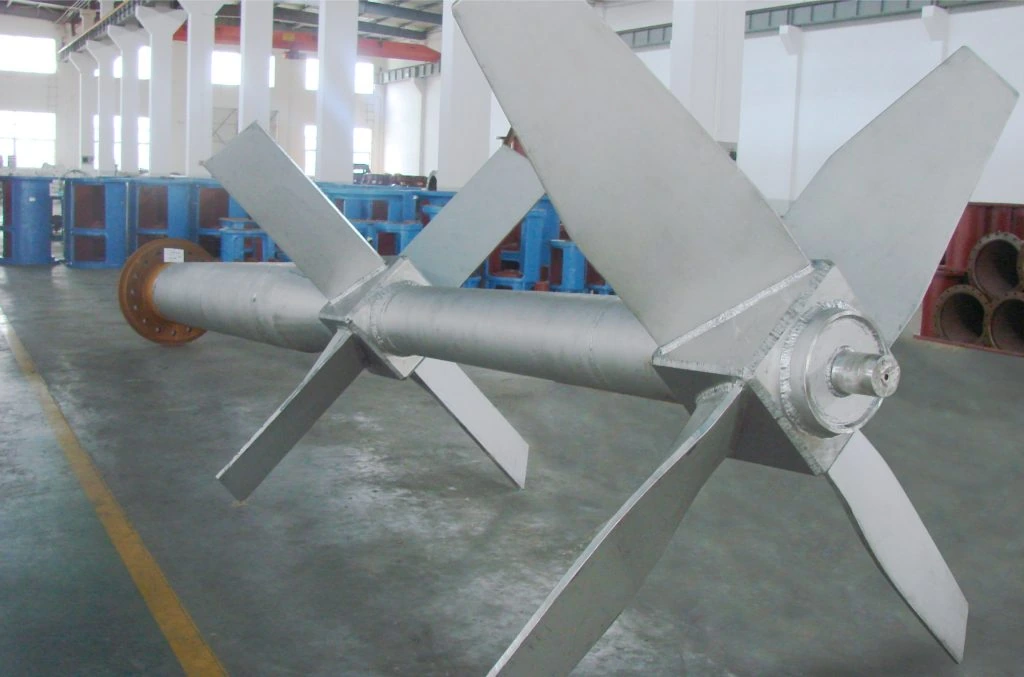
An agitator has to keep solids available for reaction without creating unnecessary shear or power demand. Impeller geometry, tank diameter, liquid level, baffles, particle size, slurry density, viscosity, temperature, and operation mode all affect the selection.
ان اچ دی nonferrous beneficiation agitator engineering combines laboratory tests, pilot tests, scale-up experiments, CFD, CFM, LDA and finite-element analysis. The selection inputs include tank geometry, concentration, throughput, density, viscosity, particle-size distribution, temperature, pressure, and whether the process runs continuously or by batch.
For duties where high circulation and controlled shear are important, NHD’s variable cross-section and obliquity design is another reference. Its published data gives 40–50% lower power consumption than a conventional 45° PBT agitator at equivalent mixing performance. That is a product-specific comparison, not a guaranteed energy saving for every rare earth slurry; the actual duty still needs test and scale-up verification.
Why Should the Thickener Be Tested with the Same Process Slurry?
The thickener determines how much solution leaves with the solids and how concentrated the next slurry stream becomes. That affects washing, reagent recovery, filtration load, and water balance.
ان اچ دی deep-cone slurry thickening equipment uses gravity sedimentation and is applied in mineral processing and non-ferrous metallurgy. Its design incorporates torque monitoring, DCS integration, and ultrasonic slurry-level and solids-content measurement. NHD lists deep-cone and automatic thickener configurations, with final size customized to the duty.
Those controls become more useful when a pilot campaign deliberately records underflow solids, overflow clarity, flocculant dosage, torque behavior, and feed variation. Without that record, a larger thickener is being selected from nominal flow rather than actual settling behavior.
Where Does Pressure Filtration Enter the Scale-Up Plan?
Not every rare earth pilot needs the same filter type, but a process that produces washed residue, precipitated intermediate material, or another filterable slurry should establish the filtration basis before scale-up.
The key numbers are not just filtration area. Buyers need dry-solids throughput, pressure development, filtrate clarity, cake thickness, cake moisture, wash consumption, air demand, cloth regeneration, and discharge behavior.
NHD’s HDLY vertical automatic pressure-filter range covers 6–180 m² units at a listed maximum pressure of 1.6 MPa and is used for washing, filtration, and dewatering in non-ferrous smelting and other industries.
A pilot test can then determine whether that equipment type fits the particular rare earth slurry rather than making the selection from an unrelated mining application.
What Can an Existing Heavy Rare Earth Pilot Project Teach Buyers?
NHD has a directly relevant reference with Northern Minerals in Australia.
Its Northern Minerals heavy rare earth pilot project covered modular agitators, CCD thickeners, and a flocculant preparation system for a 100 kt/a heavy rare earth pilot plant involving dysprosium and terbium. The modular system had to comply with Australian AS/NZS requirements, while the delivery window ran for only five months, from June to November 2017. The full equipment suite was delivered by November 25.
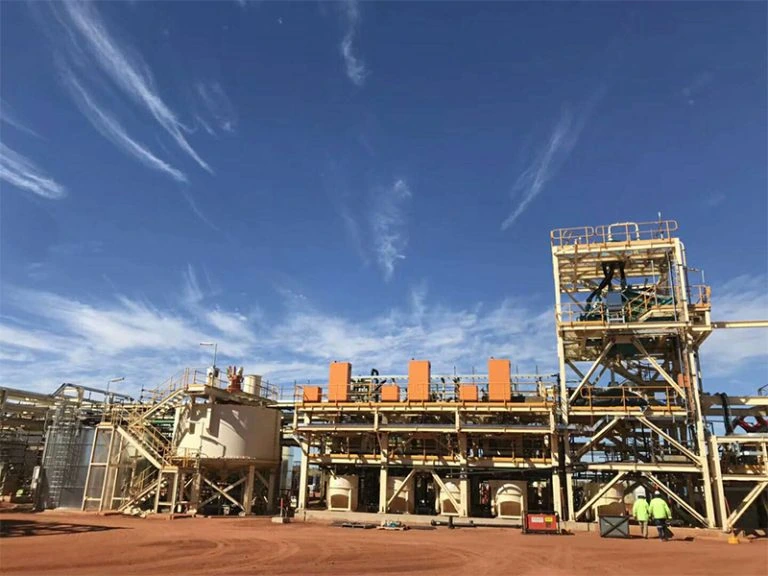
One detail is important: that documented scope was agitator, CCD thickener, and flocculant preparation equipment. It should not be presented as proof that NHD supplied a filter press to that particular project.
Its value for a new heavy rare earth project lies elsewhere. The case shows the engineering work involved in converting process requirements into modular equipment, working to a foreign standard, coordinating multiple equipment interfaces, and delivering a pilot-scale package on a defined schedule.
How Should Buyers Protect the Move from Pilot to Full Scale?
The point of a pilot plant is to reduce uncertainty. Procurement should preserve that advantage rather than restarting the design from zero.
Which Test Results Should Follow the Project into Basic Design?
The final pilot report should retain stable operating ranges, not just the best run. Tank residence time, solids suspension, agitation power, settling performance, flocculant consumption, underflow concentration, filter cycle, washing, cake moisture, and utility use should all be recorded against the material conditions that produced them.
Those values should then become the design basis for equipment RFQs and acceptance criteria.
Why Do Standards and Modular Interfaces Matter Early?
Overseas rare earth projects frequently involve an owner, local contractor, international engineering company, and equipment vendors working under different standards. Mechanical dimensions are only one interface.
Electrical requirements, guarding, platforms, lifting, structural loads, piping classes, control signals, fabrication documents, transport limits, module connections, and site installation responsibility should be resolved before equipment leaves the factory.
This was a central issue in NHD’s Australian rare earth project, where modular design had to meet Australian mechanical, electrical, safety, and environmental requirements.
For projects now moving through feasibility in Africa or elsewhere, the same lesson applies: a compact pilot package is already an engineering project, not simply a collection of test machines.
نتیجه گیری
The new round of heavy rare earth investment will create opportunities for equipment suppliers, but the strongest projects will not move directly from resource announcements to full-scale machinery.
Pilot work should first establish how the real slurry mixes, settles, washes, filters, and changes under repeated operation. Agitators need a scale-up basis. CCD thickeners need settling and flocculant data. Pressure filtration needs a tested cycle. Modular interfaces and project standards need to be settled before fabrication.
NHD’s experience in a 100 kt/a dysprosium-and-terbium pilot project gives buyers a useful reference for that transition. Teams planning a new study or demonstration line can discuss a rare-earth scale-up package with NHD using the flowsheet, material data, pilot objectives, site standards, module limits, and planned industrial capacity.
سوالات متداول
Q1: What equipment data should a rare earth pilot plant generate before industrial scale-up?
A1: Record slurry concentration, density, viscosity, particle distribution, agitation power, residence time, settling rate, flocculant consumption, underflow solids, overflow clarity, filtration cycle, cake moisture, washing demand, filtrate quality, and utility consumption under stable repeated conditions.
Q2: Is a pilot-scale agitator enough to select the full-scale agitator by simple power multiplication?
A2: No. Tank geometry, circulation path, impeller diameter, shaft loading, baffles, slurry rheology, solids suspension, and scale effects must be reviewed. Pilot results should be combined with mixing simulation and mechanical engineering before the full-scale configuration is fixed.
Q3: Can NHD support an overseas rare earth project beyond a single piece of equipment?
A3: NHD has experience with modular agitator, CCD thickener, and flocculant preparation packages for a heavy rare earth pilot plant. A new scope can be reviewed around agitation, thickening, filtration requirements, modular design, manufacturing, installation planning, commissioning, and project standards.