

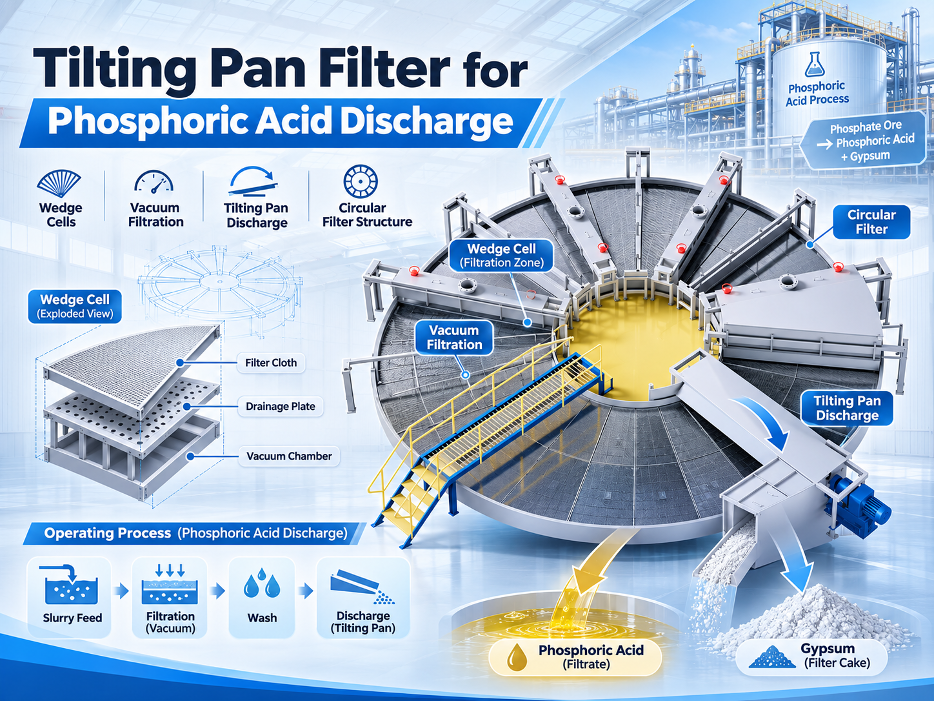
A tilting pan filter washes phosphoric acid gypsum under vacuum, then tips each cell so the cake drops clear. The pans travel around a horizontal frame, and the machine keeps moving. Liquor left in a cell is still there when that cell comes around again, so the wash that was meant to pull acid out of the gypsum mixes back into the next charge.
Phosphogypsum is coarse and uneven, and it packs into a mat. A packed cake stays in the cell unless the tip clears it. The same filter is also used on alumina red mud and other coarse suspensions. On a phosphoric acid line, the discharge decides whether the next lap starts on the cloth or on old gypsum.
Why leftover gypsum reaches the next charge
A heel of cake filters the next charge
Each lap gives the cell the same sequence. Slurry comes on, the cake forms under vacuum, the wash stages pass while the cake is still on the cell, and the cell tips. The next lap should meet the cloth. A heel of gypsum sits in that path, and the new slurry filters through it. Acid strength moves. Wash water climbs, because the crew is now washing a cake that includes the last dump. Slowing the rotation, or stopping to dig the cells, is how the line absorbs a discharge that did not finish. Emptying the cell is the job of this filter.
The cell empties when the pan tips
The cells are wedges on a circular frame, and the cake leaves at the discharge chute when the pan tips.
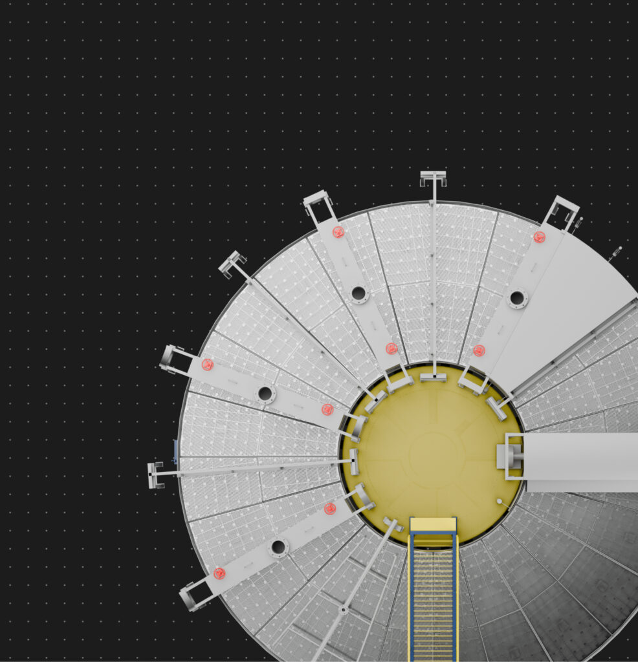
Discharge uses that tilt. No second drive is added to dump the cell, and the cells are specified to release the cake. A variable-frequency drive sets the rotation to the rock, the slurry, and the wash. The cake has the time of that lap to form and to take its washes before the cell tips. A speed locked to one rock leaves the filter short when the slurry or the wash changes. Washing is done in more than one stage on the cell. Capacity is the vacuum area, run at the speed this slurry can accept, with those washes fitting on the lap. A larger name on the drawing adds nothing if the vacuum area and the speed stay the same.
How to read the tilting pan size
Vacuum area is the surface that filters
The size name is the nominal area. The area under vacuum is smaller on every step. A 6.5 m² filter has 5 m² under vacuum, 16 cells, and an outside diameter of 4780 mm. An 80 m² filter has 71 m² under vacuum. A 120 m² filter has 103 m² under vacuum, 24 cells, and an outside diameter of 17010 mm. The gap between the name and the vacuum area is 1.5 m² at the small end and 17 m² at 120 m². The duty is sized on the vacuum area. The nominal figure names the step.
Cell count changes with the size, and it does not climb in a straight line with the diameter. The 6.5 and 14 m² filters have 16 cells. The 18 m² filter has 18. From 34 m² through 55 m² the count is 20. The 80 and 120 m² filters have 24. A higher cell count divides the circle. It does not stand in for the vacuum area of that step.
One outside diameter can be two filters
The 42 m² and 48 m² filters share an outside diameter of 10470 mm and 20 cells. Under vacuum they are 35 m² and 41 m². The footprint matches. The filtering area does not. A layout drawn around the diameter is still checked against the vacuum area of the step that was chosen.
The printed steps run 6.5, 14, 18, 34, 42, 48, 55, 80 and 120 m² nominal, and the series continues above 120 m². The 120 m² step is not the last size the machine can be.
Why cloth-wash water stays inside the plant balance
Cloth washing is a second water stream
Cake washing and cloth washing do different work. The cake wash moves acid out of the gypsum while the cake is on the cell. The cloth wash is the water that keeps the medium open for the next lap. Our tilting pan is specified so the cloth wash does not call for a large extra flow. A phosphoric acid plant is already tight on water. A large cloth-wash stream comes back as dilute liquor. On a duty where the plant cannot take that extra flow, keeping the cloth wash small is what lets the filter sit inside the water balance the plant already has.
A blinded cloth is a different fault from a heel
Filter cloth recovery is specified with the tilt and the wash. The cloth is expected to come through the tip still open. Cake smeared back into the medium blinds it. The next lap loses permeability, and the plant starts changing cloths to repair a discharge fault. A heel in the cell is the other fault: the new slurry filters through old gypsum. A poor dump can leave both, and the cell and the cloth are inspected as two checks.
After a long run the pan can lose some flatness and still stay in normal production. A cell that keeps its cake, or a cloth that blinds, is still looked at. What the product acid keeps, and what stays with the gypsum, follows the wash stages, the cake thickness, and the vacuum on that slurry.
How the cake leaves a table and how it leaves a tilting pan
The rotary table brings its own size list
NHD builds a rotary table vacuum filter for phosphoric acid. More than 300 of these tables are installed worldwide, and units up to 320 m² are operating on phosphoric acid. Slurry is distributed across the table, and the cake is dried and washed on that surface. The table is read by nominal area, active area, outside diameter and inside diameter. That 320 m² figure belongs to the table in phosphoric acid service. It is not a step on the tilting pan series, and it does not convert into the pan’s vacuum area or cell count.
The tilting pan is the filter that tips each cell
A vacuum pan filter on a flowsheet can be this tilting pan or the rotary table. The discharge decides which machine the line can use. Choose the tilting pan when cake left in the cell is already reaching the next charge, when the gypsum needs more than one wash, and when the plant can spare only a small cloth-wash flow. Choose the rotary table when the line is already laid out for that table, with its own feed, wash and discharge. The drives differ, and the way the cake leaves differs, so the two filters stay on separate lines of a bid.
Conclusion
A tilting pan filter fits when phosphoric acid gypsum should leave by tipping the cell, with more than one wash and with a cloth-wash stream the plant can spare. The size is the vacuum area of a step from 6.5 m² nominal upward, not the nominal name and not the table’s 320 m². Send the slurry, the cake thickness, and the wash stages to sales@chinanhd.com, or by WhatsApp at +86 136 6732 4277.
FAQs
Q1: Is the tilting pan the same machine as the rotary table?
A1: The rotary table vacuum filter keeps the cake on the table and washes it there. Its phosphoric acid sizes run by active area, up to units of 320 m² in service. The tilting pan empties each cell by tipping it, and its size is the vacuum area of its own series.
Q2: What do you need before a size?
A2: Send the slurry, the cake thickness you can form, the number of washes, the cloth-wash water the plant can spare, and whether cake left in the cell is already hurting the next cycle. The step is then chosen on vacuum area, from 6.5 m² nominal up through the series that continues above 120 m².
Q3: Does discharge add a second drive?
A3: Discharge uses the tilt, and the cells are specified to release the cake. The rotation is set by the variable-frequency drive. The dump does not add a power drive of its own.