
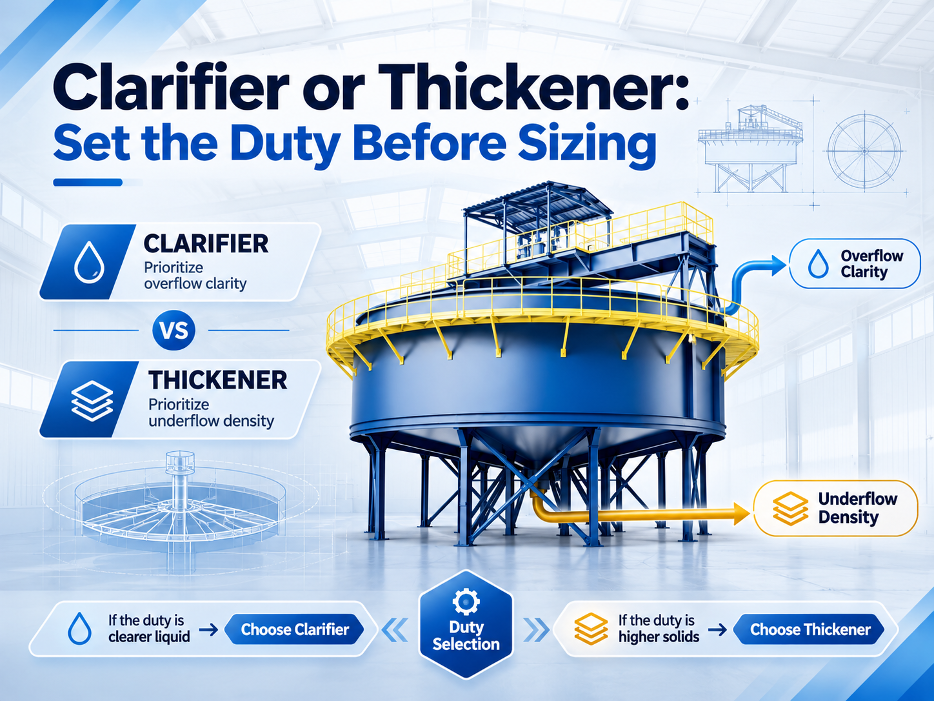
A clarifier thickener decision fails when one round tank is asked to make a dense underflow and a polished overflow at the same time. The steel can look the same. The duty does not.
Plant teams usually arrive with a flowsheet arrow labeled “settle.” That arrow hides the product. Sometimes the product is the mud: a wash circuit needs the solids packed so the next stage is not hauling water. Sometimes the product is the water: a discharge permit, a reagent recovery line, or a filter feed that cannot take solids. Those two numbers do not get solved by the same tank proportions.
Which stream has to meet a number
Overflow clarity and underflow density are separate limits
Write the two limits on separate lines before anyone picks a diameter. One line is the solids the overflow is allowed to carry. The other is the solids the underflow must reach. If both lines are tight, stop and split the duty. Forcing both into one very wide and very tall tank makes the rake, the floor slope, and the residence time fight each other.
A clarifier and thickener can share a circular tank, a feedwell, and a rotating rake. The difference between clarifier and thickener is which of those two lines is allowed to be the loose one. The thickener vs clarifier argument usually starts here, when a project has already drawn one vessel and is now arguing about the water.
On a clarity duty, the feed is dilute, the area is set by the rise rate the overflow must meet, and the rake only has to move a thin settled layer. The overflow is the stream that gets sampled. A little extra depth does not rescue an area that is short for that rise rate.
On a density duty, the tank has to hold a bed long enough for the mud to compress. The floor is steeper, the mechanism is heavier, and the overflow is allowed to leave with more solids than a water-plant clarifier would accept. Area still matters, because solids have to reach the bed. Area alone does not create the compression time.
Where our thickener sits on that split
The wash index is an underflow duty
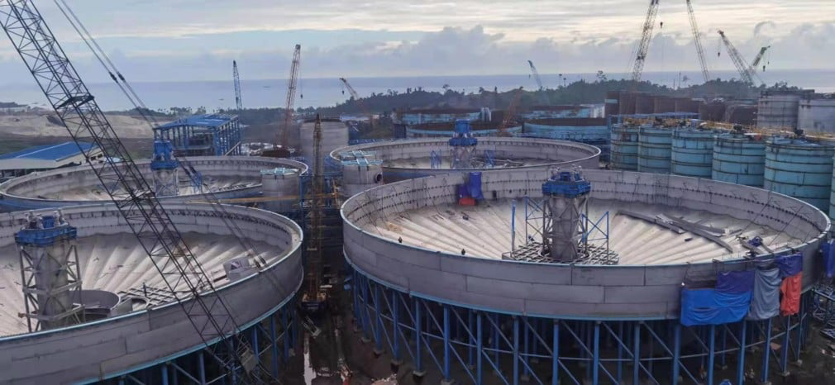
NHD builds the NHD thickener for solid-liquid separation and slurry concentration in metallurgy, mining, chemical processing, and environmental duty. The deep cone unit is the one we apply to alumina red-mud separation and washing, where the point of the tank is a thicker mud, not a drinking-water overflow.
For that final wash, the process index we publish is specific. Solids in the supernatant stay at or below 0.2 g/L. Solids in the underflow sit between 460 and 530 g/L. Alkali in that underflow stays at or below 5 kg/t. Read 0.2 g/L as about 200 mg/L of solids in the wash water. That is a wash specification. It is not a promise that the same tank will hold overflow solids down at a public-water or very tight discharge limit.
The mechanism that protects the tank on this duty is the automatic clarifier rake. It watches scraper torque and keeps the sedimentation balance, so a rising bed does not twist an arm or trip the drive and leave the tank full. Real-time torque is there to see abnormal resistance from sediment. Process settings can move while the bed and the discharge are still in range. If torque leaves that range, the unit alarms or stops, which cuts the chance of a tripped motor and a bent rake. The name on the rake does not turn the vessel into a standalone clarifier. We do not sell a clarifier as its own machine. The rake is the thickener’s protection when the mud is the product.
High torque output on this service comes from a multi-drive arrangement, a heavy-duty rotary bearing, and oil-bath lubrication, with the torque signal available to the control center. DCS monitoring can take slurry level and solids content from ultrasonic measurement and fold that into the same control loop. That package belongs to a tank that is expected to run heavy. It is the wrong story for a light rake over a dilute clarifier.
What we will not sign
A wash thickener does not replace a tight clarifier
If the overflow solids limit is tighter than 0.2 g/L, or the overflow itself is the saleable stream, say so before the diameter is frozen. We will not treat our wash index as a clarifier guarantee. A thickener that is doing its job can still send an overflow that a downstream clarifier, pond, or filter would have to finish.
The same honesty applies the other way. A large shallow clarifier sized only for clear water will not deliver 460 to 530 g/L underflow just because a rake was added. Bed depth, time under compression, and a drive that can live in that mud are part of the thickener, not decorations on a clarifier.
Bring three facts into the first review: which stream is the product, the feed solids, and the overflow solids you can actually accept. With those, we can tell whether the deep cone unit is the vessel, or whether the flowsheet still needs a separate clarity step.
Conclusion
Size the tank after the product stream is named. Underflow density at our wash index, with supernatant solids at or below 0.2 g/L and alkali at or below 5 kg/t, is a thickener job, and the automatic clarifier rake is there to keep that bed from wrecking the drive. A tighter overflow, or an overflow that is itself the product, is a different duty and should stay a different step. Duty notes can come to sales@chinanhd.com, or by WhatsApp at +86 136 6732 4277.
FAQs
Q1: Can one tank be the clarifier and the thickener?
A1: Only if one of the two limits is allowed to be loose. A single vessel can settle solids and move mud. It cannot deliver a very clear overflow and a very dense underflow at once without giving up one of those results. Split the specification first.
Q2: Does the automatic clarifier rake mean you sell a clarifier?
A2: No. The rake monitors scraper torque on our thickener so sediment and discharge stay in balance, and it alarms or stops when torque runs away. It is not a separate clarifier product, and it does not change the wash solids we publish.
Q3: What should we send before anyone talks diameter?
A3: Name the product stream, the feed solids, the underflow solids you need, and the overflow solids you can accept. If the overflow limit is tighter than 0.2 g/L, send that limit explicitly so we do not treat a wash thickener as the whole answer.