

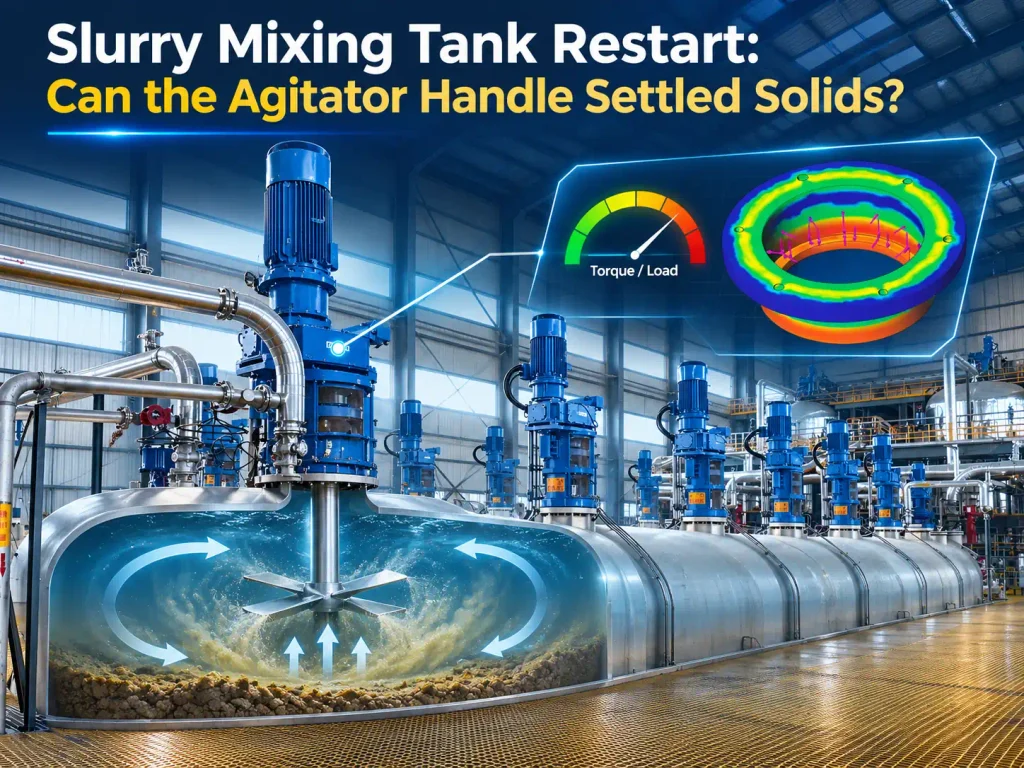
A slurry mixing tank restart belongs in the agitator’s design duty when planned interruptions can leave solids settled around the impeller. At NHD, we design mineral-processing agitators for slurry suspension and uniform concentration, using flow simulation, structural analysis and experimental measurements to examine the proposed equipment. For a project team selecting a mixer, the requirement is to define the stopped condition as well as the normal running condition.
We separate what must move inside the tank from the loads the assembly must carry. CFD and fluid-mixing simulation address the flow arrangement; support-structure analysis and shaft measurements address different mechanical and experimental questions. Our assessment needs the tank and agitator drawings, material properties, expected standstill and required recovery result before a proposed configuration can be judged against that interruption duty.
Our design assessment separates circulation from mechanical loading
The distinction matters before a motor size is compared or a mixer configuration is selected. The following table identifies the contribution of our assessment methods and the duty information that keeps each contribution relevant.
| NHD assessment capability | What it contributes to the selection | What the project must define |
| CFD and computerized fluid-mixing simulation | Examination of flow fields, impeller choices and mixing conditions | Material, vessel geometry and the operating condition being assessed |
| Support-structure FEA | Vibration and stress analysis between vessel and agitator | The actual support arrangement and the loading case to be considered |
| Agitator test-bench measurements | Shaft input-power information from torque and speed, considered with measured flow | Test material, equipment arrangement and the result the test is intended to demonstrate |
CFD lets us examine the flow needed for the suspension duty
Our mineral-processing agitator is available in configurations for mixing and suspension preparation. We compare impeller choices and flow patterns with computerized fluid-mixing simulations of different operating conditions. Our CFD work examines the three-dimensional flow field and fluid behavior as part of developing the agitator design.
For the project team, our flow assessment connects circulation with tank geometry and the concentration distribution required. Impeller movement, off-bottom suspension, uniform concentration and stable discharge describe different observations or process requirements. Choose evidence for the result the downstream process actually needs, rather than treating these observations as interchangeable.
A calculation of an established suspension represents the condition modeled. Demonstrating that circulation does not also demonstrate a start in settled solids. If the procurement duty includes a standstill, define the stopped condition explicitly; its coverage needs assessment alongside the running case.
Structural analysis and measurements address different design questions
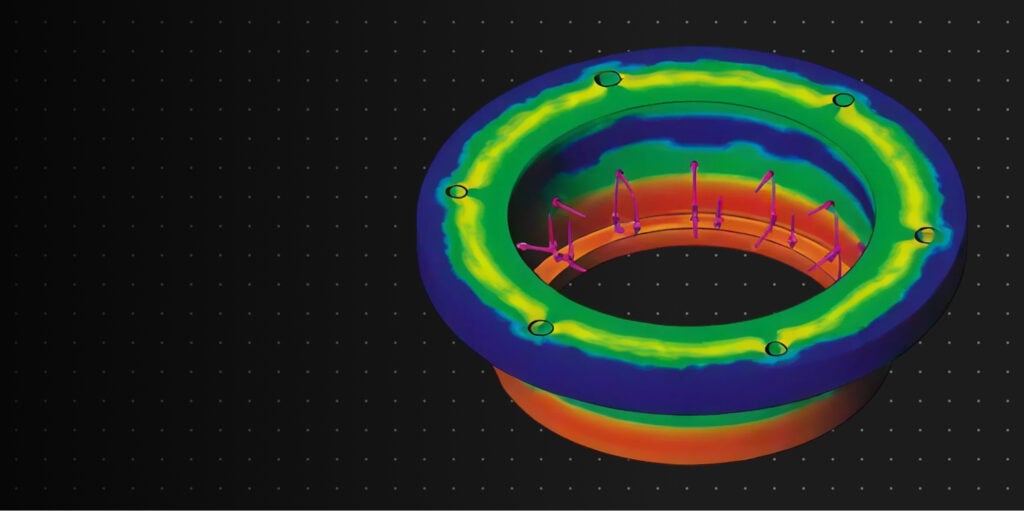
We use finite-element analysis for dynamic vibration and stress in the support structure between the vessel and agitator. This gives the support arrangement a defined role in our design assessment. It is a different question from whether the flow pattern provides the required suspension.
Our agitator test bench uses torque and speed measurement to determine shaft input power, with acoustic Doppler measurements of the flow field. Considering flow and power together helps us compare a test arrangement against the stated mixing task. Retain the tested material, impeller and vessel configuration with the result, so its relevance to the proposed equipment remains identifiable.
These capabilities provide evidence for a defined case. Support-structure FEA is not a blanket assessment of every drive component, and a normal running test does not automatically demonstrate starting in settled solids. The proposed restart duty needs its own stated coverage within the engineering assessment.
The stop reason determines what must be carried into the proposal
A power interruption changes the material case
During a standstill, solids can settle and change the material surrounding the impeller before the next start. That material may differ from the suspension circulating before the interruption.
For a project with anticipated power interruptions, give us the expected standstill and known material state with the inquiry. The earlier operating record still identifies the feed, liquid level and running conditions already handled. Restored electrical power does not extend that record to a stopped condition that has not been assessed.
This is why our assessment needs a defined interruption duty alongside the normal suspension duty. It gives the equipment selection a specific material condition to address, rather than turning a successful running record into an assumed starting capability.
An overload adds an equipment-condition question
An overload trip, abnormal vibration or suspected damage leaves an additional condition to resolve, concerning the process, the equipment or both. Before authorizing further operation, the site’s investigation and isolation arrangements need to address it. This remains necessary before intrusive inspection or maintenance.
For our review of an existing installation, include the stop reason and observations alongside the material information and configuration. A design discussion does not authorize another start while an abnormal event remains unresolved. The decision still needs the equipment’s status and the site’s authorized operating arrangements.
Selecting equipment for routine interruptions and responding to suspected damage are different tasks. We can assess a defined design duty, while the latter case additionally requires the event and actual equipment condition to be resolved. Keeping the tasks separate keeps evidence for one from being used to answer the other.
We scope the agitator around a stated interruption duty
Material and liquid-level changes belong in the duty definition
Solids concentration, particle characteristics, liquid level and standstill duration describe the case to be assessed. A change to any of them may narrow what an earlier assessment establishes. For our equipment review, keep those conditions with the tank geometry and proposed agitator configuration instead of supplying motor power alone.
Give us the tank dimensions and operating liquid level together, so the proposed arrangement is assessed for the stated geometry. Keep the configuration and the conditions used for a calculation or test with its result. A result for that defined case does not establish operating limits for a different, unassessed condition.
A proposed dilution, heating or drive-setting change likewise needs approval against the material and recovery basis. These actions are not universal solutions for a settled batch. Our selection work needs the actual material restrictions, rather than an assumed recovery measure that the process may not permit.
A recovery target is needed alongside the motor rating
Assess the motor rating within the actual drive and agitator assembly. A motor rating or variable-frequency drive alone does not define permissible starting conditions for the complete assembly. Give the assembly’s approved starting and running duties separately in the inquiry, with the configuration and loading case to be assessed.
Specify what recovery must achieve. A shaft turning or liquid moving at the surface does not establish restored solids distribution in the relevant tank region. Where the next process stage requires a uniform feed, the assessment needs evidence for that feed condition.
Our engineering and commissioning support connects equipment design with installation and process requirements. We can consider a stated interruption condition alongside normal suspension when assessing a new agitator or planned change, using the design and test methods relevant to that case. Retain the material, configuration, assumptions and operating boundaries with the result, identifying both the proposed duty and any engineering work still required.
Conclusion
Our agitator assessment connects flow, support loading and experimental evidence within one defined project duty. For a planned slurry interruption, send our team the tank and agitator drawings, slurry properties, expected standstill duration and required recovery result to sales@chinanhd.com, or reach us on WhatsApp +86 136 6732 4277. We can assess the proposed configuration against that duty, retaining the distinction between normal running, stopped conditions and equipment authorization.
FAQs
Q1: Does a normal suspension test prove that the agitator can start in a settled bed?
A1: No. It supports the material, vessel and operating conditions actually tested. A settled-bed starting duty needs to be addressed explicitly. Keep the assumptions and restrictions with the result rather than extending a running test to an unassessed condition.
Q2: What does NHD contribute to an interruption-duty assessment?
A2: Our assessment uses flow simulation for circulation and impeller arrangement, FEA for support stress and vibration, and test-bench measurements relating shaft power to flow behavior. Each contributes evidence for a defined case. None independently grants blanket permission to restart after an abnormal event.
Q3: What should be sent with a slurry mixing tank restart inquiry?
A3: Give us tank and agitator drawings, slurry properties, liquid level, expected standstill and the required recovery result. For existing equipment, include the stop reason and any abnormal condition still unresolved. We can then distinguish the design-duty question from the equipment-condition question in our review.