

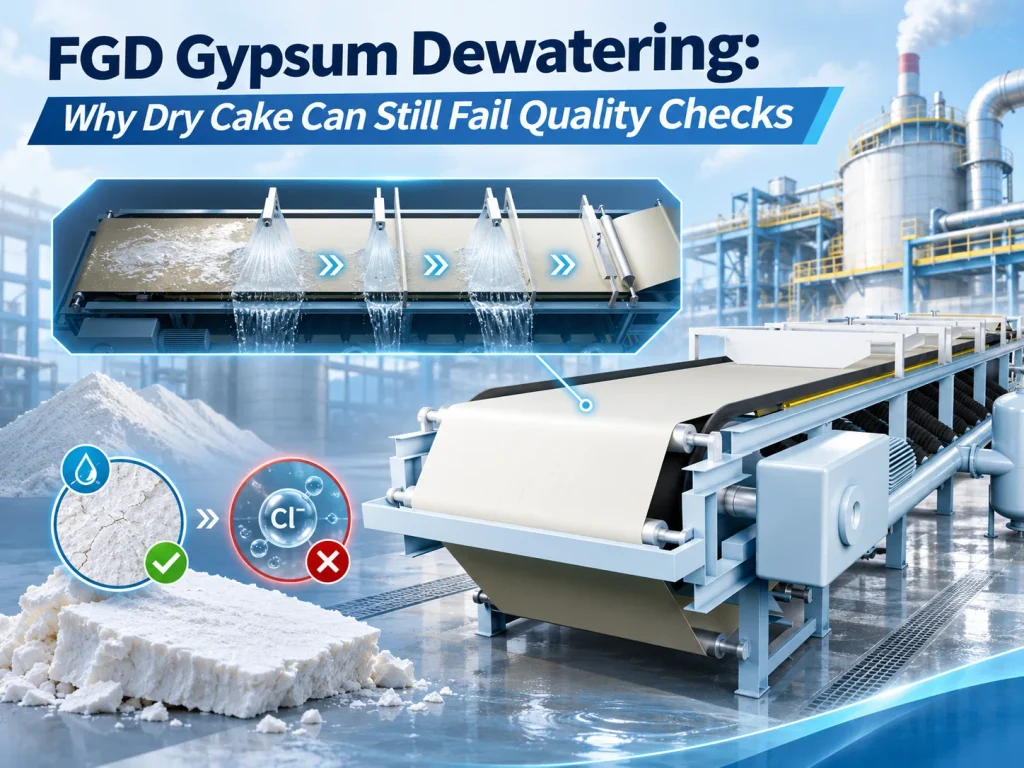
For FGD gypsum dewatering, we bring cake formation, staged washing and continuous dewatering together in our horizontal rubber belt vacuum filter. At NHD, we start with where the gypsum will go. A moisture limit tells us how much water must be removed. A chloride limit adds a washing duty. A cake that looks dry can still leave that second duty unfinished.
For a power plant selling gypsum, we select the filter model and arrangement from the receiver’s limits, slurry properties, dry-solids rate and wash-water analysis. This defines the washing and water removal required at the production rate. Our adjustable settings, slurry distribution, countercurrent washing and cloth recovery help us match the filter to that duty.
Our washing arrangement addresses the salt-removal duty
Uniform cake formation gives wash water a more consistent path
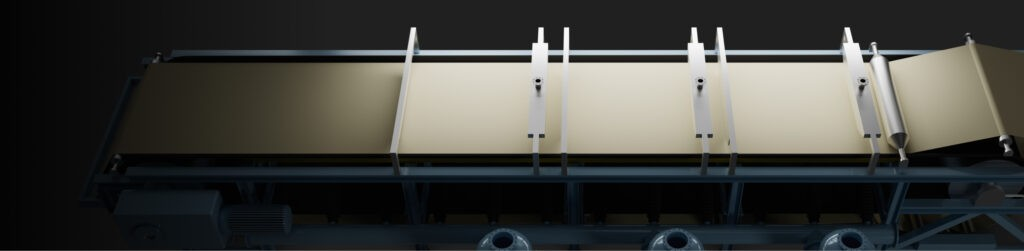
Our horizontal rubber belt vacuum filter combines uniform slurry distribution with multi-stage countercurrent washing. We consider cake formation in the wash assessment because a thick strip gives water a deeper path than a thin strip beside it.
We assess cake formation with the washing arrangement, using results representative of the proposed equipment duty. Raising total wash-water flow would not identify a distribution problem. Nor would an acceptable average from a combined sample explain the local variation. Distribution and washing need to be considered together in the equipment assessment.
Countercurrent stages give washing its own place in the duty
Liquor drawn from the cake by our vacuum carries dissolved chloride with it, while some liquor may remain after dewatering. Our washing stages displace that retained liquor with cleaner water to reduce soluble contamination. Moisture reports the remaining water; chloride in the finished cake requires its own analysis.
We review our multi-stage countercurrent arrangement against both the wash-water analysis and the available quantity. A recycled supply may already contain salts that the wash must remove. Give us its source, the receiver’s target and the outlet for displaced liquor. An adequate supply still needs evidence that the water is suitable for reuse.
We compare layouts only after establishing that each can meet the same finished-cake requirements. Identify which filtrates return for reuse and where chloride-bearing liquor leaves. With that common quality duty met and those routes defined, compare water consumption for the filter and its water circuit together.
We match operating controls to moisture and production requirements
Cake thickness and belt speed belong in the same assessment
We consider the slurry properties and required dry-solids throughput alongside our adjustable settings: cake thickness, washing water, vacuum and belt speed. Over a fixed belt length, speed sets the time available for washing and suction drying. Keep the washing result and production rate recorded at that setting with any moisture result.
For saleable gypsum, the design question is whether both quality targets can be met at that rate. Our operating flexibility lets us match a defined duty; it does not create a moisture or chloride guarantee common to all gypsum applications. The receiving specification and the actual material provide the performance basis for the proposed filter.
Drainage and cloth recovery support the liquid path
We provide belt grooves and drainage holes for filtrate to leave toward the vacuum system. Return-side cloth washing helps restore air permeability ahead of the cloth’s return to filtration. Drainage and cloth recovery support the liquid path through and away from the cake; soluble material is displaced by the cake-washing stages.
The filter-cloth selection relates the medium’s condition and permeability to cake formation and drainage. Changing the cloth cannot correct unsuitable wash-water chemistry. After a cloth change or an operating adjustment, verify washing and moisture in the cake together. If only one result has improved, the other remains to be checked.
Our selection basis connects equipment performance with receiving quality
The receiving limits define the targets for our review
Wallboard manufacture, cement use and disposal can impose different gypsum requirements. A cake may be suitable to handle or transport without being suitable as manufacturing feed. Settle its destination before finalizing our filter duty, retaining separate acceptance entries for moisture, chloride and the other specified impurities.
The following comparison keeps our equipment functions connected to the evidence required for the project. It contains no universal acceptance values.
| NHD design contribution | Quality question it addresses | Project evidence needed |
| Uniform slurry distribution and staged washing | Can the washing arrangement address soluble contamination across the cake? | Representative cake results, wash-water analysis and the proposed filtrate routes |
| Adjustable cake formation, vacuum and belt speed | Can washing and moisture targets both be met at the production rate? | Slurry properties, dry-solids throughput and results for the assessed operating conditions |
| Belt drainage and return-side cloth washing | Does the liquid path support the assessed filtration and washing duty? | Cloth condition and permeability considered with drainage and cake formation |
A moisture pass does not close an untested washing requirement
Keep moisture and chloride as separate entries in the receiving-quality checks. Compare each result with the receiver’s agreed limit using the corresponding test method and reporting basis. If chloride is reported on a dry-solids basis, retain that basis throughout the comparison. The moisture percentage does not supply a chloride concentration.
A moisture pass with a chloride failure still leaves washing or quality unresolved. A chloride pass with a moisture failure leaves dewatering and handling unresolved instead. If both pass, the other specified quality conditions still need their evidence. Keep the material, operating conditions, sampling location and analytical basis with a filter-trial result so it supports the equipment decision it actually represents.
A defined inquiry lets us assess the proposed arrangement
Give us the slurry, water and product conditions together
Our engineering review starts with the slurry properties and dry-solids throughput. Send the receiving quality requirements and the quantity and analysis of the proposed wash water with them. Include the filtrate destinations, plus the reporting bases for moisture and chloride. Together, these describe the duty against which we assess cake formation, washing and dewatering.
Keep equipment selection and shipment acceptance identifiable. An earlier filter trial can help define the equipment duty, but it cannot release a later shipment. The plant and receiving laboratory need the agreed sampling method and results for the lot being accepted. Our equipment record supports their acceptance decision without replacing it.
Conclusion
We assess our belt filter’s cake formation, countercurrent washing, drainage, dewatering and operating adjustments against the material, receiver’s requirements and intended production rate. Send the slurry properties, receiving limits, wash-water analysis and dry-solids throughput to sales@chinanhd.com, or contact us on WhatsApp +86 136 6732 4277, for our assessment of the corresponding filter arrangement.
FAQs
Q1: Can gypsum meet its moisture target and still contain too much chloride?
A1: Yes. Dewatering can leave chloride-bearing liquor in the gypsum. The moisture measurement reports water content; a passing result leaves chloride unresolved without a separate analysis. Compare the chloride result with the receiver’s limit.
Q2: Does FGD gypsum washing always require fresh water?
A2: We need the source and analysis before judging a fresh or recycled supply against the required chloride removal and finished-cake target. This review includes whether reuse is appropriate for recycled water. A sufficient quantity, by itself, leaves the water’s washing value undetermined.
Q3: What information helps NHD assess a gypsum filtration inquiry?
A3: We need slurry properties and dry-solids throughput, receiving quality limits, the wash-water quantity and analysis, and the proposed filtrate routes. Tell us the reporting bases for moisture and chloride as well. We use these inputs to assess equipment for the intended gypsum product duty.