

img.Thickener Sizing Starts With the Settling Test.webp
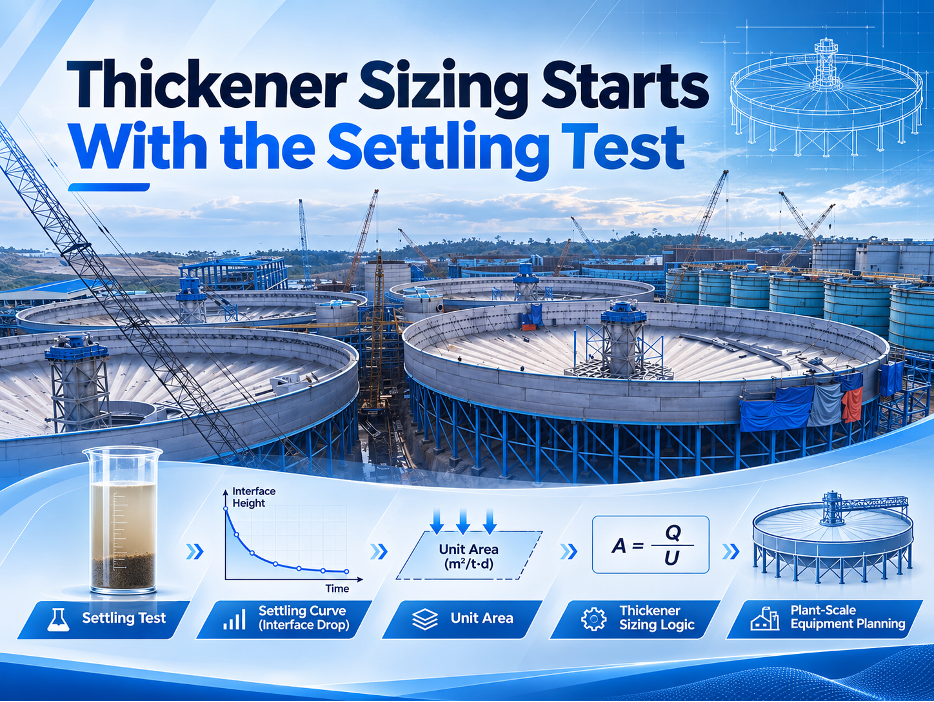
Thickener sizing is the step that turns a settling test into area, then into depth and rake torque. A continuous thickener keeps taking feed while underflow and overflow leave. Thickener design that starts from a neighboring tank’s diameter skips the only measurement that belongs to this slurry.
The test is ordinary and still decisive. Solids settle in a cylinder. Someone records how fast the interface drops and whether the mud ever reaches the density the plant actually needs. That sheet, not a catalog diameter, is what we size from.
Area comes from the rate the solids settle
A cylinder is not the plant tank
Area has to pass the solids load at the settling velocity this slurry showed. Faster settling, for the same solids rate, means less area. A slurry that stays cloudy and drops slowly needs more area, even when the plant next door runs a smaller tank on a different ore.
Copying a diameter feels conservative and often is not. The other tank may have a different feed percent, a different flocculant dose, or a different underflow target. Those three change the unit area. A continuous thickener also dilutes feed as it enters the feedwell, so the settling that matters is not the first minute of an undiluted jar left on a bench.
We do not publish one universal square-metres-per-tonne figure, and we will not invent one from a formula that was fitted to someone else’s mud. If the test exists, we use that test. If it does not, the honest next step is to run one on the slurry you will actually feed, at the flocculant dose you are willing to live with.
Density the test never reached is a depth question
Bed height and draw-off move together in a heavy mud
Area gets solids into the tank. It does not, by itself, finish the compaction. If the cylinder run ends before the underflow density you wrote down, adding only diameter gives you a wider tank of the same unfinished mud. The missing piece is time under compression, which is bed depth and how fast you pull the underflow.
The deep cone thickener from NHD is the unit we use on alumina red-mud washing when the mud has to leave dense. The wash index is supernatant solids at or below 0.2 g/L, underflow between 460 and 530 g/L, and alkali at or below 5 kg/t. That underflow band is already a compressed mud. A short jar that stalled at a much lower solids content has not yet shown the area, and it has not shown the depth either.
At lower underflow density, the draw-off rate is what moves the solids most. Once the bed is in the range our deep cone is built for, both the pumping rate and the interface height move the density. Raising the bed without a drive that can turn in it, or pulling the underflow so hard that the bed collapses, both miss the 460 to 530 g/L window. Thickener design at this point is those two handles, not a second copy of the area calculation.
The drive is part of the size
Torque has to be read while the bed is heavy
img.Exploded view of a thickener drive with motors and gear housing.webp
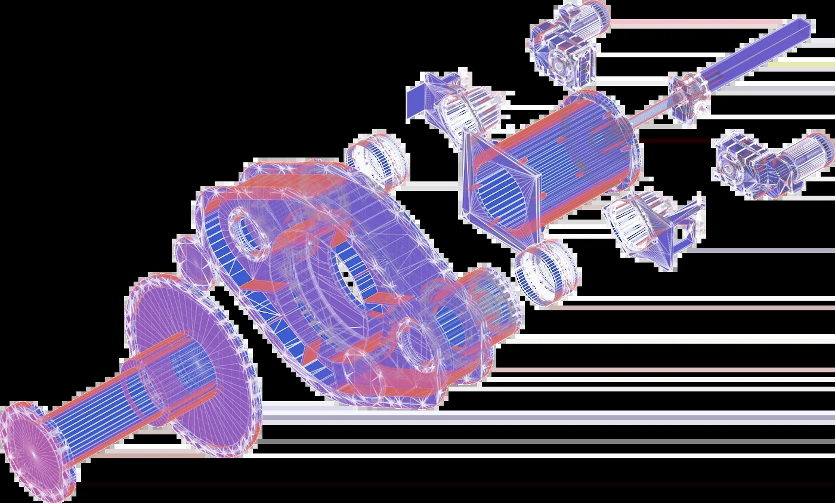
A rake sized for a light clarifier bed will not live in a deep cone of red mud. High solids and a high compression ratio put a steady heavy load on the drive. Our thickener uses a multi-drive arrangement, a heavy-duty rotary bearing, and oil-bath lubrication so that load can be carried for a long run, and the torque value goes to the control center.
The torque indicator is not a gauge for the monthly report. It reads the change while the tank is operating and gives the control system a way to keep sediment and discharge inside a set range. When torque rises because the bed was left too deep, the feed changed, or the underflow pump fell behind, the same loop can alarm and stop before an arm twists or the motor trips and the tank has to be dug out.
That is why torque belongs in the sizing package with area and depth. A tank with enough area and not enough drive is a tank that makes density until the first upset, then becomes a maintenance job. DCS monitoring of level and solids, including ultrasonic measurement of the slurry, is how we keep those three in one loop rather than hoping the operator sees the bed in time.
What we need before a diameter
Send the settling curve, the feed solids, the underflow you actually need, and the overflow solids you can accept. Say whether the test reached the target density or stopped early. Say whether the rake must restart in solids that have already settled, because a start in a packed bed is a different torque from a start in a fluid mud.
With that sheet we can separate a shortfall in area from a shortfall in depth or drive. Without it, a diameter is a guess wearing the clothes of thickener sizing.
Conclusion
Set area from the settling rate of this slurry, then set depth and rake torque for the density the test did or did not reach. Our deep cone wash duty lives at 460 to 530 g/L underflow, with supernatant solids at or below 0.2 g/L, and the drive is instrumented because that mud is heavy. A copied diameter does not carry those numbers. The curve and the target density can be sent to sales@chinanhd.com, or by WhatsApp at +86 136 6732 4277.
FAQs
Q1: Can we size from a similar plant’s tank diameter?
A1: Only after the feed solids, flocculant, and underflow target are shown to match. A continuous thickener on a different slurry can need a different unit area even when the tonnage looks familiar. The settling test is the cheaper way to find that out.
Q2: The cylinder never reached our underflow target. Do we just add area?
A2: Not by default. Area moves the solids rate. Depth and the underflow draw-off are what finish compaction. If the test stopped short of 460 to 530 g/L, we look at time in the bed before we widen the tank.
Q3: Does rake torque change the diameter?
A3: Torque does not replace the area calculation. It decides whether the mechanism can turn once the bed is at the density you asked for, including a restart in settled solids. An undersized drive fails a tank that was wide enough.