

China’s concentrate-fed copper smelting capacity is close to its ceiling in 2026, according to the China Nonferrous Metals Industry Association, which said on 17 November 2026 that it will work with regulators on capacity monitoring and early warning. With spot treatment charges at a record low of −$247.20 a tonne in early November, on Argus data, smelters cannot earn their way out through volume. The remaining lever is the efficiency of existing lines, and in the acid plant that lever is gas cleaning: a wire mesh demister in sound condition is part of what keeps acid quality, downstream equipment and stack emissions inside their limits.
Why Mist Control Carries More Weight in a Capped Market
The Gas Path From Smelter to Acid Plant
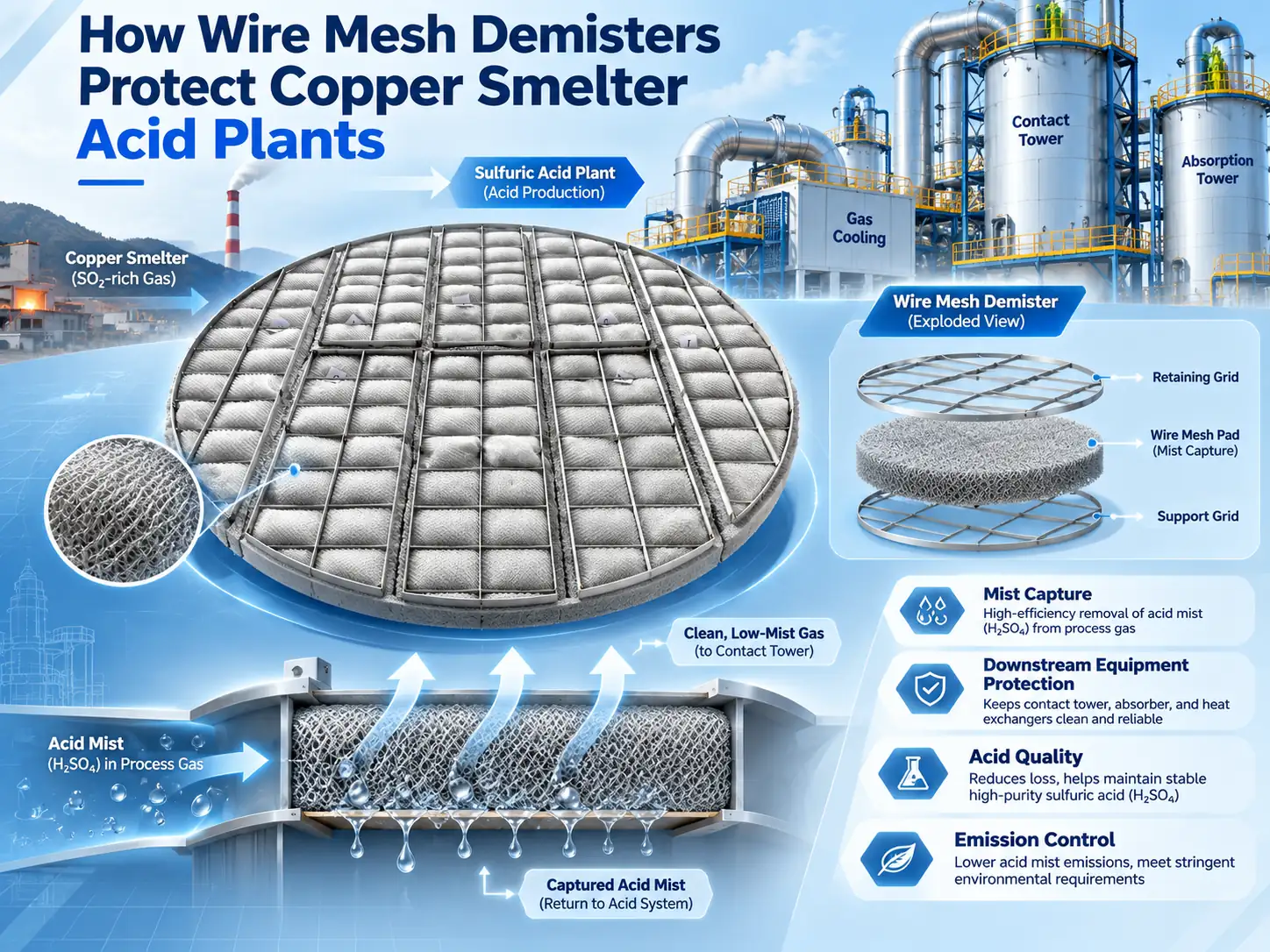
Smelter off-gas is cleaned, dried, converted and absorbed in sequence to produce sulfuric acid. Acid mist forms where gas meets concentrated acid, principally in the drying and absorption towers, and fine droplets that are not captured travel with the gas. The demister sits at the tower outlet as the last separation step before the gas moves on.
What Carryover Costs in Practice
Carried-over mist is acid the plant made and then lost. It corrodes downstream ducting, fans and heat-exchange surfaces, contaminates the acid product where it collects with the gas stream, and leaves the stack as an emission the plant must report. A fouled or damaged demister also raises pressure drop across the tower, and the gas blower pays for that on every operating hour. None of these costs appears in a capacity figure, but all of them decide whether a capped plant still makes money.
How a Wire Mesh Demister Captures Acid Mist
Impaction, Coalescence and Drainage
A wire mesh demister is a pad of knitted wire mesh fitted across the tower outlet. Fine droplets move with the gas and, through Brownian motion and direct interception, strike the wires and stay there. Captured liquid builds on the mesh until the droplets merge into drops heavy enough to drain back against the gas flow by gravity. Separation therefore depends on the mesh staying complete and evenly loaded: broken wires, gaps at the support grid or local fouling each open a path that the mist will find.
Three Mesh Types, Three Different Jobs
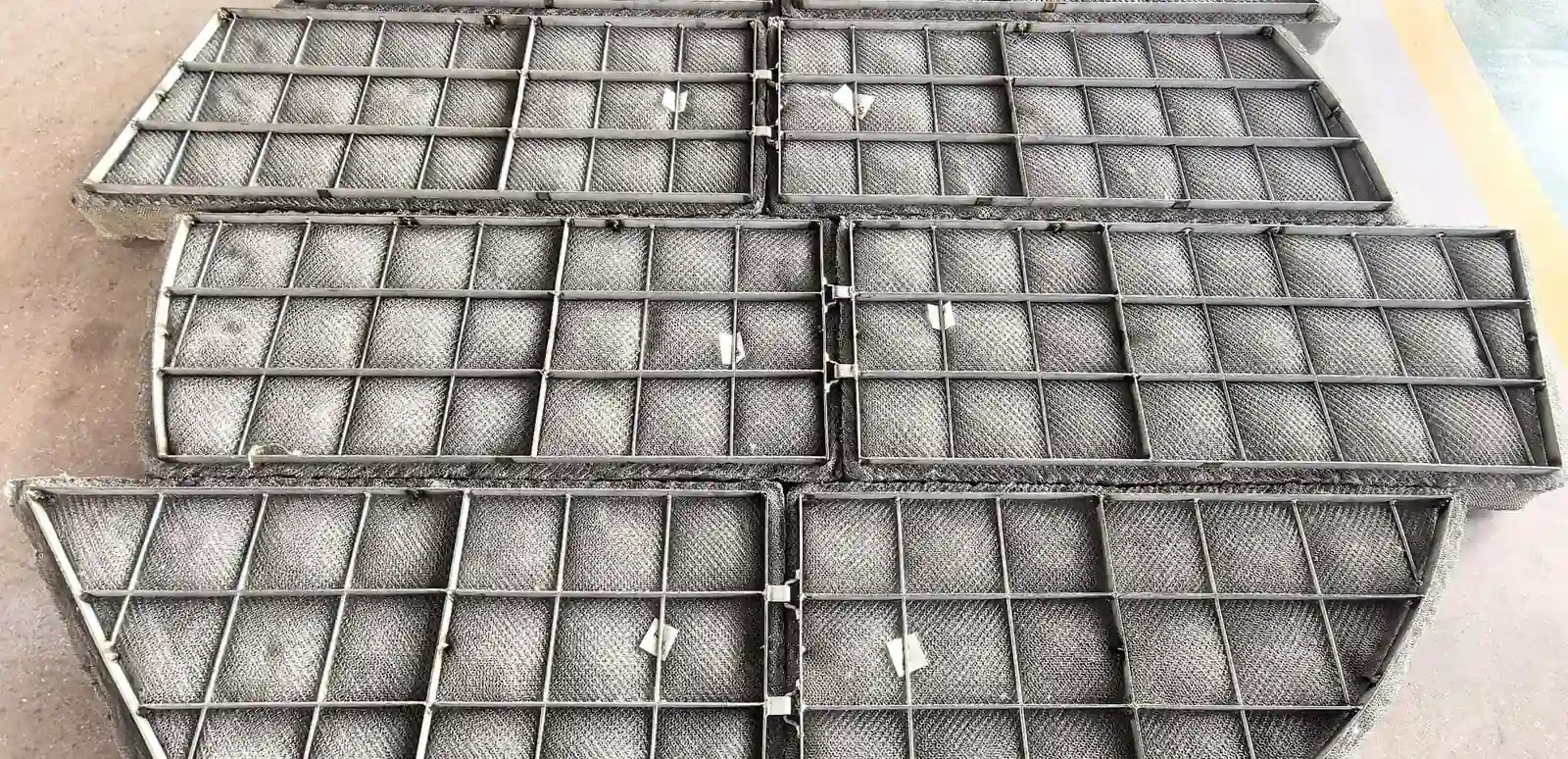
NHD has developed three generations of mesh demister for this service. The standard type is compact, light and low in pressure drop, and remains the default for a straightforward tower outlet. The drawer type, patented as ZL93.2.46402.5, is built so the mesh sections can be pulled out, cleaned or replaced without anyone entering the vessel, and it can be fitted with a blanking plate so the tower still separates properly at low load; NHD’s enterprise standard for this design became the industry standard. The V type, patented as ZL97.2.36744.6, shapes the mesh to suppress re-entrainment, gives about 15% more filtration area, and reaches with a single layer the separation performance that a standard pad needs two layers to match.
Material Selection and Maintenance in Acid Service
Match the Mesh to the Gas It Will See
The mesh material has to be chosen for the gas the pad will actually see. The gas composition, acid strength, operating temperature and any chloride or fluoride load set the corrosion rate, and a mesh that thins or breaks loses separation long before it fails mechanically. The specification should therefore state the full gas analysis and temperature range the demister must survive, and the material should be chosen and warranted against those figures rather than against a generic acid duty.
Keep the Pad Working Between Turnarounds
Pressure drop across the tower is the plant’s everyday indicator: a rising trend means fouling or damage is narrowing the gas path. At inspection, the checks are wire condition, mesh compression, support condition and the state of the drainage path. The drawer design shortens this work because sections come out from outside the vessel. Where the final mist load is finer than a mesh pad is meant to carry, the polishing stage belongs to a BECOFIL candle filter, and the two devices should be specified as one system rather than substituted for each other.
Conclusion
With smelting capacity capped, the acid plant’s contribution is measured in steady running: acid inside specification, equipment lasting to the next planned shutdown, emissions inside the permit. Mist separation is a small line in the equipment list and a large one in that result. NHD is a designated demister manufacturer for China’s chemical, nonferrous and petrochemical industries, and its team can work from a tower’s gas flow, acid strength and vessel drawing to specify the mesh type and material; send those figures to sales@chinanhd.com or WhatsApp +86 136 6732 4277 to start the selection.
FAQs
Q1: Where is a wire mesh demister installed in a sulfuric acid plant?
A1: At the outlet of the drying and absorption towers, across the gas path. It is the last separation step before the gas leaves the tower, capturing acid mist formed in the tower so the droplets drain back instead of travelling downstream.
Q2: What is the difference between standard, drawer and V-type mesh demisters?
A2: The standard type is a compact, low-pressure-drop pad for ordinary duties. The drawer type can be pulled out for cleaning or replacement without vessel entry and can run with a blanking plate at low load. The V type is shaped against re-entrainment, has about 15% more filtration area, and matches double-layer standard performance with one layer.
Q3: How does a plant know a demister needs attention?
A3: A rising pressure-drop trend across the tower is the first sign of fouling or damage. Confirmation comes at inspection: broken or thinned wires, uneven mesh compression and blocked drainage all reduce separation and call for cleaning or section replacement.