
Ghana’s integrated aluminium programme moved from policy to contract in late October 2026, when GIADEC and RUSAL signed a cooperation agreement worth more than $1.5 billion covering bauxite mining at Nyinahin and a 1.2 million tonne per year alumina refinery. A Bayer refinery of this size produces red mud at roughly the same rate as alumina, and the mud leaves the circuit through one route: settling, counter-current washing and caustic recovery. That duty sets the refinery’s water balance, its caustic soda consumption and a large part of its operating cost, and it is the duty a deep cone thickener is built to carry.
What the Ghana Project Puts Into the Bayer Circuit
A Refinery Sized Around Local Bauxite
The agreement, signed in Moscow during a Russia-Africa forum and reported through November 2026, sets up two joint ventures, Nyinahin Bauxite Ltd and Ghana Alumina Company, with RUSAL providing the funding and holding the controlling stake. The mining side is planned at about 5 million tonnes of bauxite a year, feeding a refinery of 1.2 million tonnes of alumina a year, with a construction period of about 36 months and gas-fired power. Ghana holds large bauxite reserves but has historically exported ore rather than refining it at home; this project is the country’s first full move from mine to alumina on one site.
Where Red Mud Washing Decides Operating Cost
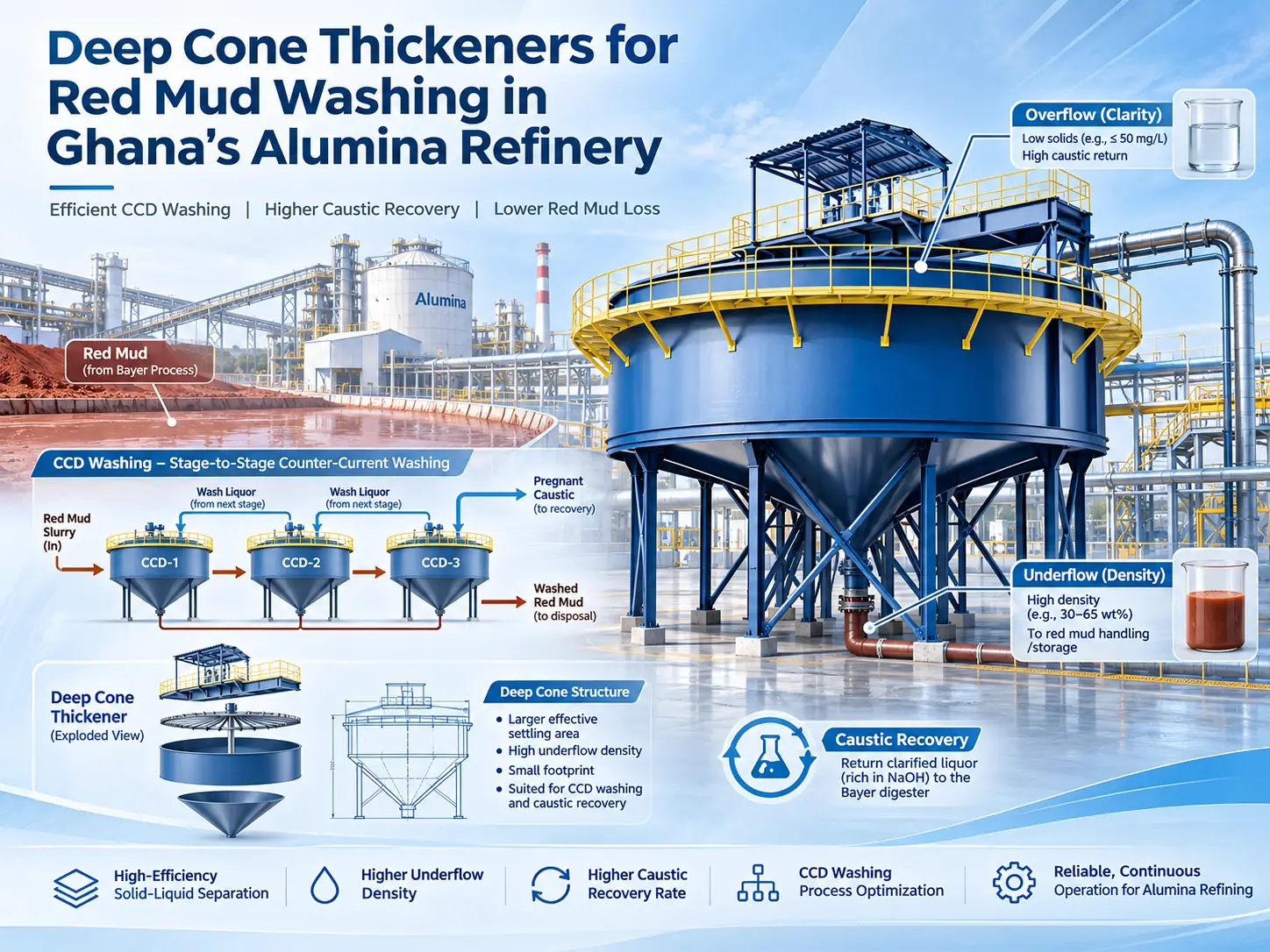
In the Bayer process, digested slurry is separated into pregnant liquor and red mud residue, and the mud carries a heavy load of caustic liquor with it. A counter-current decantation (CCD) washing train settles and washes the mud stage by stage, returning recovered caustic to digestion and sending washed residue out at the final stage. Every point of underflow density the train gains is caustic and water the refinery does not lose; every gram of solids that escapes in the final overflow returns with the wash water and loads the liquor circuit. The washing train is therefore specified on three numbers: final overflow solids, final underflow density, and the alkali still held in that underflow.
The Three Numbers the Thickener Train Must Hold
Underflow Density and Caustic Recovery
NHD developed its deep cone thickener for alumina red mud separation and washing, and its design targets for the final washing stage are an underflow of 460–530 g/L solids with alkali content held at or below 5 kg/t. The deep cone gives the settled mud a long compression path under its own weight, and the machine’s underflow compression capacity is about ten times that of a conventional thickener, at roughly fifteen times the throughput capacity. Higher underflow density means less liquor leaving with the residue at each stage, fewer washing stages for the same recovery, and a smaller water addition to the circuit.
Overflow Clarity at the Final Stage
The matching target on the liquid side is a final-stage overflow at or below 0.2 g/L solids. Overflow from the last washer returns as wash water to the earlier stages, so solids in that stream are recycled into the train instead of leaving it, raising the load on every upstream unit. Holding clarity at this level depends on feed distribution that does not break the flocculated mud structure, a controlled bed level, and discharge that keeps the settling rate and the underflow rate in balance rather than surging.
How the NHD Deep Cone Thickener Is Built for This Duty
Deep Cone Compression and the Drive
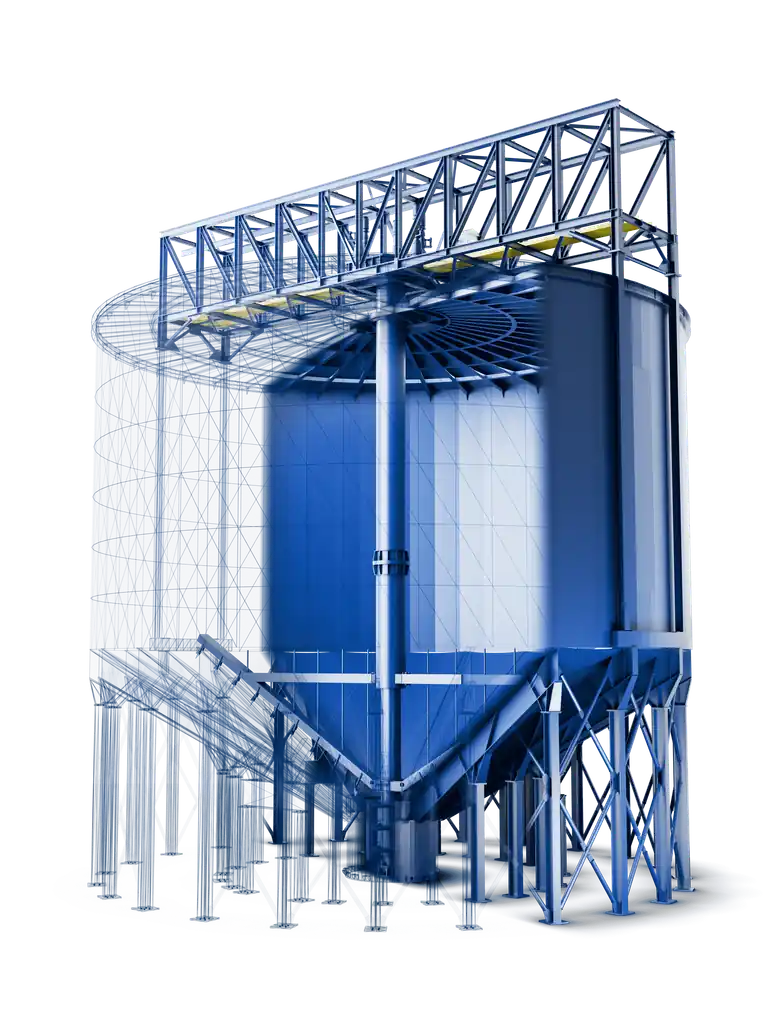
The deep cone thickener uses a steep cone and a centre drive carried on a heavy-duty slewing bearing with multi-point drive and oil-bath lubrication, a structure chosen for the high torque that a deep, dense mud bed generates. Feed enters in a way that limits damage to the flocs formed ahead of the tank, protecting the settling rate. CCD thickeners from this range are already running at large diameters in hydrometallurgical service, including Φ55 m units in Indonesia and a Φ36 m CCD train in Papua New Guinea.
Torque Monitoring, Automatic Rake Lifting and Control
Torque is measured in real time and transmitted to the control centre. When the mud bed builds beyond the set range, the system alarms and can stop the drive before damage occurs, and the rake lifts automatically to hold the balance between settling and discharge. Bed level and underflow solids are followed by ultrasonic measurement, and the unit integrates with the plant DCS, so the washing train’s key variables sit in the same control room picture as digestion and precipitation.
Setting Thickener Parameters for a New Refinery
Settling Tests on the Project’s Own Red Mud
Red mud settling behaviour changes with the bauxite source and the digestion conditions: settling rate, compression behaviour and flocculant response all move, and with them the tank area and torque the duty needs. The sizing work therefore starts with settling tests on mud produced from the project’s own ore, not with a standard diameter. Test results set the unit area loading, the cone and drive sizing, and the flocculant dosing range the control system will work within.
Fix the Duty Points Before Ordering
Process engineers fixing the specification should confirm the design throughput and its surge margin, the number of washing stages, the underflow density and final overflow solids the guarantee will be written against, and the residue route after the last stage. Where the washed residue goes on to final dewatering, a pan vacuum filter for alumina is the usual companion duty in this industry, and its feed conditions should be agreed with the thickener discharge at the same design table.
Conclusion
Ghana’s refinery will be judged on alumina output, but its operating cost will be set in the washing train: caustic recovered or lost, water added or saved, residue discharged at a density the disposal route can take. Those outcomes are fixed by thickener selection and by the test work behind it. Project teams working on alumina capacity can share the bauxite source and design throughput, the planned number of washing stages and the underflow and overflow targets with NHD for review of the settling test scope and equipment sizing. Contact sales@chinanhd.com or WhatsApp +86 136 6732 4277.
FAQs
Q1: Why does a Bayer refinery use deep cone thickeners for red mud washing?
A1: Red mud must leave the washing train at high density so that caustic liquor is recovered instead of discarded with the residue. A deep cone gives the mud a long compression path, and the NHD design reaches about ten times the underflow compression of a conventional thickener, which raises underflow density and cuts the wash water the circuit needs.
Q2: What overflow and underflow values should a new alumina project specify?
A2: For the final washing stage, NHD’s deep cone design targets are an overflow at or below 0.2 g/L solids, an underflow of 460–530 g/L solids, and alkali in the final underflow at or below 5 kg/t. Project-specific guarantees are set from settling tests on the project’s own red mud.
Q3: What information is needed to size a thickener for an alumina refinery?
A3: The design throughput and surge margin, settling test results for the project’s red mud (settling rate, compression and flocculant response), the number of washing stages, and the underflow density and overflow clarity the plant will guarantee. Diameter, cone design and drive torque all follow from those inputs.