
India’s Ministry of Mines convened a national seminar on critical-mineral recycling and the circular economy in New Delhi on 21 September 2026 and launched a concept paper there, with technical sessions ranging from e-waste collection to lithium-ion battery metals and black-mass processing. The message to Indian recyclers is unmistakable: end-of-life products are to be handled as secondary sources of critical minerals, and plants will be expected to recover more, from a broader spread of them.
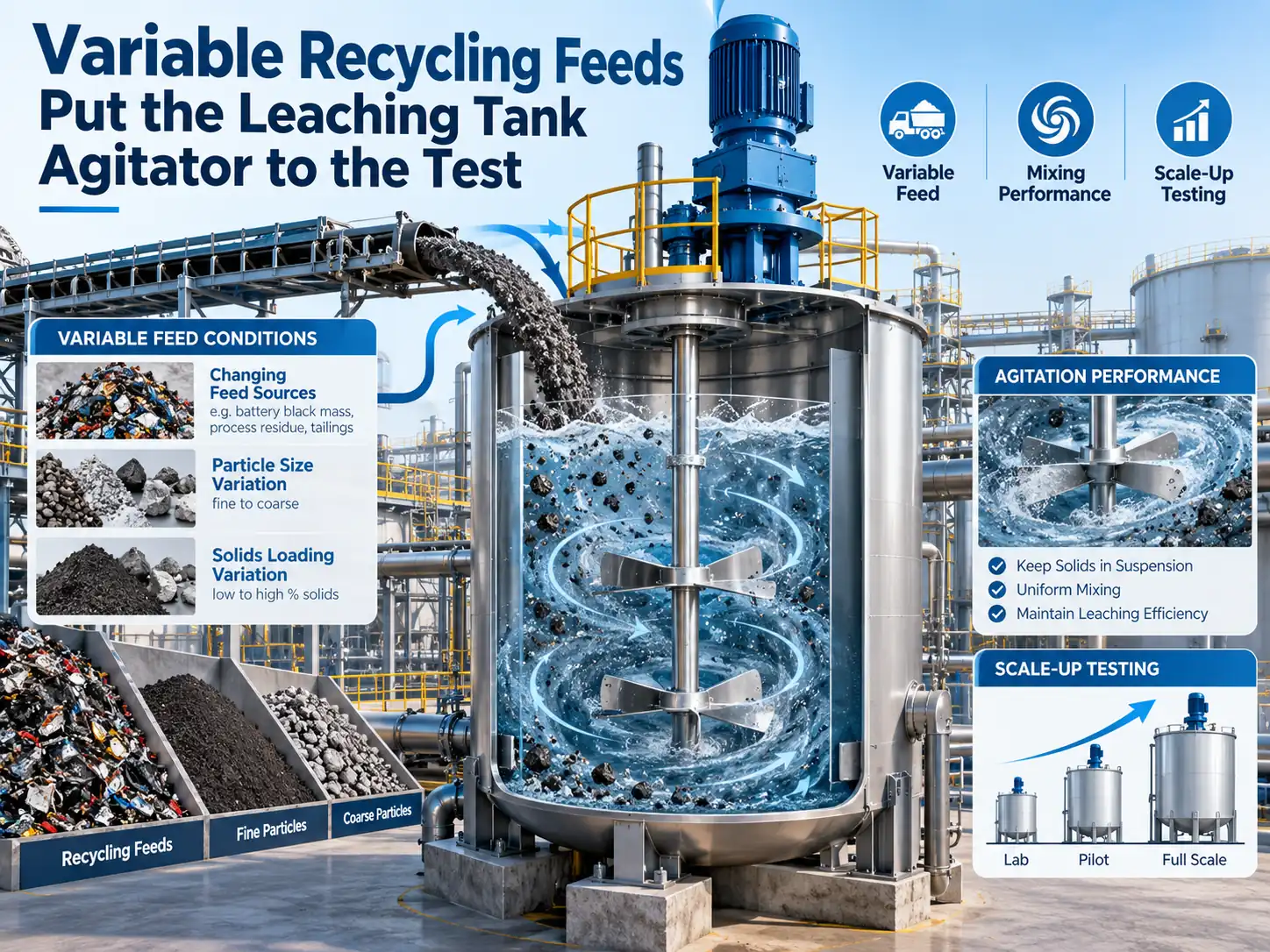
Every new source arriving at the gate arrives eventually at a leaching tank, and its paperwork describes the chemistry far better than the slurry behaviour. Whether dense solids stay suspended, meet the reagent and leave in a stream of even composition is physics, which the vessel and its agitator alone can settle.
That is the thread running through what follows. An agitator chosen for one well-behaved feed may turn out, for the feed delivered half a year later, to have the wrong capacity, the wrong arrangement or the wrong specification in its wetted parts — and long before anything breaks mechanically, the mismatch announces itself in recovery that falls short and batches that stall.
A Wider Intake Changes the Mixing Duty Before It Changes the Chemistry
Every New Source Arrives With Its Own Particle Behaviour
Black mass differs from lot to lot; no two deliveries are the same material. Chemistry from one battery family to another shifts the metal content, the difference a buyer notices first. The dismantling route counts for exactly as much.
It decides how much plastic, foil and fine material travels with the solids. Moisture wanders, and so does carried electrolyte, so the liquor entering the tank is rarely the flowsheet liquor.
How a plant meets the variation depends on how it runs. Campaign one source at a time and differences arrive in sequence, adjustable between lots. Blend sources for steadiness and they arrive all at once, in one vessel, whose blend behaves only as well as its worst fraction.
Preparation contributes variation of its own. The harder the crushing, the more fines. Salts washed out ahead of the leach are salts the tank is spared. Material dried and then repulped may fuse into agglomerates.
For a time those lumps pass for coarse solids, until midway through a batch they disintegrate and cease to pass. The record that matters is therefore not a list of feed names but a sample card per material — size curve, solids concentration, density difference against the liquor — tied to the preparation route that produced it. Build an agitator review on the average of those cards and you design around a feed that never enters the tank; build it on the difficult sample, and the average takes care of itself.
Leaching and Neutralization Fail in Different Ways When Mixing Falls Short
Leaching is a contact process. A particle in a settled bed sits in depleted liquor and gives up almost nothing, however long the batch runs; held in circulation, it keeps meeting fresh reagent and leaches at the rate chemistry promises. Neutralization fails in the opposite direction — through excess, not shortage.
Dosed into a poorly mixed vessel, reagent neutralizes the liquor near the dosing point first. A probe mounted there reports that local pH as the tank’s, while the bulk lags behind — still acidic, or already overshot — and the operator doses against a local condition.
An outlet sample cannot arbitrate between these failures: it measures material that left, nothing about what stayed behind. In a pilot vessel, sample at several elevations and compare solids concentration and particle size between them. Each pattern points to where circulation is breaking down: a clear stratum near the surface, a sluggish cloud that never fully disperses, and a bed under the impeller persisting through a speed change point to different corrections — impeller position, baffle arrangement and operating speed respectively.
Suspension Is Won or Lost at the Bottom of the Tank
Coarse, Dense and Wide-Ranging Feeds Set the Hardest Case
The mixing duty is decided at the tank’s bottom. The particles settling there are the coarsest fraction, or the densest, or both, and hoisting them back into circulation demands more energy than any other work the impeller does higher up.
Geometry governs how far that energy travels: tank diameter and liquid level set the circulation distance; impeller diameter and pumping direction set the shape of the flow carrying it.
Bottom clearance, baffles and impeller count then decide whether the lowest solids sit inside that flow or stranded beneath it. Change one element and the others change effect. Tank and agitator must therefore be appraised as a single arrangement, not as a vessel off one drawing and a drive off another.
Built in that spirit, around tank and duty together, our agitator for nonferrous processing and beneficiation comes in top-entry, side-entry and long-shaft builds with differing circulation paths, designed for stable suspension and uniform concentration. The range carries a blade drawn for leaching: the variable cross-section obliquity agitator grew out of leach-tank work in nonferrous and phosphoric-acid plants, where the tank asks for pumping flow on a generous scale to keep solids aloft, paired with low shear, because crystals torn apart in the leach return downstream as fines for filtration and settling to contend with.
Set beside a conventional 45° pitched-blade turbine, it delivers the same effect on 40–50% less power. The validating test follows the densest fraction, not the bulk. A uniform outlet stream reassures, but a bottom bed visibly moving, thinning and drawn back into circulation is stronger evidence. When a feed change arrives mid-cycle, samples drawn after the change carry more weight than a longer run on the feed the tank began with.
The Liquor Chooses the Wetted Materials, and the Solids Wear Them
What attacks the agitator is not the metal under recovery. It is the liquid. Batch after batch, hour after hour, that liquid touches shaft and impeller, and its identity is fixed by four variables: the leach reagent, its concentration, the temperature, and how long the surfaces stay immersed.
Neutralization adds a second chemistry to the same train, so a vessel reviewed only against leach liquor may meet an alkali, a chloride load or a cleaning regime it was never reviewed against.
Describing the duty as acid service disposes of none of this. Under a shared label, two liquors can diverge in concentration and temperature enough to demand different alloys, linings or coatings.
Our standard selection already spans 304L and 316L through 317L, 904L, the duplex grades 2205 and 2507, and titanium, with more than a dozen further materials behind it that the group developed for particular acid and alkali concentrations and temperatures. The grade follows the liquor analysis, not the name painted on the tank.
Alongside the chemical load sits a mechanical one: hard battery fragments and abrasive gangue wear blades, hubs and shafts continuously. The two loads usually climb in step when the intake widens, for an uncomplicated reason: each new source delivers its liquor and its hard fraction together, in one consignment. Corrosion-resistant materials and construction tailored to the case are how we answer that combined duty.
Inspection after a test run extends to the hardware, not only the slurry. Scale is the quiet saboteur: a film accreting on a blade constricts the flow path and distorts the very circulation the test set out to measure, and a deposit on the shaft near the liquid surface, where gas-phase attack is fiercest, is precisely the failure our patented co-current agitator suppresses by holding the surface concentration gradient down.
Pilot Results Only Scale When Geometry and Measurements Travel With Them
Copy the Arrangement, Not the Speed
Copying impeller speed is no way to transfer a pilot result into an industrial tank. The landing zone is broad: our agitators span 1.5 kW to 1,000 kW, at speeds from 0.01 to 3,000 r/min, and a recycling leach tank sits somewhere specific inside that range. The production vessel is wider, its liquid deeper, and the proportions linking impeller, baffles and bottom — the proportions that produced the pilot outcome — have moved with the dimensions. What must travel from pilot to design intact is the arrangement itself: tank diameter and liquid height, bottom shape, impeller type and position, baffle layout, and where feed and reagent enter. All of it should be recorded with the available power, and kept with a drawing or photograph of the vessel as actually configured. Without that record, a later engineer cannot repeat the test — and a result that cannot be repeated cannot be scaled with confidence.
Our test bench is laid out to make exactly those comparisons. It carries three tank diameters, 600 mm, 1,200 mm and 1,800 mm, three sets of impellers making nine in total under geometric similarity, interchangeable baffles and different tank bottoms, and a vessel below 1,800 mm can run on it at prototype scale. Small geometric changes produce visible consequences: raise the impeller, and a bed can gather in the space left beneath it; move a baffle, and the swirl pattern reorganizes around it. On the same feed, either change can turn a pass into a failure — which is what separates a property of the material from a property of the arrangement.
Power, Torque and Velocity Have to Be Read Together
Measurement completes what observation starts. On our bench a variable-speed motor drives the shaft through a torque sensor and speed detector, recording shaft input power as the run happens; at the same moment an acoustic Doppler velocimeter maps the flow field, so velocity and power pictures belong to the same instant of the same run. An impeller comparison therefore rests on both together: what the motor was asked to deliver, and what the fluid did in response. Flow simulation in Fluent comes before the bench and narrows the impeller candidates, earning its place in that role; it still sits beside the measured data rather than above it, since no model output can abolish a settled bed, a foam layer or a wear mark a physical run produced.
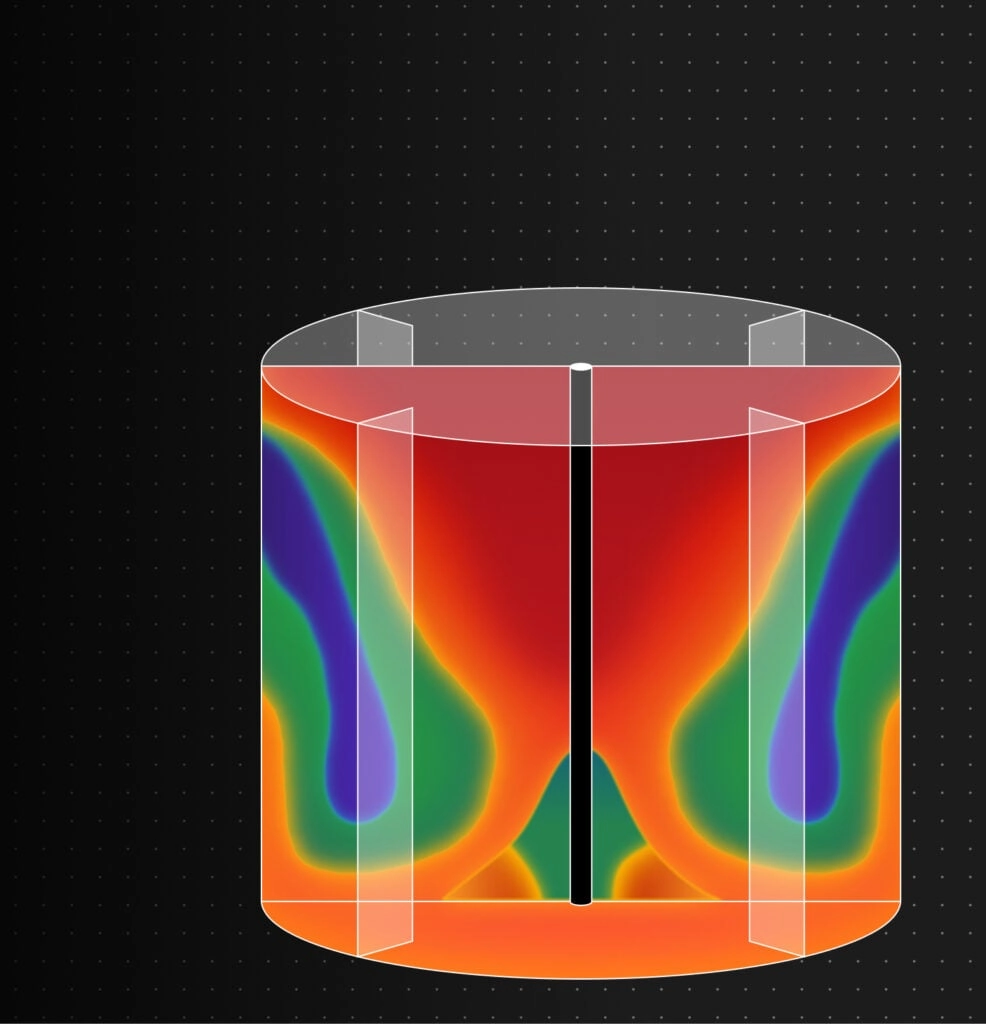
There is a downstream stake in that standard of evidence. The NHD range runs from mixing and thickening into filtration, and the impeller shapes what the leach tank hands over to that sequence. An under-mixed vessel discharges extra fines in one period and a stalled coarse fraction in the next, and the separation stage that follows inherits the instability as a feed problem it did not create. An agitator holding its suspension steady is protecting the performance of equipment it will never be bolted to.
Conclusion
Inside plants, India’s recycling push will be judged by a practical question: how wide a range of secondary feed can each vessel accept without losing suspension, contact or pH control? The difficult particle and solids cases supply the answer, read together with the liquor chemistry and the task the tank performs. It becomes a design basis only when the tested geometry, power and flow evidence are carried into the industrial arrangement intact. If you are widening an intake or specifying a new leach line, send your vessel dimensions, feed range and liquor conditions to our engineering and commissioning team, and the review will start from your most difficult feed rather than its average.
FAQs
Q1: Does a wider recycling intake automatically mean a larger agitator is needed?
A1: Not automatically. A wider intake raises duty only where new material is coarser, denser, more concentrated or more corrosive than what the vessel already handles, so the decision turns on the difficult fraction and the geometry it must circulate in — not on how many sources are on the receiving list.
Q2: Why should the agitator be tested against more than one recycled feed?
A2: Settling behaviour, and the power needed to defeat it, are each moved by particle size, density, solids concentration and liquor chemistry — and the four seldom move in a convenient direction at once. Test the difficult feed in one pilot campaign before tank size and drive power are frozen, and the cost is one campaign; leave the mismatch to production scale, and the cost is of another order entirely.
Q3: What should a scale-up review compare between pilot and industrial vessels?
A3: The review compares tank and liquid geometry, impeller type and position, baffles and the feed and reagent entry points, then checks the operating evidence against the same feed: solids distribution through the vessel, local pH response during dosing, shaft power, torque, speed and fluid velocity.