
Selecting the right industrial agitator is central to phosphoric acid production, where the reaction between phosphate rock and sulfuric acid depends on more than reagent ratio and residence time. The agitator must keep the slurry moving while allowing phosphogypsum crystals to form and grow in a usable condition. Run a mixing tank agitator too fast, and high shear can damage the crystals. Run it too slowly, and solids can settle before the reaction is complete. Both conditions can appear later as unstable filtration, lower throughput, or uneven plant performance.
An industrial agitator therefore needs a process-specific operating window. Speed, impeller shape, tank geometry, liquid level, solids loading, and temperature affect the flow field together. NHD determines this operating window through customer material samples, FLUENT-based fluid analysis, and testing that connects the impeller, speed, and tank design to actual reaction behavior.
How Does Agitator Speed Change Phosphoric Acid Reaction Performance?
Agitator speed affects both reaction contact and phosphogypsum crystal quality. Increasing speed may improve circulation in one part of the tank while creating excessive shear in another. Reducing speed may protect crystal growth but leave solids outside the effective circulation zone. The suitable setting is therefore a process-specific range rather than the highest or lowest available speed.
Excessive Shear Can Break Phosphogypsum Crystals
High speed can create strong local shear around the impeller. In phosphoric acid production, this may break phosphogypsum crystals while they are forming and growing. Smaller or damaged crystals increase the fine-particle fraction in the slurry, which lowers filter-cake permeability, slows the filtration rate, and leaves a wetter cake — making solid-liquid separation less stable.
The risk does not depend on rotational speed alone. Impeller shape, impeller diameter, local velocity, slurry solids, viscosity, and tank geometry determine where the highest shear occurs. A speed that appears acceptable in a low-solid test may produce a different result in actual phosphate rock and sulfuric acid slurry.
For this reason, reaction performance should not be judged only by whether the slurry looks active. The process team also needs to consider whether the circulation pattern supports crystal growth and whether the resulting phosphogypsum remains suitable for downstream handling.
Insufficient Circulation Can Cause Settling and Incomplete Reaction
The opposite problem occurs when speed is too low to maintain sufficient pumping flow. Heavier solids may settle near the tank bottom or wall, while some slurry remains outside the main circulation path, creating concentration differences across the vessel — one zone may receive fresh feed while another holds settled solids or partially reacted material. This reduces contact between phosphate rock and sulfuric acid, and the result can be an incomplete reaction, lower effective tank capacity, or unstable production conditions.
A chemical agitator therefore has to provide enough axial movement for suspension and reaction contact without relying on excessive turbulence in place of proper impeller and tank design. The useful operating window sits between crystal damage and insufficient circulation.
Why Agitator Speed Must Be Matched with Slurry, Impeller, and Tank Conditions
The same rpm does not produce the same result in every vessel. Slurry density, solid content, particle behavior, liquid level, tank dimensions, and impeller geometry all change the flow field. A mixing tank agitator should be evaluated as part of the complete reaction system rather than selected from motor power or catalogue speed alone.
Solid Content and Particle Behavior Set the Mixing Requirement
Solid content, particle size, density, viscosity, acid concentration, temperature, and liquid level together set the resistance and shear load the agitator must handle. Higher solids loading demands more pumping capacity, but simply raising speed adds shear that can damage developing phosphogypsum crystals. Because phosphate rock source and production rate can shift this behavior even with the same tank and motor, the resistance is never fixed.
The design basis should connect the material condition with the required result: complete reaction, stable suspension, controlled crystal growth, or better downstream separation. Without this connection, the selected chemical agitator may perform well under normal conditions but lose stability when the slurry becomes more concentrated or difficult to circulate.
Impeller Geometry and Tank Layout Define the Usable Speed Range
The mixing impeller determines how much fluid is pumped, in which direction it moves, and where local shear develops. An axial-flow design may provide stronger top-to-bottom circulation, while an unsuitable geometry can leave dead zones or concentrate energy around the shaft.
Tank diameter, liquid height, bottom shape, baffles, feed location, discharge location, and internal obstructions then determine whether the impeller flow reaches the full working volume. A mixing impeller that works in a short tank cannot automatically be transferred to a deeper or wider reaction vessel.
The usable speed range is created by the combination of these factors. The process team needs enough circulation through the lower part of the tank, but the impeller and tank layout must also limit unnecessary local shear.
How NHD Uses Testing and FLUENT Simulation to Set the Design Basis
Material Samples Reveal the Actual Mixing and Crystallization Behavior
A material sample helps identify whether the main limitation is settling, weak circulation, excessive shear, or a combination of several effects. In a phosphoric acid duty, the sample should be evaluated not only for movement inside the tank but also for the condition of the phosphogypsum crystals formed during the reaction.
This is important when phosphate rock characteristics, solids loading, acid concentration, or production rate change. A generic water test cannot reproduce the density, particle behavior, and crystallization response of every phosphate slurry. Testing the actual material gives the design team a more useful basis for judging the trade-off between pumping flow and shear.
The sample results can then be connected with the required production outcome. If the plant needs more complete reaction without damaging crystal structure, the test should examine both circulation and the quality of the resulting solids.
FLUENT and Fluid-Mixing Analysis Map Flow and Shear
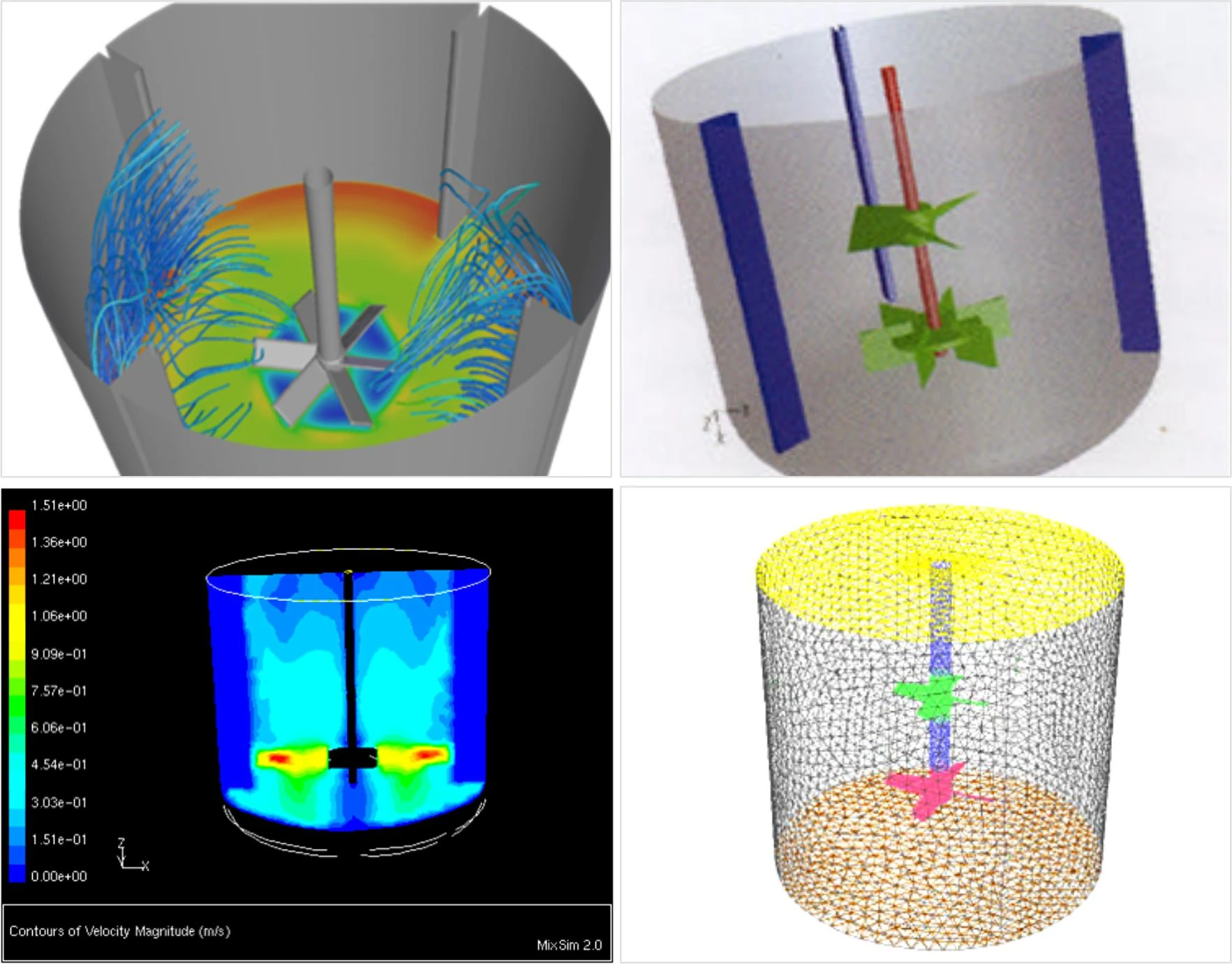
FLUENT-based CFD analysis can show how the slurry circulates through the vessel. It can help identify poorly renewed areas, dead zones, velocity differences, and regions where local shear may become excessive. The analysis is most useful when it answers a real plant question rather than producing a general flow image.
For example, the design team can examine whether the lower tank receives enough axial circulation, whether feed enters an active mixing zone, and whether the proposed speed creates unnecessary shear near the impeller or tank wall. The model can also compare alternative impeller arrangements and tank layouts before fabrication.
Pilot and Scale-Up Testing Connect Laboratory Results with Plant Design
Model and pilot testing are important because the flow field and power demand do not always scale in a simple way. A configuration that appears effective in a small vessel may produce different circulation coverage, torque, or dead zones after the tank becomes larger.
The purpose of these tests is not to promise one universal speed. It is to reduce the gap between material behavior, calculated flow, physical testing, and the operating conditions of the actual phosphoric acid plant.
NHD’s agitator design approach starts with the actual material and process conditions rather than a fixed agitator model, combining flow simulation, fluid-mixing analysis, and physical testing to make the design discussion more specific than choosing a speed from a standard table. Its testing capability can compare different impellers, baffle arrangements, and tank-bottom conditions, considering shaft torque, input power, rotational speed, and flow-field measurements together to connect observed slurry behavior with the final production-scale design.
What the NHD Variable Cross-Section & Obliquity Agitator Offers for Phosphoric Acid (PA) Duties
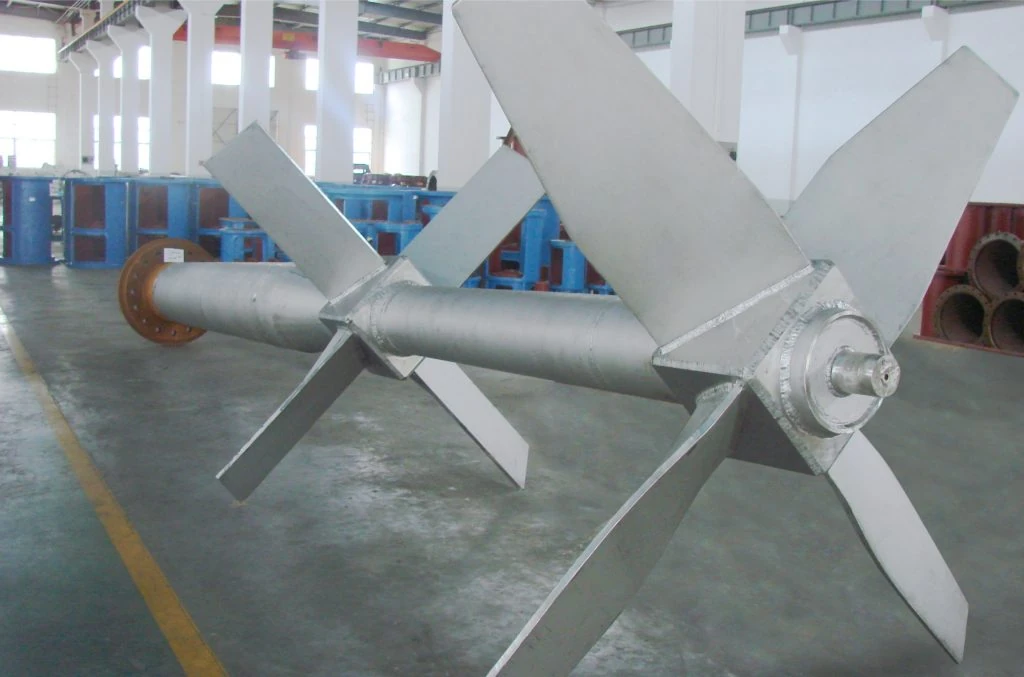
NHD’s Variable Cross-Section & Obliquity Agitator was developed for displacement reactions in phosphoric acid and non-ferrous applications where the slurry needs high pumping flow with a lower shear rate. The design is relevant when the process must maintain circulation while limiting excessive breakage of solid crystals. More details are available on the agitator product page.
High Axial Recirculation with Controlled Shear
The agitator is designed to provide high recirculating axial flow at lower shear and low power consumption. For a PA reaction tank, this combination addresses the two competing requirements directly: phosphate rock and sulfuric acid need sufficient contact, while phosphogypsum crystals should not be subjected to unnecessary breakage.
High axial circulation can improve movement through the working volume, including the lower part of the tank where solids may otherwise settle. Controlled shear keeps the design focused on reaction and crystal quality rather than maximum turbulence.
Coordinated Impeller, Speed, and Tank Design
The Variable Cross-Section & Obliquity Agitator should not be treated as an isolated mixing impeller. Its performance depends on the slurry properties, tank dimensions, operating liquid level, impeller arrangement, and reaction target.
NHD uses the customer’s material sample, FLUENT analysis, and physical testing to coordinate impeller and speed with the tank flow path and actual slurry behavior, rather than assigning one fixed rpm to every plant. This matters most when the tank is deep, solids loading varies during operation, or the process needs both strong suspension and controlled crystal growth.
Design Support for Downstream Filtration and Sedimentation
The reaction result continues into downstream solid-liquid separation. Crystal condition affects how the phosphogypsum behaves during filtration, sedimentation, drainage, and solids handling. Excessive breakage in the reaction tank can create a downstream separation problem even when the slurry appears well mixed.
NHD’s design route connects high axial recirculation and controlled shear with these later process requirements. The goal is not simply to make the tank look more turbulent. It is to support complete reaction, maintain a usable crystal structure, and provide more consistent downstream behavior.
What Should Be Confirmed Before Selecting an Industrial Agitator?
| Category | Information to Confirm |
| Process & Slurry Information | Solids content (%); particle/crystal size range; slurry density and viscosity; operating temperature; pH and corrosivity level; required reaction retention time |
| Tank & Mechanical Information | Tank diameter, volume, and liquid level range; baffle configuration; agitator mounting type, including top-entry or side-entry; available motor power and speed range; wetted-parts materials of construction |
| Performance Targets for Technical Review | Target suspension/blend time; acceptable crystal-breakage tolerance; downstream filtration or sedimentation requirements; turndown/operating speed range; allowable power draw and energy consumption |
Conclusion
Stable phosphoric acid production does not come from pushing an agitator to the highest speed. Excessive shear can damage phosphogypsum crystals, while insufficient circulation can leave solids settled and the reaction incomplete. The final industrial agitator choice should therefore connect slurry behavior, crystal quality, flow pattern, mixing impeller, tank geometry, and downstream separation requirements.
As a mixing tank agitator built for this duty, NHD’s Variable Cross-Section & Obliquity Agitator provides a relevant design route through strong axial flow with limited crystal-damaging shear. More importantly, NHD can combine customer material samples, FLUENT analysis, and laboratory, pilot, and scale-up testing to coordinate the impeller, speed, and tank design. Matching the flow field to the actual slurry and tank conditions helps maintain complete reaction, stable phosphogypsum crystallization, and more consistent production efficiency. Contact NHD’s engineering team by Email: sales@chinanhd.com / WhatsApp: +86 136 6732 4277 with your slurry and tank data for a tailored agitator design review.
FAQs
Q1: Why can excessive agitator speed damage phosphogypsum crystals?
A1: Excessive speed can create strong local shear around the impeller. In phosphoric acid production, that shear may break phosphogypsum crystals while they are forming, affecting their later filtration and sedimentation behavior.
Q2: What process data is needed before selecting an industrial agitator for phosphoric acid production?
A2: The useful design basis includes slurry density, solid content, particle size and behavior, acid concentration, temperature, liquid level, production rate, tank dimensions, bottom design, baffles, feed and discharge arrangements, and the required reaction and crystal-quality targets.
Q3: How does NHD determine the impeller design and operating speed?
A3: NHD combines customer material samples, FLUENT-based fluid analysis, and laboratory, pilot, and scale-up testing to evaluate flow, shear, suspension, and reaction requirements before coordinating the mixing impeller, operating speed, and tank design.