

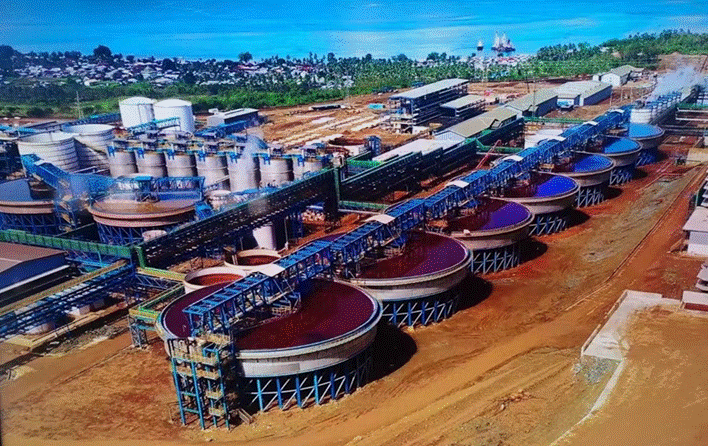
The Canadian federal government issued a federal decision statement for the Crawford Nickel Project on July 31, 2026. The decision establishes legally binding conditions for an open-pit nickel-cobalt mine and on-site metal mill about 42 kilometres north of Timmins, Ontario. It also confirms that further authorizations and permits remain necessary.
Regulatory approval and engineering readiness answer different questions. For an Ontario nickel project, the risk often appears when approval language is translated into equipment duties, construction packages, control responsibilities, and commissioning criteria. Those decisions can look complete on paper while important ore, material, utility, and interface assumptions are still moving. Nickel plant construction then becomes a test of whether those assumptions stay connected as detailed engineering advances.
Approval Changes the Question, Not the Ore
A decision statement resolves a major regulatory gate. It does not freeze mineralogy, particle size, hardness, moisture, slurry density, reagent demand, residue behavior, or the range of feed conditions the plant may see over its life. Engineering still has to turn those conditions into a design basis that procurement and construction can use. Nickel project development after approval therefore depends on tracing those conditions into equipment duties before packages become difficult to change.
A decision statement is not a frozen process design
Detailed engineering may continue after approval, and permits or conditions can still influence layout, water management, emissions control, materials, and monitoring. That creates a practical risk when equipment packages are procured before the assumptions connecting them are closed. A quote can look precise while the basis behind it remains provisional.
Open assumptions need owners and evidence
Nickel project development becomes easier to control when every important assumption has an owner and a status. It may be confirmed by representative testwork, defined by process engineering, constrained by a permit condition, or still open. Suppliers need to know which inputs are fixed and which may change. Otherwise, change control becomes a reaction to mismatched packages rather than part of the engineering process.
Where Construction Risk Usually Hides
Construction risk is not limited to site execution. It often begins when a process claim is converted into an equipment duty without the same physical conditions attached.
Representative feed cases define equipment duty
Headline grade is not enough to size nickel processing equipment. Mineralogy, liberation, hardness, fines, impurities, moisture, and chemistry influence crushing, grinding, leaching or flotation, thickening, filtration, and residue handling. A single easy sample can hide the feed cases that will determine operating range and maintenance demand. Test results are more useful when particle size, solids concentration, chemistry, temperature, residence time, and equipment configuration remain attached to the result.
Scale-up evidence must match the physical duty
A larger tank changes circulation paths, shaft loads, residence-time distribution, and the distance that solids or reagents must travel. A slurry that stays suspended in a small vessel can form dead zones at production scale. Motor power alone does not prove that the required flow pattern will be maintained.
NHD’s nonferrous agitator engineering uses simulation, pilot testing, and flow-field analysis to compare tank geometry, impeller configuration, slurry properties, and operating conditions. That capability is relevant because mixing affects reaction, suspension, transfer, and downstream solids handling. It does not mean an agitator is automatically correct for Crawford; it means the flow duty should be proven before selection is frozen.
Separation must match residue destination
A nickel process is not complete when valuable material enters solution or concentrate. The plant still has to clarify liquor, thicken or filter solids, recover water where needed, and move residue to its next destination. Underflow concentration affects pumping and downstream handling. Overflow quality affects recycle and water treatment. Settling behavior can change torque, flocculant demand, and the stability of the solids-handling chain.
NHD’s thickener equipment includes torque monitoring, automatic rake lifting, DCS integration, and slurry-level and solids-content monitoring. These are useful design considerations when residue behavior and feed conditions are still being defined, but they do not replace project-specific settling and rheology data.
Package interfaces need a buildable owner
Construction risk often appears between packages: a feed point does not match a tank, a pump duty changes after thickening, a material choice does not suit the liquor, or controls are defined differently by separate suppliers. The nickel processing route should identify inlet and outlet conditions, utility loads, control signals, and interface ownership before each package is fixed. A clear boundary is more useful than an assumption that one supplier will resolve every mismatch later.
What NHD’s Nonferrous References Can Contribute
Related experience is useful when it sharpens the questions a project team asks. It should not be mistaken for a design basis for a different orebody, site, or process route.
Lygend shows why site conditions belong in selection
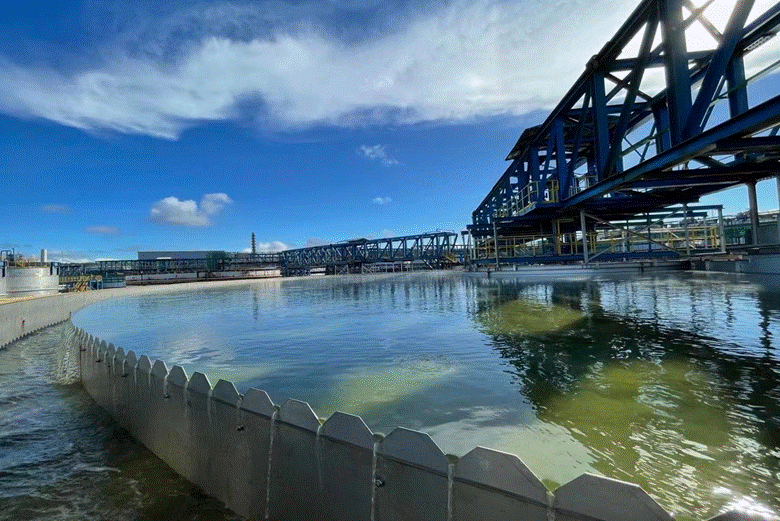
The Lygend nickel and cobalt project included Φ32 m, Φ36 m, and Φ42 m CCD thickeners. High seismic risk on the Pacific Ring of Fire and pandemic-related construction constraints shaped the project. NHD’s documented solution used duplex stainless steel in place of carbon steel and rubber-brick designs to support structural integrity and reduce civil construction time.
Those details show how site conditions, materials, structural requirements, and solids-handling duty can intersect. They do not establish the equipment scope, materials, or operating conditions for Crawford.
A reference still needs project-specific testwork
A reference project cannot establish the exact residence time, underflow density, filtration cycle, reagent response, or materials compatibility needed for another orebody. For nickel plant construction, the useful transfer is a set of better engineering questions: what material range was tested, how does scale change the physical duty, what does the next unit require, and which interface assumptions remain open? The answers have to come from the project’s own testwork and design basis.
A Better Vendor Comparison Starts With the Same Basis
Supplier comparison becomes more useful when every proposal answers the same questions. What material and operating range was the equipment designed around? What process result must it achieve? Which utilities, controls, materials, and maintenance conditions are required? Which interfaces or uncertainties could change the duty during detailed engineering? This approach keeps nickel processing equipment and the full nickel processing route connected. It also makes it easier to see where additional testwork, engineering, or nonferrous metallurgy experience is needed before a purchase order locks in the wrong assumption.
Conclusion
Federal approval is an important milestone, but the path to construction still depends on a defensible design basis. For an Ontario nickel project, a decision statement resolves a regulatory gate; it does not remove ore variability or close every equipment interface. Its engineering team should connect representative feed cases, scale-up evidence, separation duties, materials, controls, utilities, and package boundaries before construction freezes those assumptions. A useful next step is to ask every supplier to explain the operating range, evidence, and interface risks behind its offer using the same project data. That comparison turns nickel plant construction from a collection of quotations into a traceable engineering decision.
FAQs
Q1: Does federal approval freeze equipment specifications?
A1: No. Approval resolves an important regulatory gate, but detailed engineering, permits, design conditions, and operating assumptions still have to be translated into equipment duties and procurement packages.
Q2: Why does ore variability matter after the process route is chosen?
A2: Different mineralogy, hardness, fines, chemistry, and moisture can change grinding, reaction, separation, materials, and residue handling. The equipment duty should reflect representative feed cases, not one sample.
Q3: How should nickel project teams compare equipment suppliers?
A3: Give each supplier the same feed range, process target, utility limits, control requirements, and interface conditions. Then compare the evidence behind the proposed operating range and the assumptions that remain open.