

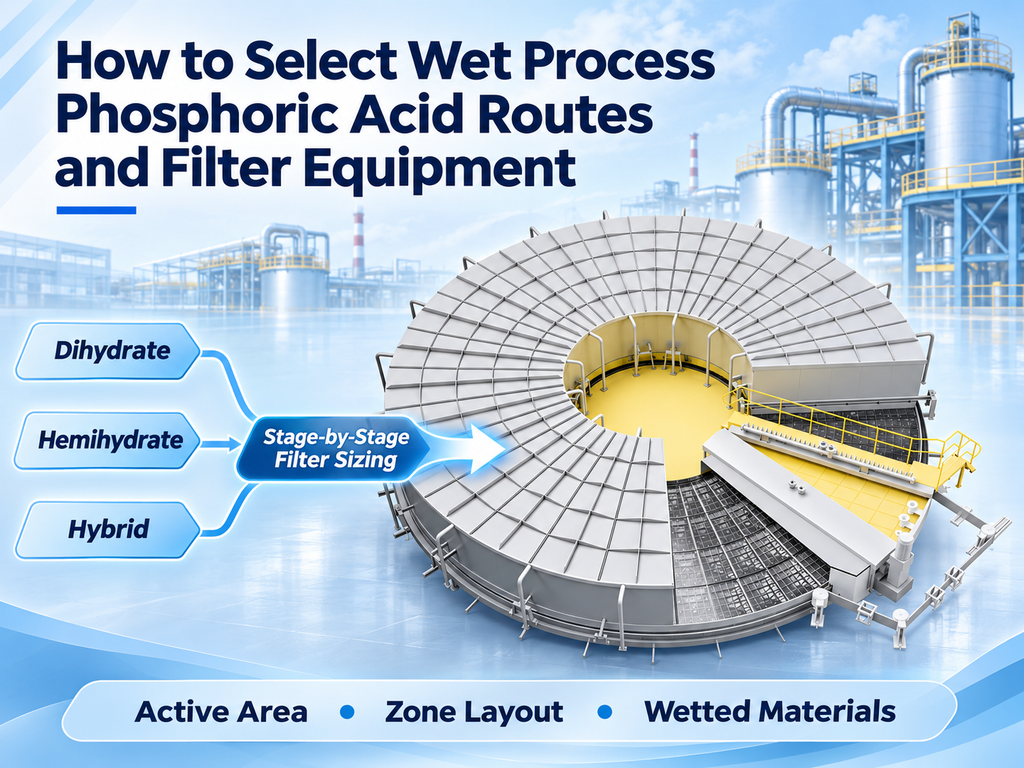
Selecting a wet-process phosphoric acid route determines the filtration duty. Dihydrate, hemihydrate, and hybrid routes produce different calcium sulfate crystal forms, acid concentrations, and separation-stage requirements. NHD’s rotary table vacuum filter for phosphoric acid is used in phosphoric acid plants; evaluate the route against phosphate rock characteristics, target acid concentration, and gypsum requirements before defining the duty, area, zone layout, and materials for each filter stage.
How Dihydrate, Hemihydrate, and Hybrid Routes Differ
Dihydrate Routes Use a Familiar Single-Stage Gypsum Separation.
The dihydrate route crystallises calcium sulfate as gypsum (CaSO4·2H2O), and one filter separates that gypsum from the product acid in a single stage. The crystal form is stable and the crystals grow comparatively coarse, so the cake drains and washes predictably, and the operating window is the widest of the wet-process routes. This conventional route sets the reference duty: one filter, one gypsum stream, and the filter acid leaving at the strength the reaction section produces.
Hemihydrate Routes Can Raise Acid Strength but Tighten Operating Control.
A direct hemihydrate route crystallises calcium sulfate hemihydrate (CaSO4·0.5H2O) instead, and its filter acid leaves stronger than dihydrate acid, cutting the evaporation duty in later concentration. The cost of that strength is control. Hemihydrate is metastable: if temperature or acid concentration drifts outside its range, it recrystallises to dihydrate in the slurry, on the cloth or inside the cake, blinding the cloth and scaling the lines after the filter. The stage also runs on hotter, stronger acid, so its duty is a stability duty as much as a separation duty.
Hybrid Routes May Use One or Two Filters and Shift Separation Duty Across Stages.
In a hemihydrate-dihydrate route, hemihydrate is formed in the attack section and then recrystallised to dihydrate. Whether the route needs one filter or two depends on where separation is placed. If the hemihydrate slurry passes to recrystallisation without intermediate filtration, a single filter separates the final dihydrate gypsum. If the hemihydrate is filtered first to take off the strong acid, a second filter handles the recrystallised dihydrate and its washing. The route name alone does not fix the filter count; the flowsheet does.
The dihydrate-hemihydrate arrangement reverses the order. Gypsum is crystallised and filtered as dihydrate first, so the first filter carries the bulk solids duty at dihydrate conditions, and the hemihydrate stage following it produces stronger acid with its own separation. The second filter carries a smaller tonnage, but a more demanding one: hemihydrate crystals, stronger acid and the same recrystallisation risk. Sizing both filters from one averaged duty undersizes one stage and oversizes the other, so each stage is specified on its own slurry.
The Route Must Match Acid, Rock and Gypsum Requirements.
Route selection starts from three inputs fixed at the outset. The phosphate rock sets reactivity and the impurity load, including fluoride, silica, magnesium and organics, which influence crystal habit and scaling. The target acid concentration decides whether dihydrate-strength acid serves downstream, or hemihydrate strength is needed. The gypsum requirement sets the residual P2O5 and moisture limits for stacking or sale into cement and plaster. A route that fits the rock but misses the gypsum specification moves the problem to the filter, as more washing, more area and tighter moisture control.
Wet-Process Routes Change Filtration Duties at Each Stage
Crystal Formation Determines Cake Permeability at Each Stage.
Cake permeability is decided before the slurry reaches the filter. The crystal size distribution and habit from the crystalliser determine how the cake packs, how fast filtrate passes through it and how completely wash liquor displaces the mother liquor. Coarse, uniform crystals form an open cake; fine or needle-like crystals compact under vacuum, and hemihydrate that recrystallises inside the cake fills the voids the filtrate needs. The filtration rate used for sizing must come from that stage’s own slurry: crystal form and size are sizing inputs, not background information.
Wetted Materials Must Match Acid Temperature and Impurities.
Every wetted part, from pan segments and distribution valve to piping, cloth and fasteners, works in the stage’s acid at its temperature and impurity load. Wet-process acid carries fluoride and chloride, which attack alloys and linings adequate in cleaner services, and the hotter, stronger acid of a hemihydrate stage narrows the acceptable materials further. Materials are therefore specified per stage, and the duty sheet for each stage states acid concentration, temperature and impurity range, so materials match the actual exposure, not the plant’s average acid.
Washing Must Balance Phosphorus Recovery and Water Use.
Washing the gypsum cake recovers soluble P2O5 that would otherwise leave with the gypsum; more washing recovers more. The wash water is not free: it returns to the process as weaker acid or evaporation load. The wash ratio is an economic setting, not a maximum, set to meet the residual P2O5 target in the discharged cake, spread across the wash zones so displacement stays even, and no higher than the water balance can absorb. On multi-stage routes the calculation repeats per filter, because each cake carries a different mother liquor.
Each Filter Stage Must Be Defined Before Equipment Sizing.
A filter is sized from its own duty sheet: feed rate and solids load, crystal form and size, acid concentration and temperature, wash ratio, residual P2O5 and cake-moisture targets, vacuum conditions, recycle streams and operating hours. A single-stage dihydrate plant needs one such sheet; a hybrid route needs one per separator, because no two stages share a slurry. A quotation requested before the duties are fixed is priced on assumptions, which return as changes to area, washing or materials.
How a Rotary Table Vacuum Filter Matches Each Duty
The Table Must Allocate Filtration, Washing and Drying Across Its Zones.
One revolution of the table carries the cake through the full sequence: feed and cake formation, mother-liquor filtration, one or more washing stages, drying, cake discharge and cloth washing. The distribution valve assigns vacuum to each zone, whose arc length is set at specification. A high wash ratio claims more of the revolution; a moisture-limited duty claims more drying arc. The zone layout is part of the filter’s process design, fixed from the stage duty, not adjusted after arrival.
Even Feed Distribution Helps Keep Cake Depth Consistent.
The plate-type distributor lays the slurry across the pans so the cake forms at an even depth across the table. Even depth matters: vacuum, washing and drying all act through the cake. A thin patch passes wash liquor without displacing mother liquor, and a thick patch leaves the wash short and the cake wet at discharge. Consistent depth keeps the wash ratio effective over the whole area and cake moisture inside its target band, which lets nominal area work as filtration area.
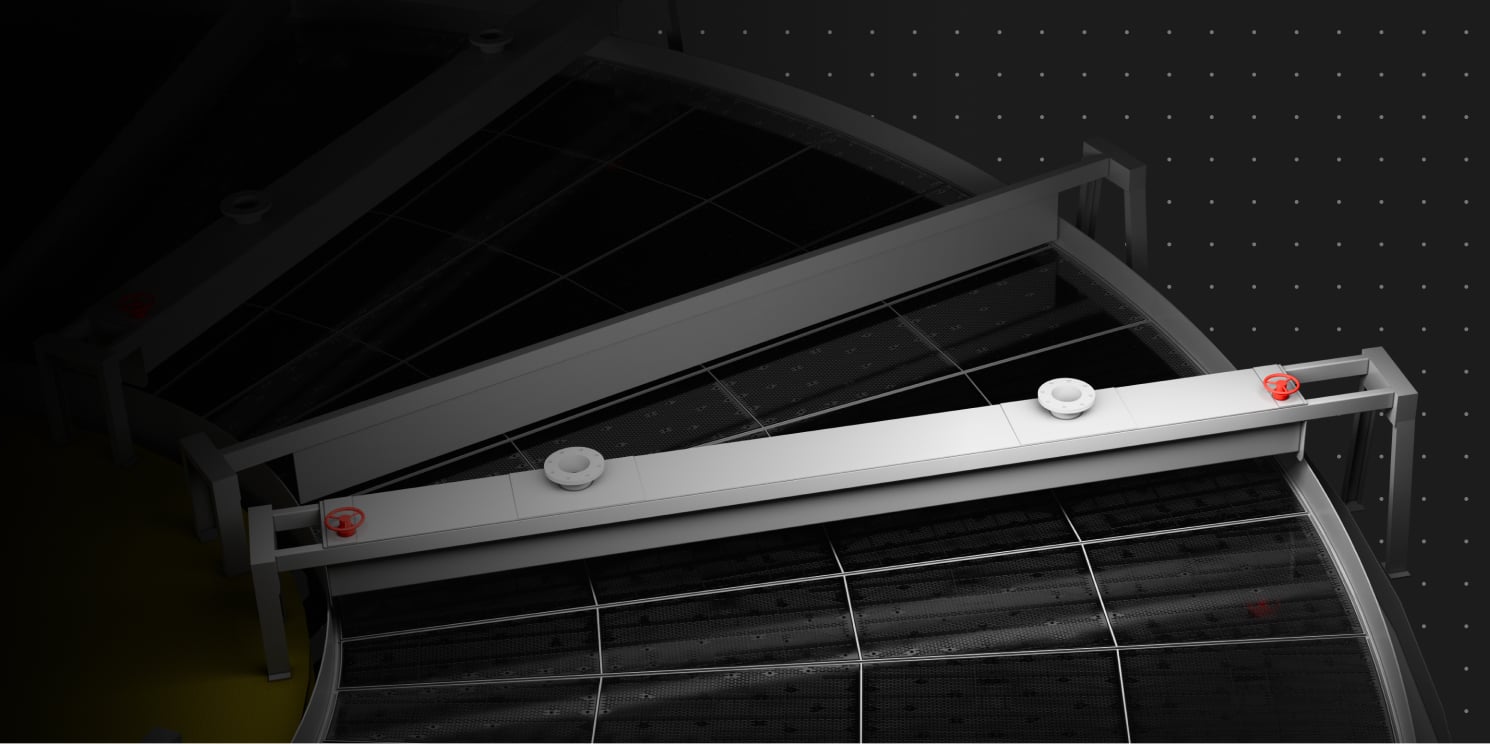
Table Suitability Must Be Checked Against Every Slurry Duty.
A rotary table suits a duty when the slurry forms a self-supporting cake at the available vacuum, the crystals do not blind the cloth at the required rate, and the cake discharges cleanly at cycle end. Those conditions are checked stage by stage: the same table can suit a dihydrate gypsum duty and fail a fine-crystal stage unless cloth, zone layout or wash arrangement changes. Suitability is confirmed against every slurry the filter will see, including start-up and off-specification slurry, not the design point alone.
NHD Rotary Table Vacuum Filters Can Be Evaluated for Duty-Specific Phosphoric Acid Service
Filtration Area Should Match the Required Throughput
Filtration area comes in two figures: the nominal area is the full table area; the active area deducts the discharge and cloth-washing zones from the revolution where cake forms, washes and dries. Throughput is active area multiplied by the actual slurry’s filtration rate, so equal nominal areas can carry different duties. NHD has more than 300 rotary table vacuum filters installed worldwide, with units of up to 320 m² operating in phosphoric acid service, and the largest model reaches 380 m². The pinwheel drive delivers the torque the table needs with low-power drive motors, and automatic lubrication keeps oil supply precise over long campaigns.
Zone Layout Should Match Filtration, Washing, and Drying Duties
On the NHD filter, the filtration, washing and drying arcs are proportioned to the stage’s process data. Water-saving nozzles deliver wash liquor with high flushing power at low consumption, working with anti-clogging elements, so the wash stays effective between cloth changes. Where a duty needs more washing, for example a hybrid second stage with a strict residual P2O5 limit, the layout gives that stage more wash arc instead of adding wash water.
Materials and Construction Should Match the Acid Conditions
Construction follows the acid conditions of the stage the filter serves. The floating support structure removes the thermal-expansion stress a hot acid duty places on the bottom frame. Segmented discs are held to strict flatness, keeping cake depth and cloth tracking stable across a large table. The grid-supported frame limits shadowing, bridging and pan scaling, and the low distribution valve minimises scaling and clogging, reducing cleaning frequency. Wetted materials are selected against the stage’s acid, temperature and impurities, so a hemihydrate-stage filter is not a dihydrate filter with more area.
NHD Application Cases Help Define the Project Scope.
320 m² Rotary Table Filter for Guizhou Kailin’s 600,000 t/y Phosphoric Acid Project
The largest NHD rotary table filter in phosphoric acid service is the 320 m² unit supplied for Guizhou Kailin’s 600,000 t/y phosphoric acid project. The case marks the top of the proven range: the table size available when a high-capacity plant defines its gypsum duty first and sizes the filter to it. It sets no standard size for other plants; it marks the capacity end of the range the active-area calculation selects from.
80 m² West Asia Project as a Mid-Scale Application Reference
For the 80 kt/a phosphoric acid facility of Kimia Daran Kavir Co. in West Asia, NHD supplied an 80 m² rotary table vacuum filter as the key filtration component, scoped for engineering, supply, installation and commissioning. As a mid-scale reference, the case shows the other half of scope definition: less about maximum area, more about where the supplier’s responsibility starts and ends, whether design interfaces, installation and commissioning sit inside the scope, or the supply is equipment only.
COPEBRAS Replacement Project as a Retrofit and Delivery-Scope Reference
The COPEBRAS project involved a rotary table vacuum filter replacement for Anglo American’s Brazilian subsidiary COPEBRAS, delivered with WesTech Engineering of the United States. A replacement duty is defined differently from a new-plant duty: the operating line fixes slurry, throughput and interfaces, and the new filter must match all three without changing the plant around it. The case is the reference for how a replacement scope is framed, duty taken from the existing unit’s service, delivery matched to the plant’s fixed points.
What Process Data Should Be Provided Before Filter Selection
A Process and Separation Data Sheet Should Be Issued Before Quotation.
Before quotation, the project team issues one process and separation data sheet for each filter stage. It states the route and the stage served, the rock and slurry analysis, the dry gypsum rate, crystal form and size, acid concentration and temperature, the impurity range, the wash ratio, the residual P2O5 and cake-moisture targets, vacuum conditions, recycle streams and operating hours. With it, the supplier calculates active area, sets zone layout and selects wetted materials against stated conditions; without it, every figure rests on assumptions.
Offers Should Be Compared by Complete Duty Rather Than Purchase Price.
Offers for the same nominal area can cover different duties. One offer may be priced on the full stage duty: washing to the residual P2O5 target, materials for the strongest and hottest acid the stage produces, with engineering and commissioning included. Another may be priced on the table alone. Comparison is made line by line against the data sheet: active area, zone layout, wash arrangement, wetted materials, scope boundary and committed performance figures. Purchase price ranks the offers only after those lines match.
Conclusion
Route choice sets gypsum form, acid stream and filter-stage count. Compare rock, acid and gypsum targets, then define each duty before sizing area, zones, materials and washing. NHD’s HDPP-320 and COPEBRAS replacement cases show phosphoric-acid filtration experience, not route-specific guarantees. Share the flowsheet and stage slurry data for a duty review through sales@chinanhd.com or WhatsApp +86 136 6732 4277.
FAQs
Q1: Which wet-process route typically produces the highest acid concentration after filtration?
A1: A direct hemihydrate route can produce a higher acid concentration after filtration than a conventional dihydrate route. Results for hybrid routes depend on where gypsum is recrystallised and filtered, as well as on the specific process conditions.
Q2: Do hemihydrate-dihydrate and dihydrate-hemihydrate routes always require two filters?
A2: No. Filter count depends on intermediate filtration.
Q3: What information is needed to size an NHD rotary table vacuum filter?
A3: Provide the route and filter stage, rock and slurry analysis, dry gypsum rate, crystal form and size, acid concentration and temperature, impurities, wash ratio, residual P2O5 and cake-moisture targets, vacuum conditions, recycle streams and operating hours. For a hybrid process, provide a separate duty for each separator.