

September 29, 2026. Bali. Indonesia’s Investment and Downstreaming Ministry used the ICMMS Indonesia 2026 summit to open phase two of the downstreaming roadmap — 28 strategic commodities, USD 618.1 billion of investment needed by 2040, and a push past smelting and refining into EV batteries, energy storage and higher-value manufacturing. Downstreaming money is already moving: Rp300.1 trillion in the first half of 2026 alone, 29.7 percent of all national investment. The processing sessions argued about HPAL economics and sulfuric acid supply. Underneath every argument sat the same two numbers — product quality and metal recovery.
Recovery is where a wash trial earns or burns its money. A trial can pass on paper and still lose nickel. The metal leaves in two places. Some stays dissolved in the liquor the cake holds onto. The rest leaves with wash water that found a shortcut through the cake and never displaced the liquor ahead of it. Record only filtrate clarity and final moisture, and neither loss shows up anywhere on the trial sheet.
A washing trial is valid only when the cake and liquid balance are comparable
Start with the process result, not a single outlet sample
Set the target before the first run. A nickel-cobalt circuit already works in numbers: soluble impurity allowed in the cake, dissolved metal that must come back, the limit the next step sets. Write them down. “Clean cake” is not a target. Nobody can run a trial against it. Nobody can sign off on it either.
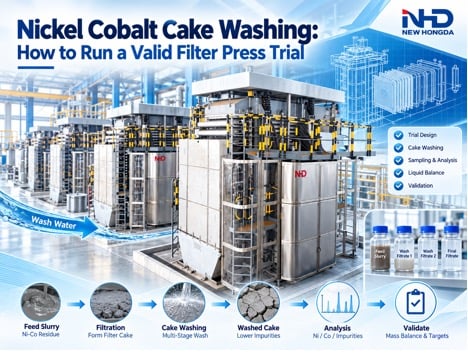
Then collect everything. Separately. Mother liquor in one vessel. Each wash fraction in its own. The final cake on its own. Weigh the wet cake, take the moisture, assay every liquid for the dissolved species the plant tracks.
Put numbers on the leak and it stops being abstract. One hundred tonnes of wet cake holding 12 tonnes of liquor at 3 g/L nickel carries roughly 36 kg of dissolved metal out of the press. Displace 70 percent of that liquor and about 25 kg comes back. Displace 40 percent and 14 kg comes back. Eleven kilograms per hundred tonnes of cake, decided inside the wash stage and nowhere else.
If a stream was never collected, its metal was never counted. Cake assays can look beautiful while displaced nickel sits in a wash stream nobody sampled. It happens constantly: the cake sampled three ways, the liquids not at all.
Hold the feed still while settings change. Same lot, same solids, same reagent condition, same temperature, same filtration endpoint. Change the feed between runs and the trial stops testing the cycle. It tests the feed.
Make the cake thickness part of the comparison
Wash water is lazy. It takes the shortest path the cake offers. A cake thick in the middle and thin at the edges hands it a fast lane and a dead zone in the same chamber. The fast lane rinses clean. The dead zone keeps its mother liquor. Average the sample and the run reports itself washed.
On our HDLY Automatic Vertical Press Filter the cloth lies horizontal. Cake forms evenly across the chamber, up to 45 mm thick. Washing sits mid-cycle in a six-stage sequence — Filtering, 1st Squeeze, Washing, 2nd Squeeze, Drying, Discharging. Wash liquid enters through the same manifold pipe as the slurry, crosses cake and cloth, and leaves by the discharge pipe.
No spray bar does this work. The cake is the distributor. Its shape matters more than the water volume.

img.Automatic vertical press filter for nickel cobalt plants.webp
So measure the cake. Thickness at several points across the chamber, written next to each wash fraction. A run with a thin edge never compares honestly with a run on an even cake, whatever the wash totals claim.
Follow the six-stage cycle when defining the test window
Separate filtration, squeezing, and washing results
Run the stages as separate events. They are separate events. Filtering builds the cake. The first squeeze pushes liquor out before any wash water arrives. Washing displaces part of what is left. The second squeeze and the air drying settle final moisture. Judge the whole cycle on final moisture alone and nobody can say which stage did what.
Mark the clock at every stage change. Keep the bottles separate too — feed filtrate, wash filtrate, cake liquor, three containers, no mixing. It sounds fussy. It stops sounding fussy at the first disputed result, when a wash fraction assays high and the room needs to know whether the wash moved that metal or the squeeze did. A mixed bottle answers neither question.
Two catalogue figures belong in the trial plan. Maximum pressure 1.6 MPa. Cake moisture down to 10 percent or less. Both are equipment limits, nothing more. A laterite HPAL residue and a sulfide concentrate at the same pressure build different cakes and wash on different curves. Where your feed lands is what the trial is for.
Set the comparison around plant decisions
Test two or three wash volumes, chosen around the decision the plant actually faces. More wash water displaces more liquor. It also dilutes the recovered-metal stream and hands downstream more liquid to treat. On the worked example, pushing displacement from 70 toward 85 percent buys roughly five more kilograms per hundred tonnes of cake — paid for in wash water the next step handles all over again. Some plants take that trade gladly. Some cannot afford the liquid. Either way the trial should show where the gain flattens: this feed, this cake thickness, this cloth.
Scope obeys the same logic at purchase time. Six stages include washing. Four stages leave it out. A four-stage quotation answers a different duty, and no layout comparison fixes that afterwards. Put the required sequence in the enquiry, in writing, before vendors draw anything.
The HDLY runs its sequence automatically, self-diagnosis and alarms included. Stage boundaries stay where the program puts them. They do not drift with whoever is watching the machine.
Filter cloth selection changes how the trial behaves
Use permeability, fineness, and chemistry together
A cloth going blind does not fail all at once. It stretches the cycle a little more each shift. Filtration time creeps, the squeeze starts against a wetter cake, and the wash numbers wander — while the trial sheet blames the wash settings. Cloth choice decides whether the trial measures washing at all.
Start with chemistry. In acid hydromet duty the material call outranks every other line on the order. We supply PP, polyester and nylon. PP multifilament rates “Excellent” against acid and alkali. Polyester takes strong acid and weak alkali — put it in a hot, strongly alkaline stream and the fabric pays for the mismatch. Match cloth to the real liquor and the real temperature before the first run. Get it wrong and every result after it is evidence about a dying cloth.
Then fineness and permeability, against the actual particle size. Our vertical-press range runs 5 to 50 μm, 5 to 300 L/m²·s. The spread exists because duties differ. V11P05HC, multifilament PP, filters at 5 μm and breathes at 5 L/m²·s — the cloth for fine residue that must not pass. V11S010HC opens to 10. The polyester V12S025H sits at 20 μm and 25, built for strong-acid duty where the stream allows a coarser cut.
Same press. Three different trials.
Fine HPAL residue carrying a tail of sub-10 μm particles blinds cloth in its own way; a crystalline precipitate blinds it in another. Permeability that looked generous on day one can be half gone by week three. The full NHD filter cloth range is published with its duty data, vertical filter presses listed among the equipment it serves.
Keep cloth condition consistent across runs
A fresh cloth and a cloth carrying three cycles of deposits are not the same test equipment.
On the HDLY the cloth washes on both sides in turn as it travels, so each cycle starts closer to first-cycle condition. In our plant the looms come from Germany. The fabric gets heat-set to hold its dimensions, then calendered under uniform pressure across the width — calendering is what delivers clean cake release and stable precision. Before a cloth ships it passes six checks: weight, thickness, density, filtration precision, tear strength, air permeability. In 2023 we also sat on the revision of the industry standard for woven filter cloth for chamber and plate-and-frame presses.
Record cloth type and condition before each run. If release or filtration time drifts across a series, the drift goes in the record, in its own column. Never let it wander into the wash column dressed as a washing result.
What Indonesian nickel-cobalt projects can establish
Local installations provide relevant equipment context
HDLY presses already run Indonesian nickel-cobalt hydrometallurgy. Thirteen units at 180 m² and 168 m² in one group. Five more at 168 m². The family works elsewhere too — two 144 m² units on copper in the DRC, eight 168 m² units on phosphogypsum in Guizhou, 180 m² machines on nickel-cobalt in Papua New Guinea.
References like those give a project team ground to stand on. Layouts that fit real plants. Maintenance crews who already know the machine. What they never do is close the specification. A new feed earns its numbers in its own trial, or it does not earn them at all.
Turn trial evidence into a purchase specification
Carry the trial basis into the enquiry documents. Feed composition and solids. The impurity or soluble-metal limit. How each filtrate stream gets collected. Cake thickness to hold. How moisture gets measured. The cycle stages required. Vendors then quote one duty, and their answers line up side by side. The figure that vanishes from the comparison is “washing efficiency” — quoted by everyone, defined by no one.
Conclusion
A wash trial is a small plant run before the plant. Same feed, same cloth, same discipline about bottles and clocks. Run it loosely and the numbers describe the trial instead of the duty — and the purchase inherits the error, at full scale and full price. Run it the way this article sets out, and the results survive the trip from the test bench into the enquiry document, where vendors have to answer them line by line.
When a feed is ready to test, NHD builds trials like this one around it. Send the slurry data and the cake target by email to sales@chinanhd.com — feed composition, solids, the soluble-metal limit to hit — and the wash cycle and cloth get proposed against your numbers, ready to be proven or argued with. Anything that will not fit in an email fits on WhatsApp at +86 136 6732 4277.
FAQs
Q1: Why does a 45 mm cake matter during washing?
A1: Because the cake is the flow path. Even thickness means wash liquid travels roughly the same distance everywhere. Thin spots become shortcuts, thick spots keep their liquor, and the run averages out to a lie. Check several points across the chamber — the middle alone is too polite to tell you.
Q2: Does the 1.6 MPa rating determine the wash result?
A2: No — 1.6 MPa is the ceiling the machine is built to, not a result. Feed, cake structure, cloth and wash settings decide the wash curve. Run a sulfide concentrate and a laterite residue at identical pressure and the curves part company immediately.
Q3: Can any NHD filter cloth be used for nickel-cobalt slurry?
A3: No. The catalogue holds a 5 μm PP cloth and a 20 μm polyester cloth side by side, and an acid nickel-cobalt stream treats them as different tools — because they are. Fineness against the particle size first, material against the liquor second, and the trial settles the rest.