


A quotation may list “multi-stage countercurrent washing,” but the actual wash arrangement still needs to be checked. On a horizontal rubber belt the cake travels from the feed end toward discharge. Countercurrent wash travels against that cake: the freshest water meets the cake nearest discharge, and the liquor from that stage becomes the wash for the dirtier cake one stage closer to the feed. True countercurrent cake washing starts after the cake has formed, with wash liquor moving stage by stage against the direction of cake travel.
The check is the path, not the filter area. See where the slurry is spread, where the first wash meets the cake, which way the wash liquor moves, and whether the two liquors are collected apart. Cake thickness, wash water, vacuum and cycle time then decide how much that path can do. They do not turn a co-current layout into a countercurrent one.
Why Cake Formation Comes Before Washing
Wash Water Added Before the Cake Forms
Cake washing works by displacement, and displacement needs a formed cake: until the slurry has settled into a bed of solids on the cloth, there is no pore structure for wash liquor to push mother liquor through. Spray wash water onto slurry that is still spreading and it simply dilutes the surface and leaves with the first drainage. What matters is the state of the cake when the first spray opens — formed, and still saturated with mother liquor, because the liquor held in that cake is what the wash has to displace. Water spent before that moment is water the downstream stages no longer have.
Even Slurry Spread Across the Belt Width
The cake can only be as uniform as the slurry layer it forms from. Feed that runs heavy on one side of the belt builds a thick lane there and leaves the neighbouring lane thin, and that difference is locked in before washing starts.
Wash liquor finds it at once. Flow follows the path of least resistance, through the thin lane and the larger pores there — the fingering that washing practice warns against — while the thick lane, holding the most mother liquor, is barely touched. And once a thin layer has formed, the cake itself does most of the filtering, so its depth sets the resistance every wash stage has to work against. NHD’s own description makes the same pairing: slurry distribution for uniform cake formation, then multi-stage countercurrent washing.
Mother Liquor Leaves Before Any Wash Arrives
The first liquid to leave the belt is not wash water at all. During cake formation the vacuum draws the slurry’s own liquid through the cloth; that is the mother liquor, and it leaves before any wash is applied, at full process strength — in phosphoric acid production it is product liquor going back to the process, which is why it must not arrive diluted. Keep that drainage ahead of the first wash and the two liquids stay distinct. Let wash water in early and it is drawn into the same stream, leaving the plant with a mixture that is neither mother liquor at strength nor a wash filtrate that can be judged on its own.
Fresh Wash Enters Nearest the Discharge End
The Last Stage Meets the Cleanest Cake
By the time cake reaches the last wash stage it has already been washed by every stage before it, so the liquor left in its pores is the weakest on the belt. This is where the fresh water goes. It makes the final displacement, picks up very little doing it, and leaves still clean enough to be collected and reused as the wash for the stage immediately upstream — the return that makes the countercurrent loop possible.
Each Stage’s Liquor Washes the Stage Before It
Under each stage sits its own collection. The filtrate is not discharged; it is pumped back and sprayed as wash liquor onto the cake one stage nearer the feed end, so the same water works its way upstream, meeting dirtier cake at every step and leaving each stage more loaded than it entered.
When it finally leaves at the feed end it carries the heaviest load of everything the wash removed. Count the fresh-water inlets and there is only one: the last stage. Everything upstream runs on reused liquor.
Direction Matters More Than Stage Count
Stage count, on its own, says little. Pipe the stages so each one gets fresh water and the result is a co-current wash with extra hardware; collect the filtrate into a common tank and redistribute it at random and no concentration gradient forms at all. Direction creates the gradient — the stages only subdivide it. In published washing practice, three countercurrent stages are generally enough for most duties; beyond that, each stage has to justify its receiver, its pump and its flow control against a tighter purity target.
Why Mother Liquor and Wash Filtrate Are Often Collected Separately
Mother Liquor Should Be Identified Before Washing Starts
Mother liquor is identified by where it leaves the machine: the liquid drawn off during cake formation, before the first wash spray opens. On a belt filter that outlet sits in a short stretch between the feed box and the first wash header.
Fix it, because the routing decisions all hang on it — which stream returns to the process, which goes forward for recovery, which streams the wash filtrate may join — and none of them can be made cleanly unless the mother liquor is one known stream, at one known strength, leaving at one known point.
Wash Filtrate Can Be Collected by Stage or Concentration
Separate collection is built into the machine rather than left to operating preference. NHD’s belt filter draws filtrate off through multiple vacuum suction boxes arranged along the belt, stretch by stretch, instead of combining it into a single stream — lean filtrate under the last wash stage, loaded filtrate under the first. Taken off by stage, each stream can be routed by strength: back one stage as wash liquor, forward to the process, or out with the mother liquor where the duties coincide. Plants that group the outlets by concentration instead of by position reach the same separation from the other direction.
Mixing the Streams Can Reduce Process Control and Recovery Value
Combine the two streams and the mixture takes a concentration neither stream had. The mother liquor reaches the process diluted. The wash filtrate, meanwhile, loses the thing that made it useful as a control measurement — read stage by stage it shows whether each stage is washing or idling; combined, it can only report an average.
Recovery pays for the same decision: the soluble material to be recovered is unchanged, but it now travels in a larger volume, and every additional volume has to be pumped, heated or evaporated to recover the same mass.
What Determines Washing Efficiency on a Vacuum Belt Filter?
Cake Thickness Affects Displacement Distance
Wash liquor enters from the top of the cake; the mother liquor it has to displace is spread through the full bed depth. Double the thickness and displacement has twice as far to travel, through a bed holding roughly twice as much liquor. Going thin is not the answer either. A cake that drains too freely lets the wash pass without doing much displacement, and a very thin cake tends to crack, opening channels that short-circuit the bed. In practice the thickness that dewaters best is often not the one that washes best, and the setting has to serve both.
Wash-Water Volume Affects Soluble Removal
More wash water removes more soluble material, but not in proportion. The first volume displaces mother liquor at close to full strength; each volume after it meets a cleaner cake and a weaker liquor, mixes more and displaces less, until extra water is mostly diluting.
Countercurrent reuse is the standard answer to that flattening curve, because once-used wash liquor keeps most of its capacity and can be spent again on dirtier cake. A published worked example puts figures on the effect: a cake that needs five volumes of wash liquor in a single pass can be washed with roughly one and a half volumes once the loop runs in countercurrent stages.
Vacuum and Belt Speed Affect Contact and Drainage Time
Vacuum is what drives the wash through the cake, but more vacuum is not the same as better washing. Push the differential too high and the liquor spends less time inside the cake and finds the cracks and thin spots instead, bypassing the bed rather than displacing liquor across its full face — effective displacement needs an adequate differential, not a maximum one.
Belt speed sets the time the wash has to work in. The wash zones are a fixed length, so a slower belt holds the cake under each spray longer and drains it further, at the cost of throughput; a faster belt does the opposite. The two are set together, against the cake thickness the feed is actually building.
How the Horizontal Rubber Belt Vacuum Filter Supports Countercurrent Washing
Grooves and Drainage Holes Carry Filtrate Away
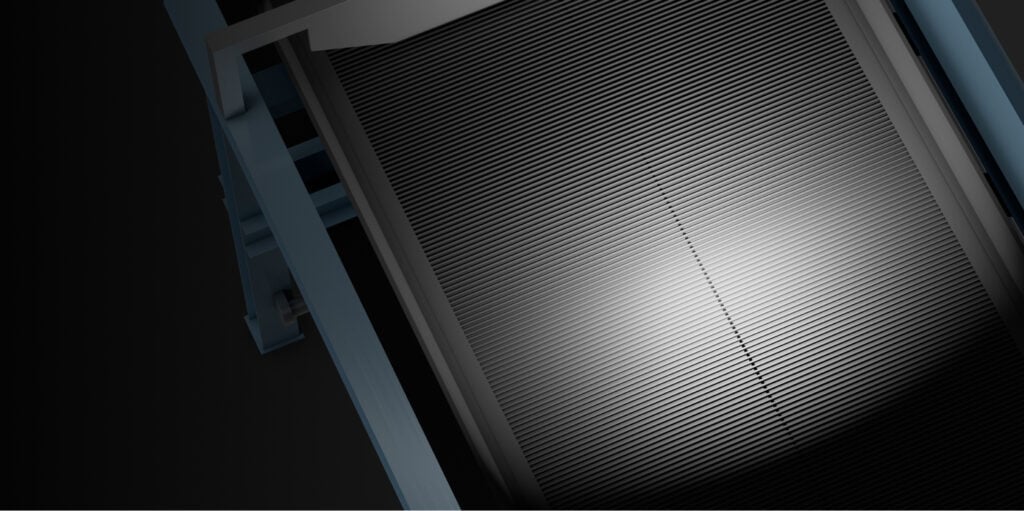
On the Horizontal Rubber Belt Vacuum Filter, the belt itself is part of the drainage system. Grooves run across its surface and drainage holes pass through it — an optimized design of filtrate grooves and holes, in the manufacturer’s description — and filtrate that has crossed the cloth is collected by a groove, led to a hole and drawn into the vacuum box beneath, with the flow-guide vacuum box raising the filtrate flow rate further.
That speed of removal is what staged washing stands on: filtrate left sitting on the belt is carried into the next wash zone and blurs the boundary between stages.
Wash Stages Are Arranged Along the Belt
Filtration, washing, suction drying, discharge and cloth regeneration follow each other along a single horizontal run, and the washing section of that run is arranged as a multi-stage countercurrent wash. NHD builds the machine in belt widths from 400 to 4500 mm, with effective filtration areas from 0.8 to 162 m², and sizes outside the standard table can be built to order.
The arrangement is already working at production scale: eight 120 m² units on phosphogypsum repulping and washing in Hubei, another 120 m² unit in Inner Mongolia, an 84 m² unit at a DAP plant in Vietnam. The Senegal unit — 20 m² on phosphate beneficiation — was the manufacturer’s first belt filter in mineral processing; after on-site filtration testing it met its capacity and cake-moisture targets.
Return-Side Cloth Washing Helps Restore Permeability
At discharge the cloth leaves the belt and makes the return run, where a sprinkler washes it. The point of that wash, in the manufacturer’s description, is to recover the cloth’s air permeability as fully as possible, so it comes back to the feed end ready for the next load of slurry — the cloth runs as a closed loop, and its condition at the feed end is largely decided on this return run.
Send it back blinded and the cost shows up immediately: resistance under the new cake rises, drainage slows, the cake builds unevenly, and every wash stage downstream inherits both defects. A replacement filter cloth changes drainage and washing behaviour along with it, which is why cloth selection is reviewed together with the wash layout rather than treated as a routine consumable decision.
Conclusion
Countercurrent washing on a vacuum belt filter depends on the direction of cake travel and wash-liquid reuse. The cake moves toward discharge, while the cleanest wash water is applied near the discharge end and reused stage by stage toward the feed end. Mother liquor and wash filtrate should be collected in a way that preserves the process information and concentration differences required by the circuit. Cake thickness, wash-water volume, vacuum level, and belt speed then determine how effectively soluble material is displaced from the cake. On an NHD horizontal rubber belt vacuum filter, the liquid that passes the cloth drains through the grooves and holes, the wash is the multi-stage countercurrent path along the belt, and the scrubber restores the cloth’s air permeability. Share the slurry properties, washing target, wash-water availability, and required throughput with NHD for review of the wash-stage layout and filter sizing. Contact sales@chinanhd.com or WhatsApp +86 136 6732 4277.
FAQs
Q1: Where does fresh wash water enter in a countercurrent belt wash?
A1: At the stage nearest discharge. That cake is about to leave, so the freshest water does the last displacement, and the liquor from that stage washes the dirtier cake one stage nearer the feed.
Q2: Why are mother liquor and wash filtrate often collected separately?
A2: Mother liquor leaves the cake before washing, while wash filtrate contains liquid displaced during the washing stages. Separate collection helps preserve concentration differences and makes recovery or reuse easier to control.
Q3: Does more wash water clean the cake by itself?
A3: No. Washing efficiency also depends on cake thickness, vacuum, belt speed, and residence time. More wash water does not automatically improve soluble removal if the contact and drainage conditions are not suitable.