

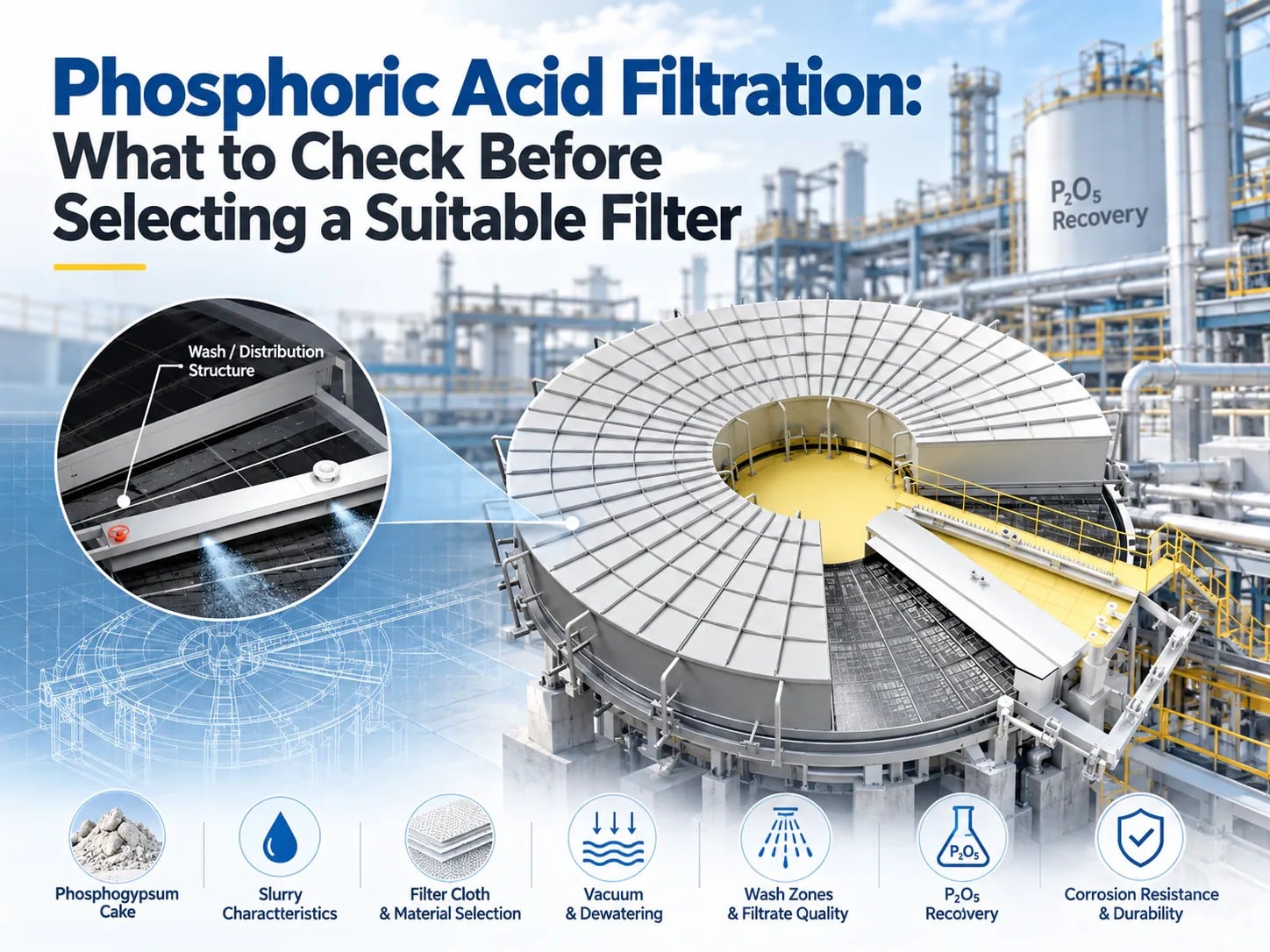
Two filters with a similar filtration area and price may perform very differently in a phosphoric acid plant. Phosphogypsum crystal properties, slurry solids, washing requirements, cake moisture, acid conditions, continuous operating capacity, and filter cloth performance all affect the final result.
Before comparing equipment quotations, the project team should first define the process duty and the performance targets the filter has to meet.
What the Phosphogypsum Slurry Decides
Crystal Size and Shape Affect Filtration Rate
On a 320 m² table the pans receive a crystal the reactor has already finished. Wet process phosphoric acid production grows it in the reactor. The pans only receive it. Filtration for phosphoric acid is that separation, on the crystal already made. A coarse crystal leaves channels in the cake, and liquor from that tonne moves through. A fine crystal, or one that grew as needles, closes those channels. The same cake thickness then takes more of the rotation.
The process engineer attaches the crystal note to the inquiry. “Coarse” or “fine” is enough when a measured size distribution is not in hand yet. Both suppliers size from that note. Leave it off and each office assumes its own cake. The two areas then stop being comparable.
Slurry Solids and Throughput Define the Real Duty
Dry tonnes of gypsum per hour, at the solids the reactor is actually holding, is the duty. That solids figure tells the project team how much liquor each tonne still has to push through the cake. Filtration, wash and drying are laid out for that volume. Move the solids and all three zones move with it.
A test-stand peak, run at some other concentration, is the wrong number here. Cloth regeneration happens while that reactor is still feeding. The inquiry cell for that duty carries tonnes per hour, with the solids written beside them.
Acid Concentration and Temperature Affect Material Selection
On every model, including the 380 m² unit, concentration and temperature are written next to the table, the pans, the piping and the distributor. Phosphoric acid can sit on the wrong metal for months. The first week of running will not show it. A catalogue build, drawn for another concentration, is only where the selection starts.
Change the concentration after the offer, and the shop repeats the material pick before steel is cut.
How Do Washing and Cake Moisture Affect P2O5 Recovery and Downstream Handling?
Washing Performance Should Be Measured by Residual P2O5
Ask for the P2O5 left inside the washed gypsum. Per tonne of gypsum the station needs a liquor volume, a place where that liquor lands, and a time in the zone. Those three move the P2O5 left in the cake. A pale cake face can hide phosphate in the interior. The offer prints the residual the zones were calculated against. Two offers with no residual cannot be ranked on recovery.
Washing Conditions Must Match the Filter Structure
On the 320 m² unit, each pan meets the wash station once per turn. Wash liquor arrives only after the cake is sitting on the cloth. A thicker cake, uneven liquor, a short station or a weak vacuum each leave more P2O5 in the gypsum.
Stages of countercurrent wash travel with the cloth. The stages are built into the rubber belt vacuum filter. That layout belongs to the belt. A wash written for the belt will not land the same way on the table. A table zone will not reproduce the belt’s stages.
Filtration, drying, discharge and cloth regeneration share the same turn. Give the wash more of the circle and filtration loses the difference. The project team takes the split from this duty. A zone drawing from a smaller plant leaves a 320 m² duty short on wash or short on filtration.
Cake Moisture Affects Downstream Handling
The drying pull starts when the pan leaves the wash station. The conveyor and the stacker set how much moisture the cake may still hold. Past the conveyor’s limit, that phosphogypsum cake moisture needs another dryer, or the conveyor starts to plug. Extra wash liquor, added so more P2O5 comes back, is water the drying zone then has to pull. An offer that prints a moisture number shows the drying zone behind it.
Why Do Continuous Operation, Filter Cloth, and Maintenance Matter?
Nameplate Capacity Is Not the Same as Continuous Capacity
A 600,000 t/a reactor is still feeding when the crew changes a cloth or clears the valve. Nameplate capacity is a clean machine on a fresh cloth. Continuous capacity counts the hours spent regenerating cloth and clearing scale. The project team compares the second number, and asks which conditions that number assumes. A peak with no basis cannot be lined up against a continuous rate.
Filter Cloth Selection Affects Filtration Performance
Liquor crosses the filter cloth; the gypsum stays. Air permeability is the drainage rate. Fineness is the particle size that cloth is chosen to hold. Acid and alkali resistance decides whether PP, polyester or nylon belongs at this concentration and temperature. Thickness, breaking force and grammage are read with those two.
Those parameters travel with the zone duties. A price for “cloth”, with no fibre and no permeability, does not tell the process engineer which medium the zones were calculated on.
Cloth Life and Maintenance Access Affect Availability
A cloth change costs the tonnes the reactor would have sent during the stop. Scale builds along the table edge. The arc-shaped clamping bar slows that buildup, and a cloth change finishes sooner. The water-saving nozzles wash with anti-clogging elements behind them. Energy stays low. Flushing power stays high. The cloth blinds later.
The maintenance team still has to reach the cloth, the nozzles and the wash points. The offer shows that route, and the minutes the filter is down.
Why Is a Rotary Table Vacuum Filter Suitable for Phosphoric Acid Production?
Continuous Zone-Based Operation
Pans keep moving while the reactor feeds. Filtration, washing, drying, discharge and cloth regeneration are stations on one circle. The line is not waiting on a second filter. NHD rotary table vacuum filters are widely used in phosphoric acid service. The duty sheet fixes the zones and the cloth on this rotary table vacuum filter.
Filtration, Washing, Drying, Discharge, and Cloth Regeneration
Distribution comes first. The plate-type distributor lays slurry across the pans. An even cake is what the later stations dry and wash.
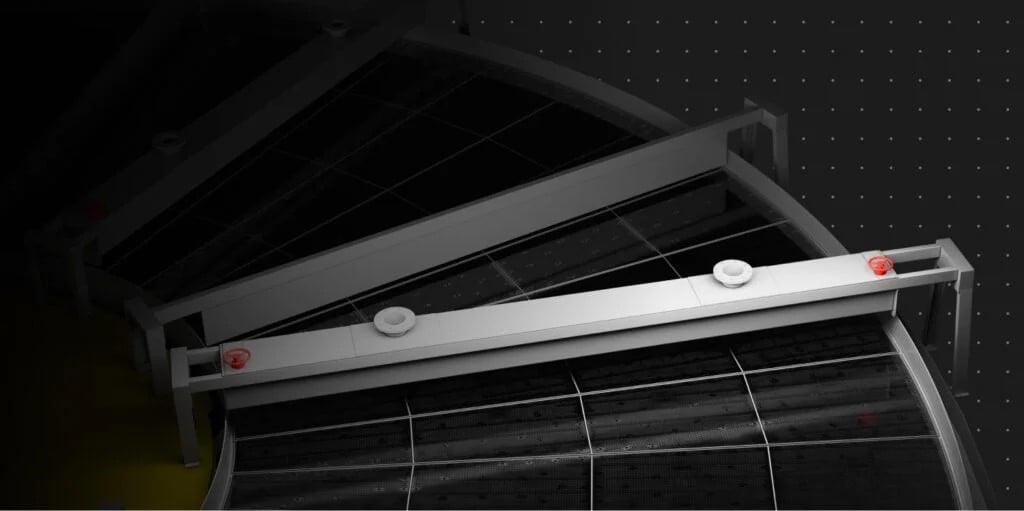
Vacuum forms the cake. Wash liquor follows. Suction dries it. The cake discharges. The cloth is regenerated before the pan comes round again. When the feed moves, the adjustable plate-type overflow distributor and scrubber hold that spread. The operator does not have to correct the cake by hand.
Scale is the other interruption. The low distribution valve keeps scale and blockage down, so cleaning stops come less often. Temperature rises and the bottom frame grows. The floating support structure takes that growth.
Large Filtration Areas Support High-Capacity Projects
HDPP-380 is the largest model NHD builds, at 380 m². That circle holds the dry tonnes, the wash liquor and the drying pull. Guizhou Kailin Group’s 600,000 t/a phosphoric acid project runs HDPP-320 at 320 m², the largest unit in that service. 380 m² is what the range can be built to. The Kailin unit is the one in operation.
A project team checks the 380 m² model against the crystal, the wash ratio and the moisture target. The same three checks apply to the 320 m² unit at Kailin.
What Should Be Confirmed Before Comparing Filter Quotations?
Process Conditions
The project team issues one sheet: slurry properties, solids, crystal, dry tonnes, acid concentration, temperature and operating hours. Area, zones and materials are calculated from that sheet. Leave the crystal line empty and one office will assume a coarse cake. The other will assume a fine cake. Both can still print the same model area. In service, one cake drains and the other holds liquor.
Performance Targets
Four numbers make “suitable” checkable after startup. Residual P2O5, cake moisture, wash ratio, continuous capacity. Residual P2O5 is the wash zone. Moisture is the drying zone. Capacity is the continuous basis. A residual with no wash zone, or a capacity with no operating basis, stays unchecked after startup.
Equipment Design and Materials
Mark the area as the model area or as the area in service. Mark the zone split, the materials for this acid and this temperature, the cloth parameters, and the way in for a cloth change. Throughput and crystal produced the area. Wash and moisture produced the zones. The acid produced the materials.
Filter Cloth and Maintenance
The acid and the temperature pick PP, polyester or nylon. Permeability, fineness, thickness, breaking force, grammage, acid resistance and alkali resistance are filled in beside the fibre. The same offer states the minutes of downtime and the path the maintenance team walks. Both the clamping bar and the nozzles sit on that path. They change scale, change time and blinding.
Data to Provide the Supplier
Procurement sends the sheet the process engineer already filled: slurry, crystal, acid, wash targets, moisture and hours. An office missing the crystal note, or the moisture target, cannot close the zones. Offices that receive the same sheet size the same duty.
Conclusion
A suitable phosphoric acid filter should be selected from the process duty rather than filtration area or equipment price alone.
Phosphogypsum properties determine filtration behaviour; washing affects P2O5 recovery; cake moisture affects downstream handling; acid conditions determine material compatibility; and filter cloth and maintenance requirements influence long-term availability. For a NHD rotary table vacuum filter, the final design brings these conditions together into the correct filtration area, zone allocation, materials, cloth specification, and continuous operating capacity.
Send the solids, the crystal, the acid conditions, the wash ratio and the moisture target to sales@chinanhd.com, or the same note on WhatsApp +86 136 6732 4277, and NHD can put the duty against a rotary table quotation.
FAQs
Q1: Does a larger filter area always increase phosphoric acid production?
A1: No. Output follows how fast this crystal drains and how much P2O5 the wash zone still leaves in the gypsum. A larger area on the quotation does not add tonnes the cake cannot pass.
Q2: How does washing work on a rotary table vacuum filter?
A2: On a rotary table vacuum filter, each pan passes through a dedicated washing zone during the rotation cycle. Wash liquid is distributed over the formed phosphogypsum cake, and the washing result depends on factors such as cake thickness, wash-liquid distribution, residence time, and vacuum conditions.
Q3: What data should be provided before selecting a phosphoric acid filter?
A3: Provide the phosphogypsum slurry properties, solids concentration, dry solids throughput, acid concentration and temperature, washing requirement, residual P2O5 target, cake moisture target, and operating hours. These data allow the supplier to size the filter and define the appropriate area, zone arrangement, materials, and operating capacity.