
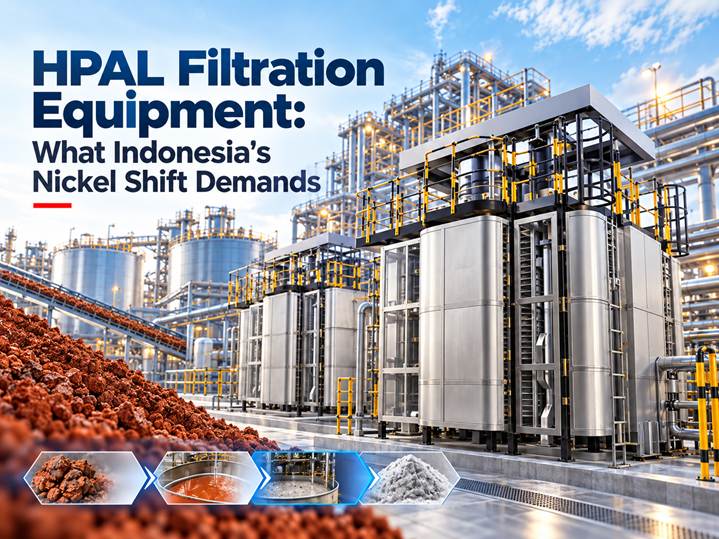
Indonesia may stop approving new nickel smelters that only make semi-finished products. The statement came in the first week of October 2026, from the country’s coordinating minister for downstreaming and energy transition. Roughly half of Indonesia’s nickel output still leaves the plant as nickel pig iron, ferronickel, nickel matte or mixed hydroxide precipitate, and most of that material gets finished abroad. The message to investors is blunt: the next wave of capacity should go further downstream. Not more of the same.
For project teams watching Indonesia, the question that matters is what “further downstream” does to the flowsheet. In laterite processing the answer is high-pressure acid leaching. An HPAL circuit lives or dies on solid-liquid separation — the residue has to be washed, the pregnant liquor thickened, the intermediate filtered into a shippable cake. Get the filtration wrong and the whole circuit pays for it, every day it runs.
What a Moratorium Would Actually Restrict
Most of Today’s Output Stops at the Halfway Point
The numbers explain Jakarta’s impatience. Indonesia counts 79 nickel smelters. Fifty-five of them run rotary-kiln electric-furnace lines making ferronickel or nickel pig iron. Ten are HPAL plants, ten make matte, six are integrated stainless works. Semi-finished products account for 50 to 60 percent of domestic output. Meanwhile the global surplus sits near 2.5 million tonnes, and nickel touched US$15,510 a tonne in early October — a year-to-date low. Building more halfway capacity into that market is, in the minister’s view, exactly the wrong move.
From Export Ban to Selective Downstreaming
This is the second act of the 2019 ore export ban. That ban forced processing onshore and triggered the smelter building wave. It worked: the ore stayed home. Now officials want the value to stay home too. Parliament’s Commission XII has backed the review. The ministry is drafting recommendations for the president on which segments get limited and which keep growing. Equipment suppliers should watch the direction, not wait for the decree. The plants most likely to break ground next are the ones that finish the job.
Why HPAL Sets the Filtration Duty
Laterite Leaching Moves Enormous Volumes of Acidic Slurry
HPAL cooks limonite laterite in acid at high temperature and pressure. Nickel and cobalt dissolve. What is left behind is a mountain of residue — acidic, abrasive, relentless in volume. Every downstream step has to survive that slurry. A filter that looks fine on a datasheet but blinds or stalls in this service does not just underperform. It becomes the bottleneck the whole plant works around.
CCD Washing Decides How Much Metal Stays in the Residue
Before filtration comes washing. Counter-current decantation thickeners wash the leach residue and pull the dissolved metal back into the pregnant liquor. This is a recovery number, pure and simple — metal left in the final underflow is metal the plant never sees again. High-rate thickeners that hold a dense, steady underflow keep the wash honest. They also hand the filters a feed that behaves the same at 3 a.m. as it did at 3 p.m.
The Intermediate Product Has to Ship
At the end of the HPAL line sits a mixed hydroxide intermediate. It has to be filtered, washed, dried and put on a ship. Water in that cake is freight paid for nothing. Impurities in it become a penalty at the refinery. The cake specification is a commercial document as much as a process one. Filtration ends at the port.
Filtration Checks That Matter in HPAL Service
Match Pressure and Moisture to the Shipping Spec
Start at the end. What does the cake have to look like when it leaves the plant? Then walk backwards to the press. The HDLY vertical automatic pressure filter runs to 1.6 MPa and holds cake moisture at 10 percent or below — enough margin to hit a drying or bagging target without buying a bigger dryer. One demand to make of any supplier: state the moisture against the actual feed. A number measured on a reference slurry is decoration.
Decide Where Washing Happens
Chloride and alkali in the cake will haunt the refinery, so washing needs a home in the design from day one. A press with its own cake-washing stage keeps the wash inside the filtration cycle. No separate step. No extra tank farm. The warning matters more than the feature: a wash stage bolted on later has to fit a cycle that was never designed for it. Decide now.
Treat the Cloth as a Wear Part
In HPAL service the cloth takes the beating — acid, abrasion, heat. Release, cycle time and cleaning all come down to that fabric. The filter cloth series for automatic press filters is built from weaving through finishing, and the selection should start from the feed chemistry on file. Track replacement intervals in tonnes filtered, not months. And when a cloth dies, ask what killed it. Blinding, abrasion and chemical attack each point to a different replacement.
Where This Duty Already Runs
Indonesia’s Nickel-Cobalt Plants Filter at Scale
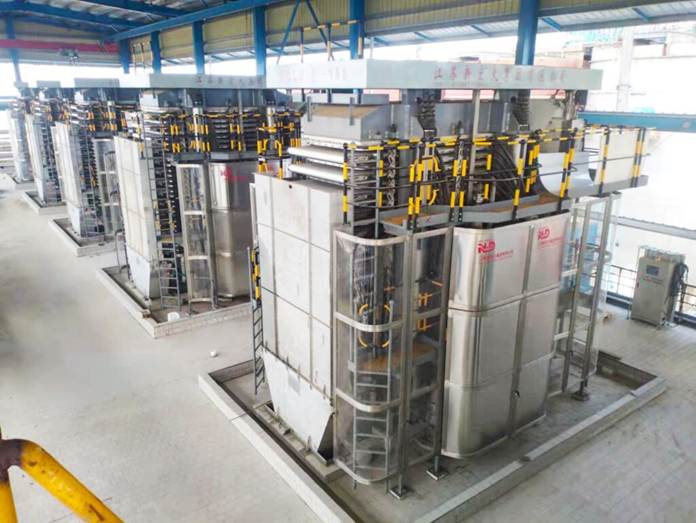
NHD‘s equipment already works this exact plant class in Indonesia: 13 sets of 180 m² and 168 m² vertical automatic pressure filters, plus another 5 sets of 168 m² units, all in nickel-cobalt hydrometallurgy service. The thickener side is covered too — Φ32 m, Φ36 m and Σ42 m CCD units at the Lygend nickel and cobalt project. Papua New Guinea runs 180 m² units in the same service. Laterite in, hydrometallurgy through the middle, shippable intermediate out. The duty the policy is pushing toward is already running.
Read References for Duty Match, Not Just Tonnage
A reference list proves a machine has run. It says nothing about whether it ran your duty. Three questions cut through it: what did the feed look like — solids, acidity; what cake moisture did the press actually hold; how long did the cloths last. Suppliers who answer in those numbers are worth a site visit. The rest are worth a polite email.
Conclusion
No moratorium will change the chemistry of laterite. It will change which flowsheets get money in Indonesia, and the money is moving toward plants that finish the job. In those plants solid-liquid separation is not auxiliary equipment. It is where recovery is defended and where the saleable product gets made. Specify the filtration for HPAL duty — pressure, washing and cloth chosen against the real feed — and the policy tailwind turns into tonnage on a ship. Project teams scoping the next Indonesian nickel investment can send the feed basis and cake targets to sales@chinanhd.com or reach the team on WhatsApp at +86 136 6732 4277 for a duty review.
FAQs
Q1: What does Indonesia’s proposed nickel smelter moratorium cover?
A1: The review targets new smelters that only make semi-finished products — nickel pig iron, ferronickel, nickel matte and mixed hydroxide precipitate. That is 50 to 60 percent of what Indonesia produces today. Plants that take nickel further downstream would get priority.
Q2: Why does a shift toward HPAL increase filtration equipment demand?
A2: HPAL dissolves nickel out of laterite in acid. The result is huge volumes of acidic slurry that have to be washed, thickened and filtered, stage after stage. RKEF smelting has a different separation profile entirely. Push the industry toward HPAL and the filtration duty per tonne of nickel climbs with it.
Q3: What should a plant team check first when specifying a press for HPAL duty?
A3: Start with the cake the plant has to ship — moisture limit, impurity limit. Then make the supplier prove the press holds those numbers on the real feed, with washing inside the cycle and a cloth rated for the slurry’s acidity and abrasiveness.