

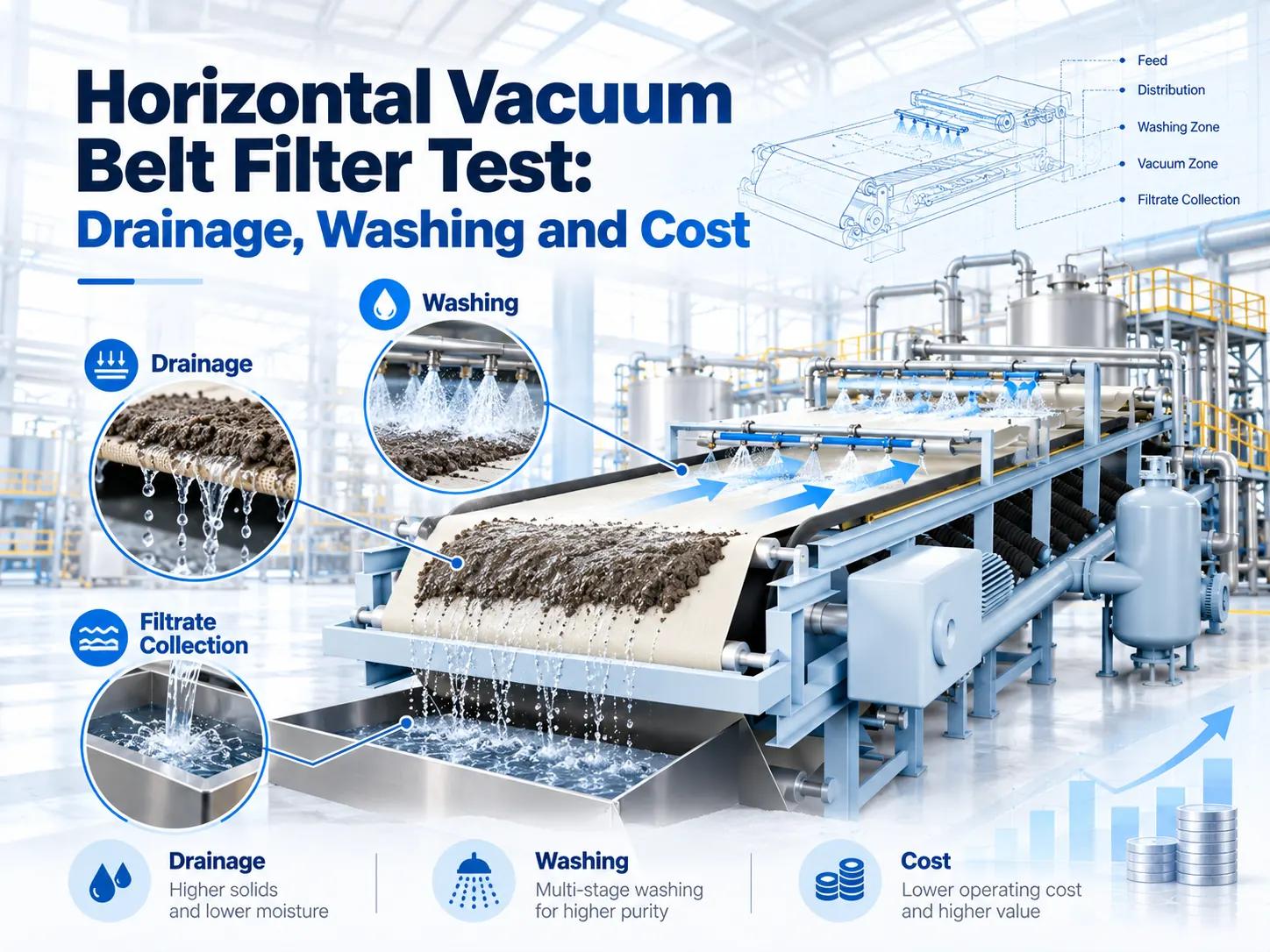
On 23 September 2026 in New York, Argentina and the U.S. Export-Import Bank signed the Build the Future framework. Through 2027 it could channel as much as $7 billion, with critical-mineral development and processing among its priority sectors.
Funding on that scale sets projects in motion, redrawing where a copper or lithium plant gets built and what it plugs into. About how a given slurry will drain, it tells you nothing. That is a property of the solids, the liquor and the cake the two build between them, and a press release alters none of those. The tracks run side by side: money decides which projects earn a hard look, and the look has to produce evidence of its own.
For a stream needing continuous separation and washing in stages, the evidence takes one form: a test on a horizontal vacuum belt filter, run while belt area, vacuum capacity and wash-water demand can still be fixed by measurement, not guesswork.
Argentina is familiar territory for us. NHD equipment has been shipped there before, and a filtration review here still opens with the same separation of concerns: a headline may warrant closer study, yet fitness for continuous filtration can only be judged against the material the plant itself produces.
Financing Can Move a Plant, but It Cannot Set the Filter Duty
Better Grid and Transport Access Changes Where Processing Happens
The filter duty feels infrastructure indirectly, through everything rearranged around the filter. Bring a substation within reach of a remote site, and processing pencilled in for later abruptly makes sense right there.
Slurry once earmarked to leave as an intermediate instead turns up at a filter, at full rate. Roads and ports act from the opposite end.
Upgrade them, and the arithmetic of shipping concentrate moves, turning residual cake moisture into a freight charge: moisture still in the cake at loading is water the project pays haulage on. Arid sites feel the squeeze from the other direction: water runs short, filtrate is recycled into the circuit, and the filter must close a far tighter balance.
Each such decision arrives at the filter as load. Dry solids lead: the hourly tonnage the belt must shift is set by that rate, and it is not negotiable. Feed concentration is another kind of number.
It fixes how much slurry gets pumped, spread and drained to yield those solids — why a watery feed can demand a far bigger belt than a thick one at identical tonnage.
After that, the utilities: the electrical system the new infrastructure is meant to reinforce must also carry the vacuum set, belt drive and pumps, and the wash sprays draw on the water system.
Shift the plant boundary and each of those numbers shifts with it. Equipment sized against the earlier layout has been sized for a plant that will never be built.
The Framework Leaves the Flowsheet Where It Belongs, With the Project
None of this amounts to approval for a particular project. What EXIM announced is cooperation that may draw in American equipment, technology and mining know-how, and AP’s coverage a day later reported the same agreement through a minerals lens.
No mine has been named as a loan recipient, and permitting plus engineering sign-off remain with the individual projects, exactly where they sat before.
In a study, then, the two questions occupy different columns: whether a project can pay for the plant its engineers designed is the financing question; what goes inside it is settled by slurry evidence.
The test sits in the evidence column, and its worth grows as funding loosens: a financed project entering detailed engineering with an unexamined filtration duty has not disposed of its biggest process risk, only postponed it.
A Belt Filter Earns Its Place Where Cake Must Form, Wash and Discharge Without Stopping
The Slurry Decides Whether Continuous Filtration Fits
Begin with the stream, not the machine. One duty is a copper concentrate. Another is a copper residue loaded with soluble salts that must come out, and lithium flowsheet solids make a third.
All three travel under the label filtration, yet they reach the belt with unlike particle populations and unlike reasons for washing, so questioning starts at the separation point itself.
What leaves with the cake? What leaves in the filtrate? What ceiling applies to each? Set down as a feed card, that means the complete particle-size range rather than an average, plus solids concentration, dry-solids rate and liquor chemistry.
The same card carries the targets: cake moisture wanted, soluble residue allowed to remain, and the filtrate’s destination.
A size curve pulls against itself at its two ends. Fines form the slow end: packed tight, they yield a cake of high resistance, and filtrate creeps even under hard vacuum. Take them far enough and the cloth seals over; then the rate does not taper, it falls off a cliff. Coarse grains occupy the opposite pole: liquor rushes through their open bed, at times too eagerly, as wash water opens channels and bypasses the bed, leaving the liquor inside untouched. Real feeds carry both ends at once, and the outcome is usually governed by the distribution’s awkward tail, not its well-mannered centre — whatever blinds cloth, splits cake or clings to soluble matter.
A test worth the name therefore runs the everyday blend alongside the dreaded one. Size on the obliging feed alone, and the machine first meets the hostile one at production scale.
Cake Formation, Washing and Cloth Cleaning Happen in One Pass
In our horizontal rubber belt vacuum filter, an endless toroidal cloth rides across a rubber drainage belt. Underneath, a row of vacuum boxes pulls filtrate through the belt’s machined grooves and drainage holes, insulated and flow-guided so cooling filtrate does not lay down scale inside them.
Cake is built, washed, dried and discharged in one uninterrupted pass, never in batches. Cake thickness can be dialled in, as can wash-water flow, vacuum level and cycle time.
Cloth drift is corrected by a long-stroke tension device that reacts fast and holds deviation low, and the annular belt support eliminates guide rollers altogether — a point that carries more weight than it appears to: resting on a surface that does not bend it, the cake is far less prone to cracking and losing vacuum halfway along the belt. Wash stages along the belt deliver multi-stage counter-current washing, the freshest water reserved for the freshest cake. On the return run, a sprinkler built to scrub the cloth restores its air permeability, leaving it, at the start of the next pass, very nearly in the state it began the last one.
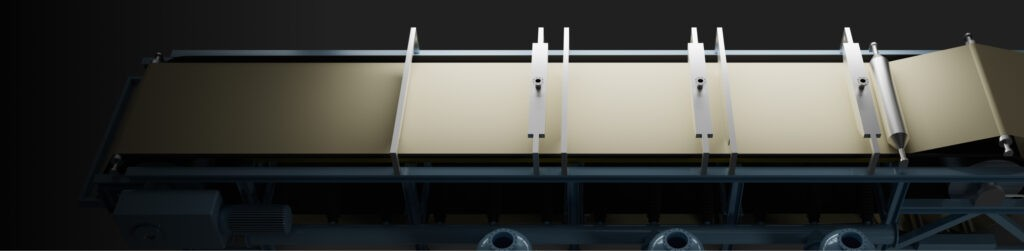
img.Slurry distribution and multi stage washing on a horizontal vacuum belt filter.webp
One pass is the machine’s strength — and its discipline. Feed must keep coming steadily, and the cake must hold its behaviour along the belt’s whole length, from feed end to discharge. A sticky slurry may have to go on thin simply to shed its water within the distance available. Cracking is uglier: a cake split ahead of a wash stage lets spray escape through the split, the bed beneath getting none. Blinding damages quietly: cloth chokes, the gauge keeps climbing, filtrate refuses to follow.
Scale, at least, is settled. Eight 120 m² units of this design wash phosphogypsum day and night in Hubei; Inner Mongolia runs another at 120 m², Vietnam an 84 m² machine on a DAP plant, and Senegal a 20 m² unit on phosphate ore beneficiation.
None of those plants can settle how a new project’s slurry behaves across the pass. Only its own sample answers that.
A Filter Test Is Worth Running When It Settles Size, Washing and Cost Together
Test the Feed the Plant Will Actually Produce
A test is worth what its sample is worth, no more, and a sample counts only if the plant as designed would produce it. Grinding reshapes the particle population; so do classification, dilution and plain holding in a tank. Grab a sample from a convenient point in an existing circuit and you may test a feed the future plant will never produce, settling a question nobody posed. Every run therefore opens with a sample card: origin and day drawn, size range, solids content, liquor composition, plus the cloth mounted that run, belt speed and vacuum applied. The sampling point is marked on the process drawing too — a tank outlet and a pump discharge carry different fractions of one slurry.
Runs move one variable at a time — legibility, not tidiness. Belt speed alone reports what residence time does to cake moisture. Vacuum alone shows how much driving force the cake answers to. Wash-water flow alone separates a contact limit from a drainage limit. Move two together and numbers emerge that cannot say which change made them. Combined cases earn their place where the plant genuinely intends to run that way, if the sheet says combined. Instruments are not the whole observation either: the cake’s face and the belt’s edges repay watching.
Combined cases still earn their place where the plant genuinely means to operate that way, provided the record sheet declares them combined. Nor are instruments the whole observation: the cake’s face and the belt’s edges repay attention.
A damp streak betrays uneven feeding; a crack opening before a wash stage foretells poor displacement in that run; staining on the cloth can be the first sign of a chemistry or cleaning problem the rate figures alone would miss.
Washing and Operating Cost Only Compare on the Same Product Target
Washing is easy to flatter: pool the stages and the average stays respectable after a stage has quietly given up. So mother liquor and each wash filtrate are collected and analysed separately — only separate sampling finds the stage where the concentration gradient stops falling, which is the stage setting the wash-water bill.
Comparisons obey the same discipline. Fix the permitted soluble content of the finished cake first; then hold dry-solids rate, cake moisture and residual-soluble target constant across the arrangements weighed, or drop the comparison. A cheaper case shipping wetter, dirtier cake has saved nothing — it has changed the product.
Cost the whole circuit, not the filter alone: vacuum generation, belt drive, slurry and filtrate pumping, makeup water, filtrate handling, cloth cleaning and eventual cloth replacement all belong in one account.
Two species of figure live in that account and must never be mixed: values the test measured, and figures the layout team calculated. Drainage behaviour comes from the sample; belt area at plant throughput comes from the layout; a hoped-for target is no substitute for a value the test failed to produce.
Cloth selection belongs to the same arithmetic: a tighter cloth buys clearer filtrate at the price of higher resistance and heavier cleaning, and our filter-cloth series, woven in-house by Jiangsu Filter New Material Co., Ltd., is graded by thickness, air permeability, breaking force, filtration fineness and acid and alkali resistance, so each compromise can be set against what the test showed.
Conclusion
Financing frameworks decide which projects get studied closely, and none profit more than those whose process risks are settled while still on paper. On a copper or lithium stream whose duty is to form cake continuously, wash it in stages and discharge it steadily, the test is where drainage rate, washing response and running cost stop being assumptions and become the footing for machine size.
As that decision approaches on your project, email the particle-size curve, feed concentration and dry-solids rate, residual-soluble target and cake moisture ceiling to sales@chinanhd.com, and our engineering and commissioning team will work them into a test plan built around your flowsheet.
FAQs
Q1: Does a project need financing in place before a belt filter test makes sense?
A1: No — in practice the order works better reversed. The test is study-stage evidence: drainage rate, washing behaviour and a defensible cost basis are established while the design can still change, which strengthens the engineering case and any financing case built on it.
Q2: When does a horizontal vacuum belt filter suit a copper or lithium stream?
A2: It fits when a stream builds a cake that will drain, needs that cake washed stage by stage, and gains from solids leaving continuously rather than batch by batch. Showing that a given stream qualifies is the sample’s job, above all at the troublesome end of its size range.
Q3: Which readings from the test belong in the selection report?
A3: Filtration rate, cake thickness and cake moisture describe the separation. Filtrate clarity and each wash stage’s result describe product quality. Water and power for the full circuit, recorded at the same throughput and product target, make the cost comparison fair.