 Indonesian
  English
  French
  Spanish
  Russian
  Arabic
  Portuguese
  German
  Turkish
  Persian
  Vietnamese
  中文
中文 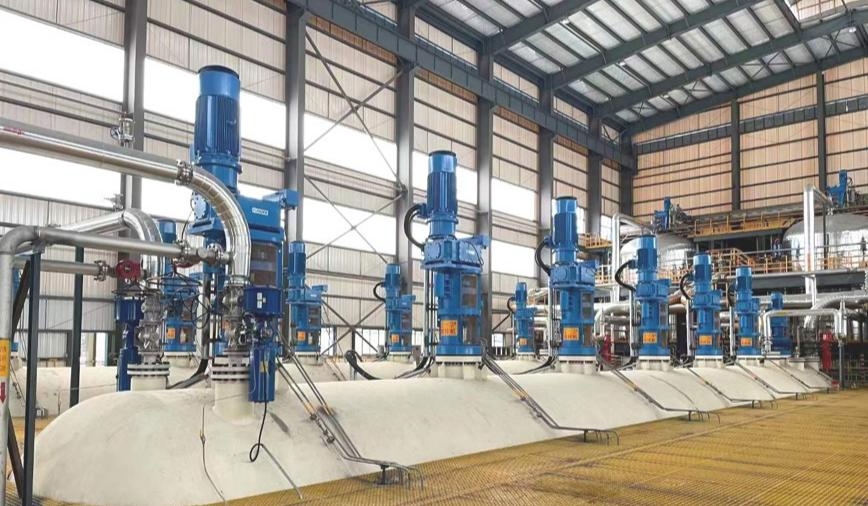
Cobalt supply has become harder to plan. The Democratic Republic of Congo still holds a major position in global cobalt output. When quotas and customs timing become less predictable, hydrometallurgy plants need to look inside the process: can the same feed produce more recoverable cobalt?
Agitator design cannot remove export restrictions. It cannot change ore grade. But in sulfuric acid leaching, reduction leaching, neutralization, and precipitation, it can influence how well solids, acid, reducing agents, and dissolved metal ions contact each other. Poor mixing wastes reaction volume. Good mixing keeps slurry moving where the reaction actually happens.
Why Cobalt Leaching Recovery Matters Under Quota Pressure
Cobalt plants usually talk about recovery rate as a technical number, but it is also a commercial number. If a plant improves cobalt recovery from the same slurry feed, it is not adding more ore. It is losing less metal inside due to residue, dead zones, poor contact, or incomplete reaction.
That matters more when supply movement is restricted. In a quota-driven market, extra licensed volume may not be easy to obtain. A plant may still be able to work on online efficiency: better leaching contact, steadier reagent distribution, and lower downtime. Agitator equipment sits right in that part of the process.
Where Agitator Design Affects Cobalt Hydrometallurgy
In cobalt hydrometallurgy, mixing is not a background task. Slurry conditioning needs even concentration. Leaching needs enough contact between acid, reducing agent, and mineral particles. Neutralization and precipitation need local pH swings to be controlled.
If the agitator only turns the upper liquid surface, the tank may look active from above while solids settle near the bottom. If the impeller creates too much shear, it may consume power without giving better contact.
What Poor Mixing Looks Like in Leaching Tanks
Uneven Slurry Concentration
When slurry concentration changes across the tank, reaction time becomes uneven too. Some zones have enough solids and reagents. Other zones are too dilute or too thick. Operators may respond by extending residence time, but that reduces line productivity.
Weak Solid-Liquid Contact
Leaching needs the solution to reach the particle surface. If solids are not properly suspended, acid and reducing agents cannot contact the ore evenly. Recovery may fall, or the plant may use more reagent to compensate.
Dead Zones and Sedimentation
Sediment at the tank bottom is more than a cleaning issue. It reduces the useful reaction volume. It may also create sudden load problems during shutdown, restart, or flushing. In cobalt projects, dead zones should be treated as a process risk.
More Power Without Better Recovery
A bigger motor is not always the answer. If the impeller and flow pattern are wrong, higher power can mainly become a higher electricity cost. Buyers should compare mixing effects under the same recovery target, not only installed power.
Which Agitator Design Factors Buyers Should Compare
For cobalt leaching agitator equipment, the first point is impeller design. Blade angle, blade width, axial flow capacity, and shear rate all change tank behavior. A good design should move slurry through the whole tank, not only create strong local turbulence.
Tank size also matters. Diameter, liquid height, bottom shape, baffles, feed point, discharge point, and reagent addition position all affect mixing. Slurry data is just as important: density, viscosity, solid content, particle size, temperature, pressure, and acid concentration.
For B2B buyers, the RFQ should include recovery target, residence time, throughput in t/h, power limit, corrosion and abrasion conditions, and whether the process is continuous or batch. Without this data, the supplier is mostly guessing.
How Axial Flow and Low Shear Improve Leaching Contact
Axial flow helps move slurry from top to bottom and back through the tank. That is useful for cobalt leaching because solids need to remain suspended, while acid or reducing agents need to reach the particle surface. Low shear is also useful when the process does not need violent breakage. The aim is contact, not unnecessary damage.
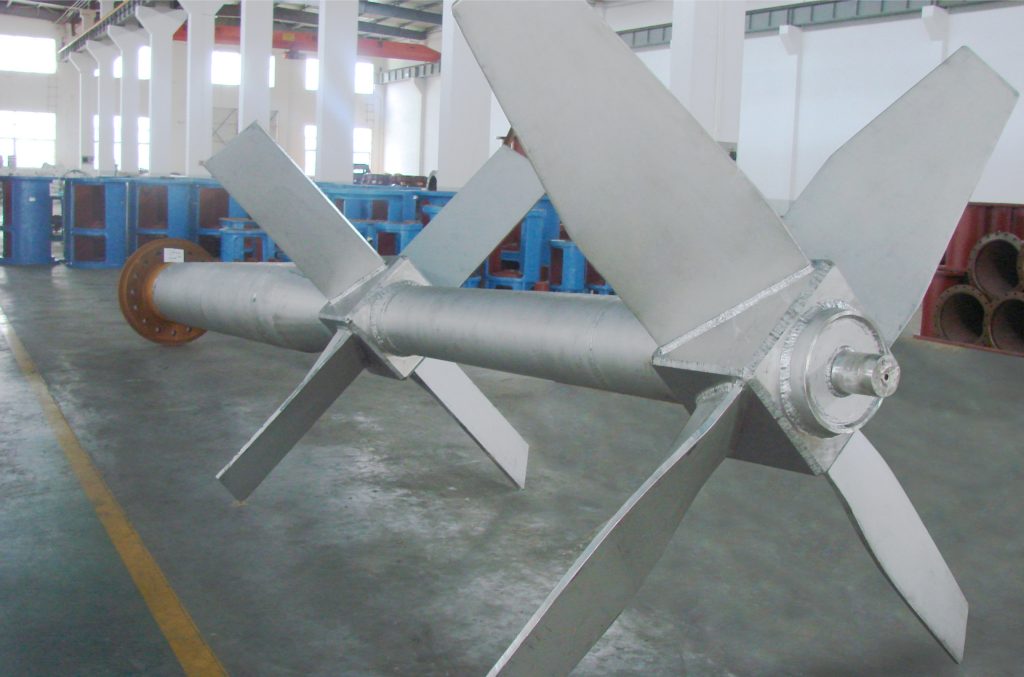
This is where variable cross-section and obliquity impeller design become relevant. NHD’s Penampang Melintang Variabel & Penggerak Kemiringan is designed for high recirculating axial flow with a low shear rate. Its product information states that, under equivalent mixing performance, it can reduce power consumption by 40-50% compared with a conventional 45° PBT agitator.
For cobalt leaching, this figure is not a direct recovery guarantee. It is a useful energy comparison for buyers who need strong circulation without simply increasing motor power.
Agitator Equipment Options for Cobalt Leaching Projects
Penampang Melintang Variabel & Penggerak Kemiringan
This equipment is worth reviewing when the project needs strong axial circulation and controlled shear. It fits leaching tanks in non-ferrous metal industries where solid suspension, reagent contact, and power consumption are all important. The value is the flow pattern: less useless energy loss while keeping the slurry active.
Agitator untuk Industri Nonferrous dan Benefisiasi
For broader cobalt hydrometallurgy sections, NHD’s Agitator untuk Industri Nonferrous dan Benefisiasi can also be reviewed. It is positioned for material mixing, dissolution, suspension preparation, reaction, and slurry concentration distribution in tanks.
In copper-cobalt or cobalt-nickel plants, this type of agitator may fit slurry conditioning, leaching feed preparation, neutralization, precipitation, or beneficiation-related hydrometallurgy sections.
Why Testing and Simulation Matter Before Bulk Procurement
Cobalt slurry changes from project to project. Ore source, acid concentration, particle size, density, viscosity, and temperature can all change mixing behavior. A design that works in one tank may not work in another.
NHD states that it uses CFD FLUENT, pilot-scale mixing simulation, lab-scale tests, pilot tests, and scale-up experiments for agitator selection. That matters because agitator design should be based on flow field, shaft power, torque, tank structure, and impeller behavior, not only past experience.
For bulk procurement, buyers should ask what slurry data was used, what residence time was assumed, and how the impeller type was selected. These questions can prevent an oversized motor and an underperforming tank.
Project Experience Buyers Can Review
NHD has project references in non-ferrous hydrometallurgy and cobalt-related systems. The MCC Ramu cobalt-nickel smelting project in Papua New Guinea included a Φ36m CCD thickener and agitator, and the project reached full production in 2017. Company materials also list DRC copper-cobalt smelting agitator application sites, including Zijin Mining, Huagang Mining, and Shengtun Mining projects.
For pressure leaching experience, NHD mentions a 5.2×32 m oxygen pressure leaching reactor stirring device for Guangxi Nandan Nanfang Nonferrous Metallurgy, plus oxygen pressure leaching reactor stirring equipment for China Nuclear Cobalt Source Uranium. These cases do not prove a fixed cobalt recovery increase. They show hydrometallurgy mixing experience, large tank handling, and process-based equipment selection.
Kesimpulan
Cobalt leaching recovery depends on chemistry, ore behavior, residence time, and equipment design. Agitator design affects slurry suspension, solid-liquid contact, reagent distribution, dead zones, power use, and long-term tank stability.
For buyers working under quota pressure and supply uncertainty, the practical route is to recover more value from the same feed. NHD’s Variable Cross-Section & Obliquity Agitator can be reviewed where strong axial circulation and lower power demand matter. Its agitator for the nonferrous industry and beneficiation can be compared for general cobalt slurry mixing and concentration distribution. Final selection should still be based on slurry tests, recovery targets, residence time, throughput, and site layout.
FAQ (Pertanyaan umum)
Q1: What data should buyers provide before selecting cobalt leaching agitator equipment?
A1: Buyers should provide tank size, slurry concentration, particle size, density, viscosity, leaching route, acid concentration, temperature, pressure, throughput, residence time, recovery target, reagent addition method, and operation mode.
Q2: Is MOQ required for cobalt leaching agitator equipment?
A2: For large industrial agitator equipment, MOQ is usually one complete set. The final quantity depends on tank number, process line capacity, spare parts plan, and whether the project needs one agitator or a full leaching tank package.
Q3: Can agitator equipment be customized for cobalt hydrometallurgy projects?
A3: Yes. Configuration can be reviewed based on tank structure, slurry properties, impeller type, shaft design, sealing, corrosion and abrasion conditions, motor power, baffle layout, automation requirements, and site installation space.
Q4: Dapatkah NHD mendukung instalasi, pemeliharaan, dan layanan purna jual?
A4: Yes. NHD can support equipment selection, customized design, panduan instalasi, maintenance advice, spare parts planning, and after-sales service. For overseas projects, buyers should confirm site data, commissioning needs, and service scope before ordering.