

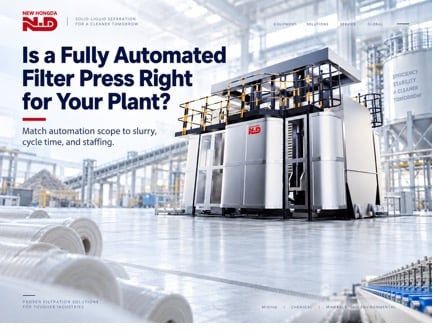
A filter press that runs fully automatically on one site is often overridden on the next, and the control panel is rarely the reason. Feed solids that move between batches, a cake that sticks at discharge, or a shift team that cannot stand at the press all change which parts of the cycle should run on their own.
The scope that fits is the one that matches the whole cycle rather than a function list: feed control, diaphragm squeeze, discharge, cloth washing, and how the cake leaves the building. Slurry conditions, batch or continuous operation, cycle time, and staffing decide where that investment actually pays back. Before the boundary is fixed, the control system has to prove it can run unattended, and the quotation has to define that boundary — down to the press structure that fits it — before two offers can be compared.
What Does the Automation Scope Have to Cover in One Full Cycle?
Feed Control, Filtrate Monitoring, and Squeeze Pump Sequencing
One cycle starts with feed. Slurry fills each filter chamber, filtrate passes through the filter cloth, and the filter cake begins to form. Diaphragm squeeze follows, with high-pressure water entering above the diaphragm to press the cake and release more liquid; the second squeeze repeats that action after cake washing, and air drying pushes air through the chamber before discharge. An automated filter press has to run that order without skipping a step, and hold it when the feed thickens.
Discharge, Cloth Washing, and Cake Transfer
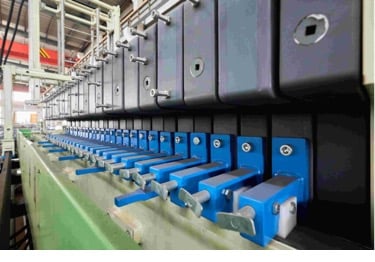
Discharge is the step buyers underestimate. The filter plates open, the cloth travels, and the filter cake falls to both sides of the press. A cycle that discharges cleanly with an operator watching behaves differently once it repeats unattended, because a sticky or cracked cake stays on the cloth and the next batch begins with part of the last one still in the chamber. Washing both sides of the filter cloth keeps the medium open, and cake transfer decides whether the automation stops at the press or continues to the conveyor.
Which Steps Still Need an Operator
Manual decisions usually stay where the slurry rather than the machine decides: the first cycle after a feed change, a batch that arrives with visible grit, or a discharge that has to be judged by eye. Naming those points turns the operator into part of the operating concept instead of a backup for a control system that cannot see the cake.
Which Duty Conditions Decide How Much Automation Is Right?
Feed Solids Content and Its Variation
A steady 35 percent feed and a feed swinging between 25 and 45 percent inside one shift are not the same duty. The second changes cycle time, squeeze pressure, and filtrate load from batch to batch, and a fixed fill time will either overfill the chambers or hold them half empty. Where the upstream thickener holds a stable underflow the press runs a fixed recipe; where it wanders, the fill endpoint comes from filtrate flow or chamber pressure, and filter press capacity follows the duty rather than a nominal figure.
Batch Operation or Continuous Production
Batch and continuous duties pull automation in different directions. A batch plant wants repeatability per cycle: the same cake, the same cycle time, the same filtrate quality. A continuous line wants the press to stay in step with the equipment around it, so discharge does not block the conveyor.
Cycle Time Target Against Available Manpower
Cycle time connects the machine to the crew. Forty minutes of press time with six minutes of attention at discharge and cloth washing means thirty cycles a shift ask for about three hours of operator time, more than a small team can give between other duties. That arithmetic decides whether full automation is a real option, because attention demand rather than press technology is usually the limiting factor in filter press operation.
Cake Moisture Target and Downstream Handling
Presses feeding a dryer tolerate a moist cake, while presses feeding a truck, a stack, or a landfill need a dry and consistent cake, which makes squeeze pressure, squeeze time, and air drying the variables that must repeat. Downstream handling belongs to the same target, since conveyor loading and chute bridging both set limits on how the discharge has to behave.
Where Does Full Automation Pay Back, and Where Does It Fail?
Payback: Batch Duties with Limited Attendance
Full automation pays back fastest where a press runs many cycles with a small crew. A hydrometallurgy plant with a two-person shift, a press cycling every twenty-five minutes, and a clean discharge is the classic case: automation removes a standing task and raises the cycle count per shift without adding people.
Complication: Slurries That Force the Cycle to Adapt
Some slurries refuse a fixed recipe. Feed carrying clay, fines, or gypsum with a scaling tendency can blind the cloth, slow the squeeze, or leave a cake that sticks at discharge, and the cycle that worked last week becomes the cycle that overflows this week. The requirement then changes, because the cycle needs a real endpoint such as filtrate flow, squeeze pressure, or cloth condition instead of fixed times.
Where It Fails: Small Plants Where Partial Automation Is Enough
Small and irregular duties rarely justify full automation. Five cycles a day, a stable slurry from one reactor, and an operator within sight of the press do not need the press to make every decision, because automatic closing, plate shifting, and pump control already cover the heavy work at a fraction of the scope. The same arithmetic applies to a membrane filter press on a campaign duty, where manual time sits in the changeover rather than in the cycle.
What Has to Be Confirmed Before Operation Is Unattended?
Control Interface, Self-Diagnosis, and Alarm Coverage
Unattended operation depends on what the control system can tell the plant. A press reporting only running and stopped leaves the crew guessing, while a control interface with self-diagnosis and alarm system names the valve that did not close, the chamber that did not fill, and the cycle that ran past its window. Alarm coverage also has to include the dull failures: filtrate flow that stops, squeeze pressure that does not build, and cloth that stops tracking.
Instrument and Valve Readiness for Unattended Cycling
A cycle that depends on filtrate flow needs an instrument that stays clean in slurry service; one that depends on squeeze pressure needs a transmitter on the water side; one that depends on chamber fill needs a reliable endpoint rather than a timer. Valves matter just as much, because automated isolation, blow-down, and squeeze valves have to close against solids and slime. Without that readiness, filter press operation drifts back to the panel.
Maintenance Access and Cloth Replacement
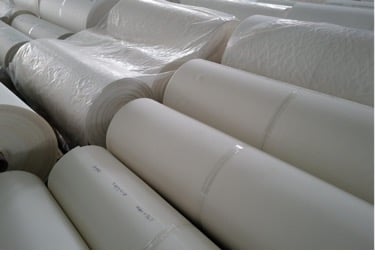
A press that runs unattended still has to be maintained by people, and access to the plate pack, squeeze manifold, and wash headers decides how long a planned stop takes. Cloth replacement is the most frequent task, so the maintenance concept has to cover how the cloth is identified, how it is ordered, and how long the change takes. NHD Filter Cloth Series covers automatic vertical filter press cloth, belt filter cloth, leaf filter cloth, plate and frame filter press cloths, and rotary table vacuum filter cloth, and a sensible filter press maintenance routine tracks cloth condition as well as the calendar.
What Should the Quotation and Technical Confirmation Define?
How the Quotation Should State Included/Excluded Control Function
Two quotations for a fully automatic press can only be compared when both state what the control system does and what it does not. The list should name the automatic functions, including closing, feeding, squeeze, washing, and discharge, and the functions that stay manual, such as the supervised first cycle after a feed change. Exclusions matter as much as inclusions, because any assumption that the plant provides the feed pump control has to be visible in the quotation.
Cycle Time, Cake Moisture, and the Capacity Guarantee Basis
Buying automation means buying a number, so that number belongs in the quotation. Cycle time, cake moisture, and capacity should be stated against a defined basis: a named feed solids range, a named slurry temperature, and a named cycle sequence, including whether the second squeeze and air drying form part of every cycle. Capacity is the figure buyers check first and the easiest one to distort, because filter press capacity depends on cycle time, chamber volume, and cake density.
Commissioning, Training, and After-Sales Support
The last part of the scope is the part that keeps the press automatic. Commissioning should include a cycle at the real feed conditions rather than only at factory settings, and operators need to know which alarms they may reset and which ones need a fitter. After-sales support decides how long the automation stays reliable, through spare valve availability, a clear response route for control faults, and a filter press maintenance plan agreed with the quotation.
Which NHD Filter Press Fits the Required Automation Level?
What Changes Between the Three Press Structures
The automation scope does not look the same on every press structure. The automatic filter press series covers the automatic vertical filter press and the super horizontal filter press: the vertical press closes as one pack and discharges over a short travel, while the super horizontal filter press works with higher closing force and a longer plate pack for dry-cake duties. What matters to a buyer is how long the press takes to discharge and how much of the cycle runs unattended.
NHD Vertical Automatic Pressure Filter
The NHD Vertical Automatic Pressure Filter is the vertical automatic filter press in the automatic filter press series, developed for continuous operation and high yield. A high degree of automation with a friendly control interface, self-diagnosis, and an alarm system supports unattended operation, the washing process can be added as per requirement, and compact structure keeps the covering area small.
NHD Super Pressure Horizontal Plate Filter Press
Where a duty calls for higher closing force and a longer plate pack, the NHD Super Pressure Horizontal Plate Filter Press carries the squeeze further and suits dry-cake targets on chemical and mining slurries. The horizontal arrangement keeps the plate pack accessible for cloth work and for plate inspections. Choosing between the two structures follows the cake moisture target, the cycle time, and the space available.
NHD Filter Cloth Series
Cloth is the part of the press that touches the slurry, and it decides how long the automatic cycle stays repeatable. NHD Filter Cloth Series covers rotary table vacuum filter cloth, belt filter cloth, leaf filter cloth, plate and frame filter press cloths, and automatic vertical filter press cloth, so a replacement is specified against the press and the duty instead of being matched by size alone. A cloth that blinds early turns every automatic cycle into a manual intervention.
Conclusion
Automation is worth buying where the cycle repeats, the feed can be sequenced, and no one can stand at the press between batches. Where the slurry shifts between batches, the cake has to be judged as it discharges, or the plant runs only a few cycles a day, a partly automated press with a clear manual decision point usually holds its cycle time better than a fully automatic one the crew overrides. What makes the difference is the scope being written down: which functions are automatic, which instruments, valves, and panels sit inside the supply, what cycle time and cake moisture the supplier commits to, and who commissions and supports the control system. NHD builds automatic filter presses for these dewatering duties and can review the slurry basis, the cycle, and the required automation scope with the project team. Reach the team at sales@chinanhd.com or WhatsApp +86 136 6732 4277.
FAQs
Q1: Which parts of the filter press cycle should automation control?
A1: At minimum, feed sequencing, filtrate monitoring, plate opening and closing, cake discharge, and cloth washing. Squeeze and air drying belong in the automatic sequence when the cake moisture target has to repeat from cycle to cycle. The steps left manual are usually the supervised first cycle after a feed change and any cake that has to be judged at discharge.
Q2: When is a partly automated filter press the better choice?
A2: When the plant runs few cycles a day, the feed is stable, or an operator already works beside the press. Automatic closing, plate shifting, and pump control cover the heavy work, while full recipe control adds cost without removing a task. A membrane filter press on a campaign duty usually falls into this group.
Q3: What should an automated filter press quotation define?
A3: The included and excluded control functions, the instruments and valves inside the supply, the cycle time, cake moisture and capacity guarantee basis, and the commissioning and support scope. Without those items an automated filter press offer cannot be compared with another on technical grounds.