

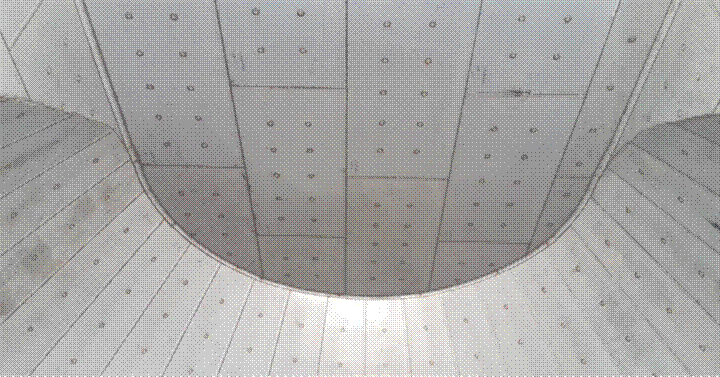
An FGD absorber is often priced as a tower shell with a lining and a spray layer. That shorthand hides the conditions that determine whether the equipment remains reliable: high-sulfur gas, temperature swings, corrosive and abrasive slurry, washing cycles, and liquid distribution across the gas path. A lining material that looks suitable on a datasheet can still fail if weld details, interfaces, or spray circulation are not matched to the actual duty. The specification stage should therefore tie together corrosion protection, gas-liquid contact, and the information a dependable quotation requires.
What Operating Conditions Cause Traditional FRP or Rubber Lining to Fail in an FGD Absorber?
Flue Gas Flow, SO2 Load, and Temperature
At the inlet of a flue gas desulfurization system, SO2 concentration and gas temperature are at their highest. Both drop as the gas climbs the tower and meets recirculated slurry, so a single absorber can run a hot, dry inlet, a saturated middle, and a cool, wet outlet at the same time. That gradient, rather than the average condition, decides how the lining behaves.
Flow rate adds a second variable. Higher gas velocity carries more droplets onto the tower wall and further up the shell, which enlarges the wetted area and sharpens the boundary where the spray no longer reaches. Conditions that look mild in a lightly loaded SO2 scrubber can become the failure driver in a unit that runs at high sulfur load for most of the year.
Slurry Chemistry, Chloride, and Solids
The liquid side of the duty matters as much as the gas side. Reagent chemistry, pH excursions, oxidation air, and the chloride that accumulates in closed-loop water all work on the same surface. Chloride is the most common reason a lining that performed well in one plant fails in another. A change in make-up water quality or blowdown practice is often enough to push the steel into a pitting regime.
Solids put a mechanical load on the same surface. Gypsum crystals and unreacted limestone grind against the plate, and the same slurry film that keeps a surface wet drags particles into crevices and around weld toes. Solids settle in dead corners or beneath internal supports, where abrasion and aggressive chemistry collect in the places an inspector can reach least easily.
Wet-Dry Cycling, Corrosion, and Delamination
The inlet sees the worst wet-dry cycling. Hot, dry gas meets the first spray curtain, and the surface behind it can swing between acid condensation and full washing within a short distance or a modest load change. Rubber and FRP linings handle a steady environment far better than a cycling one, which is why the inlet zone usually shows the first damage.
Both materials also depend on a continuous bond to the steel shell. When thermal cycling, blistering, or a crack breaks that bond, corrosion works behind the lining, out of sight. By the time the damage shows from inside the tower, the repair area is usually far bigger than the defect that started it.
Lifecycle Cost and Maintenance Access
Service life is usually what settles the comparison. Take a power plant running the limestone-gypsum wet desulfurization process. The tower shell is carbon steel, which is not corrosion-resistant by itself, so the usual answer is a rubber lining bonded to the steel. In wet service that rubber breaks down in about two years. The repair is not a patch: the tower stops for maintenance, the old lining is stripped, and the surface is relined, a job that takes one or two months.
Compare the two over plant life rather than purchase price. Alloy lining removes a recurring outage and the chance that the repaired area fails again before the next planned stop.
How Should Alloy Lining Materials Be Matched to the Absorber?
When to Use 1.4529 Alloy Lining
1.4529 is a super-austenitic stainless steel, alloyed with molybdenum and nitrogen. That chemistry puts its resistance to chloride pitting and crevice corrosion well above the 316L and 904L grades used in milder chemical service. It arrives as plate and is welded to the shell, which suits long, continuous runs of tower wall where the slurry film stays stable and chloride holds inside a defined range.
When to Use Hastelloy C-276
C-276 is a nickel-molybdenum-chromium alloy. It belongs in the zones where the duty is worst: the gas inlet, the band where wet and dry service alternate, areas under deposits, and any location that sees high chloride at low pH. There, the super-austenitic grades leave too little margin against pitting and crevice attack.
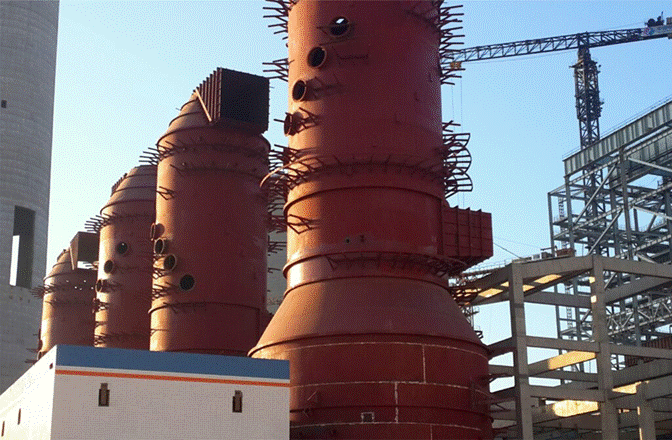
Lining an entire tower in C-276 is rarely the most economical answer. The usual approach matches material to zone: 1.4529 for the large wall areas, C-276 for the inlet and the transitions, and the same material family for the matching pipe, flanges, electrodes, and weld wire so the joints do not become the weak point. That combination replaced an FRP and rubber system on absorption towers serving 700 MW units at the Shandong Xinfa project.
Compatibility Between Lining, Welds, and Internal Fittings
A lining in a desulfurization tower is a system rather than a sheet of metal. Nozzles, manholes, stiffener rings, pipe penetrations, demister supports, and the brackets that hold internal parts all interrupt it, and every interruption is a path by which the corrosive environment reaches bare steel.
Compatibility runs in two directions. Internal fittings face the same duty as the lining, and the connection between the two has to avoid a galvanic couple. Put carbon steel bolts, brackets, or support rings in the wetted zone and they corrode first, which is how a demister or a spray header ends up at the bottom of the tower. Naming fittings, fasteners, and weld consumables in the same material family as the lining closes that risk before fabrication starts.
How Should Overlap (Lap) Welding and Plug Welding Be Specified?
Joint Design and Weld Type Selection
Two joint types carry most of the work in an alloy-lined tower. Plug welds pin the lining plate to the shell so it cannot bulge or vibrate. Overlap (lap) welds join neighboring plates and close the surface against the slurry. One is the barrier, the other is the anchorage, and the two are specified for different purposes.
Welding Procedure and Distortion Control
A qualified welding procedure sets the baseline. The consumables matter just as much. Electrodes and weld wire are matched to the plate alloy, not to a generic stainless grade, so a lined tower is usually quoted with plates, electrodes, and wire in one material scope.
Distortion control is what keeps the lining tight against the shell. Heavy heat input, one long uninterrupted weld run, or a sloppy fit-up gap can pull a plate off the shell and leave a gap that later fills with slurry. Welding sequence, interpass temperature, and tack placement belong in the procedure and in the shop check, not in a site correction.
Weld Inspection, Leak Testing, and Repair Scope
Inspection should aim at the seal rather than at the volume of weld metal. Visual examination and dye-penetrant checks on seal welds find surface defects. A vacuum box or an equivalent leak test on lap joints shows whether the joint actually closes the surface to liquid.
Testing only helps when the acceptance criteria and the repair path are agreed before fabrication. A quotation for an SO2 scrubber that lists materials and nozzle counts but not the inspection method, the repair procedure, or the re-test requirement cannot be compared with another offer on technical grounds.
How Should the FGD Spray System Be Designed and Selected?
Spray Manifold and Nozzle Layout
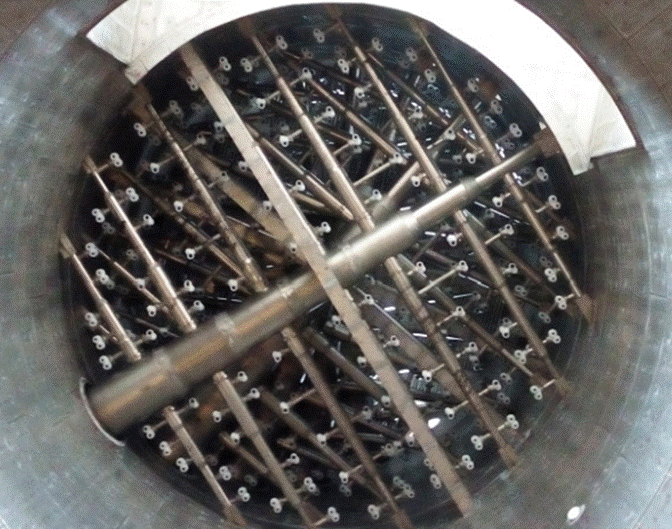
A spray header is more than a pipe carrying nozzles. Each header consists of a manifold and dozens of branches that carry slurry from the circulating pump to the nozzles. The geometry of that manifold and those branches sets both the pressure lost along the run and how evenly the flow is shared among the nozzles at the far end. Optimizing the manifold and branch design reduces pressure loss and keeps the layout compact, so each nozzle sees uniform flow and pressure.
Layout also has to work across the whole cross-section. Spray cones should overlap enough to keep the gas path wet without spending pump head on areas already covered. The number of spray levels should follow the SO2 removal duty rather than a fixed template.
The NHD Desulfurization Regeneration Tower Sprayer uses a manifold-and-branch arrangement designed to keep flow and pressure uniform at every nozzle.
Pump Flow, Pressure, and Spray Coverage
Droplet size and nozzle reach follow circulating pump flow and header pressure, and both move as soon as one pump comes out of service. A system that meets its coverage target only with every pump running will form dry bands during routine maintenance, so the reduced-pump case deserves the same attention as the full-flow case.
Coverage is not only a removal-efficiency question; it is also a statement about the lining. Wetted surface stays in a lower-corrosion regime, while a dry band above the spray zone is exposed to alternating wetting and drying, washing, and corrosion, which is the combination that shortens lining life.
Blockage Control and Maintenance Access
Solids, scale, and debris settle where velocity drops, and one half-blocked nozzle distorts the pattern of every nozzle beside it. Strainers, flushing connections, and removable branches reduce how often blockage happens, but the layout still has to assume someone will climb in to reach the header.
What Should a Technical Confirmation and RFQ Package Include?
Gas-Side Design Basis
The gas side sets the corrosion load. Flow, inlet and outlet temperature, SO2 concentration, dust, moisture, oxygen, and chloride carried in the gas belong in the design basis, together with the load profile.
Slurry-Side Design Basis
The slurry side fixes the chemistry the lining must survive: reagent, pH range, chloride concentration, suspended solids, and the oxidation and blowdown practice that decide how aggressive the liquid turns over time. If the chloride limit is left open, the lining material cannot be matched to it and the supplier has to price the worst case.
Mechanical Scope and QA Requirements
Mechanical scope defines what is actually supplied. Tower diameter and height, plate thickness and lining extent, the material of internal fittings, welding and testing standards, documentation, and the split between shop fabrication and site construction all move the price. Leaving any of them open makes two offers impossible to compare.
NHD Product and Project References
NHD’s project team scope covers the alloy lining inside the desulfurization absorption tower of a power plant in Shandong Province with six 700 MW units: all C276 alloy plates, 1.4529 alloy plates, alloy pipes, flanges, electrodes, and weld wires, together with site construction.
The performance guarantee requires that the lining withstand alternating cooling and heating, wetting and drying, washing, and corrosion without damage, deformation, or failure to its intended design purpose. Plates in 904L, 316L, 2507, 2205, and 254SMo grades are also held in stock, which keeps material procurement predictable on a lining package.
Two product families cover most of this scope: the NHD Desulfurization Equipment Series for absorber and regeneration tower duty, and the NHD Non-Standard Equipment Series for tower internals and project-specific fabrication that no catalog item describes.
The desulfurization range includes the regeneration tower sprayer, the chevron vane demister, the rotary brush scrubber, and the gas scrubbing system.
Conclusion
An FGD absorber should be specified as an integrated corrosion and gas-liquid-contact system. Gas and slurry conditions determine whether FRP or rubber is adequate or whether 1.4529 or C-276 alloy lining should be considered; weld and inspection requirements protect the lining; and the manifold, branches, and nozzles determine whether circulating slurry reaches the tower uniformly.
The Shandong Xinfa FGD Project and NHD Desulfurization Regeneration Tower Sprayer provide reference points for projects reviewing alloy materials, spray distribution, and site execution.
A project team can use these conditions to compare quotations on duty fit, material continuity, welding scope, and long-term maintainability.
For a duty review, alloy lining recommendation, or RFQ support on an FGD absorber project, contact NHD at sales@chinanhd.com or WhatsApp +86 136 6732 4277.
FAQs
Q1: Which operating conditions most affect FGD absorber lining selection?
A1: Gas temperature and SO2 load set the corrosion load at the inlet, while chloride concentration, pH range, and suspended solids in the slurry decide which material family can survive it. Wet-dry cycling is the condition that most often rules out FRP and rubber, because it attacks the bond to the shell rather than the lining surface.
Q2: What should an FGD spray system RFQ specify?
A2: For a flue gas desulfurization system, give the circulating slurry flow and chloride level, the number of spray levels and the required coverage, the nozzle type and material, the pump arrangement including the reduced-pump case, and the access needed to reach and clean the headers.
Q3: Are overlap welding and plug welding required for every alloy-lined absorber?
A3: Not in the same form everywhere. Plug welds anchor the plate to the shell, and lap welds close the surface, but the joint, its spacing, and the inspection method follow the stress and corrosion duty of each zone.