

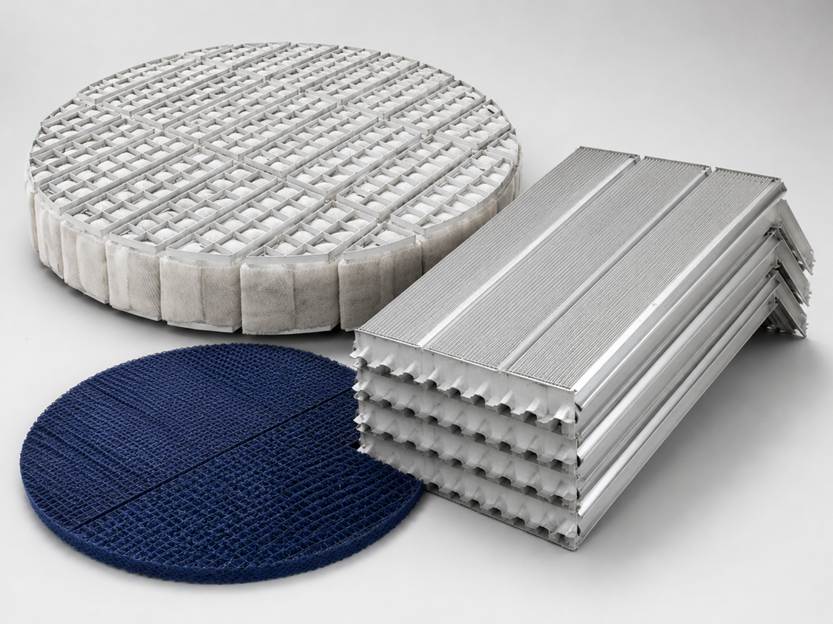
Persistent mist or acid carryover after an industrial demister doesn’t always mean one component has failed. In sulfuric acid, phosphoric acid, and chemical gas-washing duties, changes in droplet size, gas load, flow distribution, wash-water condition, drainage, or solids loading can move a once-stable separator beyond its effective operating range. Simply replacing the unit can leave that root cause unresolved. The question that matters: does the existing structure still match the droplets, gas conditions, and washing duty it now sees?
Common Causes of Persistent Carryover After a Demister
Droplet Size and Gas Load Determine the Separation Duty
A demister separates liquid only when its internal structure is suited to the droplets and gas volume reaching it. A change in upstream reaction conditions, liquid distribution, temperature, or gas throughput can alter the droplet population without changing the vessel itself. A structure sized for larger droplets doesn’t automatically handle a shift toward finer ones — the separation duty gets harder even though nothing on the vessel has changed.
Uneven Flow and Excess Velocity Can Increase Carry over
Gas does not always cross the separator at one even velocity. A duct connection, inlet path, distributor, or internal obstruction can each narrow the available flow area at one point — and the gas simply takes the path of least resistance, overloading part of the separator while leaving the rest underused. In a high-velocity path, droplets have less opportunity to be captured and drained before leaving the vessel. The distribution of gas through the installed separator is as important as the total flow figure.
Liquid Drainage and Re-entrainment Must Be Considered Together
Separation does not end when droplets first meet a surface. Collected liquid must move through the structure, reach the drainage path, and leave without being swept back into the gas stream. A poor collection path, an unsuitable slope, restricted drainage, or an intermittent wash condition can leave liquid exposed to the moving gas. That liquid can break up and return as smaller droplets, creating re-entrainment downstream of the original capture point. Drainage and wash-water conditions therefore need to be assessed alongside the separating element.
Which Operating Conditions Should Be Reviewed First?
Whether Gas Load, Pressure Drop, or Process Conditions Have Changed
The useful comparison is between the duty for which the separator was selected and the duty it sees today. Production rate, gas path, temperature, and pressure all shift over a plant’s life — and any one of them can change the actual gas volume and velocity the separator has to handle.
Process changes can also change the source and character of droplets before they enter the vessel. Reviewing those changes first helps distinguish a process shift from an equipment limitation. This prevents every carryover event from being treated as a simple end-of-life failure.
Whether Dust Loading and Wash-Water Coverage Still Match Current Duty
Dust, soluble solids, and liquid deposits can change how gas passes through the separator and how easily captured liquid drains. When a gas stream carries solids, the choice of structure must also allow for the washing and cleaning conditions available in the vessel. Wash-water coverage should reach the areas where deposits form, and the resulting liquid and solids need a clear route away from the active surface. If the washing pattern or drainage arrangement no longer matches the present solids burden, replacing one element with the same design may reproduce the same problem.
Whether the Existing Unit Still Matches the Required Separation Duty
Fit isn’t a single number — it’s whether droplet duty, gas capacity, pressure-drop allowance, solids burden, washing method, and maintenance access all line up at once. A plant may need a repair to the existing internals, a revised drainage or wash arrangement, or a different gas-liquid separation structure. The label mist eliminator alone does not define that fit.
How Can a Plant Team Identify the Source of Persistent Carryover?
Separate Process Changes From an Equipment-Structure Mismatch
The timing of the symptom often provides the first useful distinction. Timing is the first clue: carryover that shows up right after a load change, a shift in upstream liquid distribution, or a maintenance event usually means the process moved first — and the separator simply hasn’t caught up. If the process basis has remained stable, attention can turn to the condition of the internal structure, flow path, supports, drainage, and wash arrangement. An equipment issue and a process change can also exist together.
Review Gas Flow, Droplet Behavior, Washing, and Drainage as One Duty
Gas flow, droplets, washing, and drainage are linked conditions, not separate checkboxes. The three factors feed each other: higher local velocity makes drainage harder, poor drainage lets deposits build up, and those deposits shrink the open area — which pushes velocity even higher. Looking at these conditions together shows whether carryover is caused by a single local restriction or by a broader mismatch between the gas stream and the separator.
Use the Required Separation Result to Define Retrofit or Replacement Scope
A retrofit scope is clearer when it starts with the separation result required at the outlet and works back through the gas-liquid duty. The relevant decision may involve only an element arrangement, or it may require changes to liquid distribution, wash coverage, drainage, supports, or access for cleaning. The current duty determines whether a different structure is justified.
| Operating Condition | What to Review | Decision to Clarify |
| Mist persists after a process-load change | Actual gas load, gas velocity, pressure drop, and the droplet duty now reaching the separator | Whether the installed structure still matches the required separation duty |
| Visible carryover or liquid build-up | Flow distribution, liquid collection paths, drainage, and conditions that can lead to re-entrainment | Whether internal arrangement or drainage needs adjustment |
| Dust-loaded gas with regular washing demand | Solids burden, wash-water coverage, and accessible cleaning paths | Whether a wash-tolerant vane or gas-scrubbing arrangement is more suitable |
| Fine mist duty with a tight pressure-drop limit | Mist characteristics, target pressure loss, and gas-cleaning duty | Whether a mesh or structured gas-scrubbing solution best fits the duty |
When Is a Wire Mesh Demister a Suitable Solution?
Duty Fit: Fine-Droplet Separation with a Low-Pressure-Drop Mesh Structure
A wire mesh demister is a practical choice where fine droplets must be coalesced and removed without imposing an unnecessarily high pressure loss. Its fit depends on the droplets arriving at the separator, the gas load, and the way collected liquid can drain from the mesh. It is not a default answer for every mist duty. In a gas stream with a heavy solids burden or a demanding washing requirement, the same mesh arrangement may not provide the most suitable operating margin. The duty should be defined before selecting mesh density, layer arrangement, or support form.
Configuration: Standard, Drawer, or Wave, Depending on Maintenance and Drainage Access
Configuration affects how the unit can be maintained and how it behaves during changing load conditions. NHD’s product range includes standard, drawer, and V-type wire mesh arrangements. A drawer configuration can be relevant where removal without entering the tower improves maintenance access. A V-type arrangement is intended to help collected liquid converge and reduce the chance of liquid being carried back into the gas stream. These features should be matched to the available access, drainage direction, and operating range instead of being treated as interchangeable options.
Material: Matched to the Process Environment
Material selection should follow the chemical environment, temperature, liquid composition, and cleaning conditions in the vessel. The mesh, support components, and any removal arrangement must remain suitable for the service environment throughout cleaning and normal operation. Material choice is therefore part of the separation decision, not a later purchasing detail. A suitable configuration can still perform poorly if corrosion, deposits, or cleaning conditions change the surface and open area that the gas was expected to pass through.
NHD Wire Mesh Demister for Acid Mist Separation
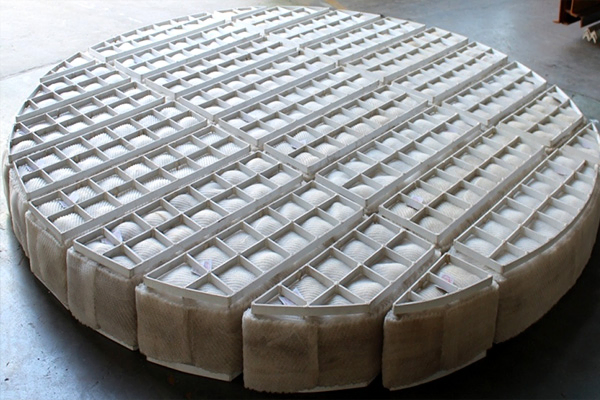
NHD’s Wire Mesh Demister range reflects three generations of development, built on NHD’s Enterprise Standard as a designated manufacturer for the Chemical Ministry, Nonferrous General Company, and Petrochemical Industry.
- Standard type — small volume, light weight, low pressure loss.
- Drawer type (Patent No. ZL93.2.46402.5) — lifts out without entering the tower; easier cleaning, longer service life, shorter repair time; a blind plate can be fitted for reduced-load operation.
- V-type (Patent No. ZL97.2.36744.6) — limits re-entrainment, increases filtering area by 15%, and performs at the level of a two-layer standard demister.
When Should a Chevron Vane Demister or BlueFil System Be Considered?
NHD Chevron Vane Demister for Larger Droplets and Dust-Loaded Gas

The NHD Chevron Vane Demister is suited to duties where larger droplets, higher gas capacity, regular washing, or dust loading shape the decision. Its wave channels repeatedly change the direction of the gas so liquid droplets can be driven toward the vane surfaces by inertia and gravity. The design combines a single tubular stage with a multi-stage wave section, using a flow-optimized blade profile to keep pressure drop low while eliminating dead zones that washing can’t reach. Collected liquid drains to the washing tank, while deposits on the vanes can be addressed through the washing arrangement.
NHD BlueFil Gas Scrubbing System for Fine-Droplet Collection in Gas-Scrubbing Duties

The NHD BlueFil Gas Scrubbing System is intended for gas-cleaning duties where liquid droplets or soluble solids must be removed within a process or before gas emission. BlueFil uses a structured mesh made from interlocked plastic monofilaments, with multiple mesh grades available for a layered arrangement. It is applied in sulfuric acid gas-cleaning duties, fertilizer operations, phosphoric acid scrubbing, and other chemical gas-washing services. This system is appropriate when the full duty calls for more than a straightforward vane or mesh replacement.
Matching the Structure to Droplet Characteristics Instead of Treating All Demisters as Equal
A wire mesh structure, a chevron vane demister, and a structured gas-scrubbing arrangement solve different parts of the gas-liquid separation problem. The duty defined earlier — droplet size, gas capacity, solids burden, and drainage — determines which one is appropriate. The same vessel can also need a change to its flow path or liquid distribution before a new internal structure can perform as intended. Treating every carryover event as a simple demister replacement overlooks the conditions that made the original arrangement unsuitable.
Conclusion
Persistent mist carryover should not be treated as an isolated demister problem. A wire mesh demister, chevron vane demister, or BlueFil gas scrubbing system has a different role when those conditions change. NHD can discuss existing gas conditions, separation duty, equipment layout, and cleaning or drainage requirements through Email: sales@chinanhd.com / WhatsApp: +86 136 6732 4277 for a more specific gas-liquid separation arrangement.
FAQs
Q1: Why can mist persist after a demister has been installed?
A1: A demister may remain physically intact while the gas load, droplet characteristics, flow distribution, washing condition, drainage path, or solids burden has changed. Persistent carryover often indicates that the present duty no longer matches the installed separation arrangement.
Q2: When does a Wire Mesh Demister fit the separation duty?
A2: A mesh unit fits fine-droplet duties where it can coalesce and drain liquid within the available pressure-drop limit. Gas load, drainage, solids loading, wash conditions, material compatibility, and maintenance access still need to match the specific service.
Q3: What should a plant team check before replacement?
A3: The review should cover current gas load, pressure drop, droplet behavior, internal flow paths, solids burden, wash-water coverage, drainage, and the required outlet separation result. These conditions define whether the right action is a repair, a retrofit, or a different separation structure.